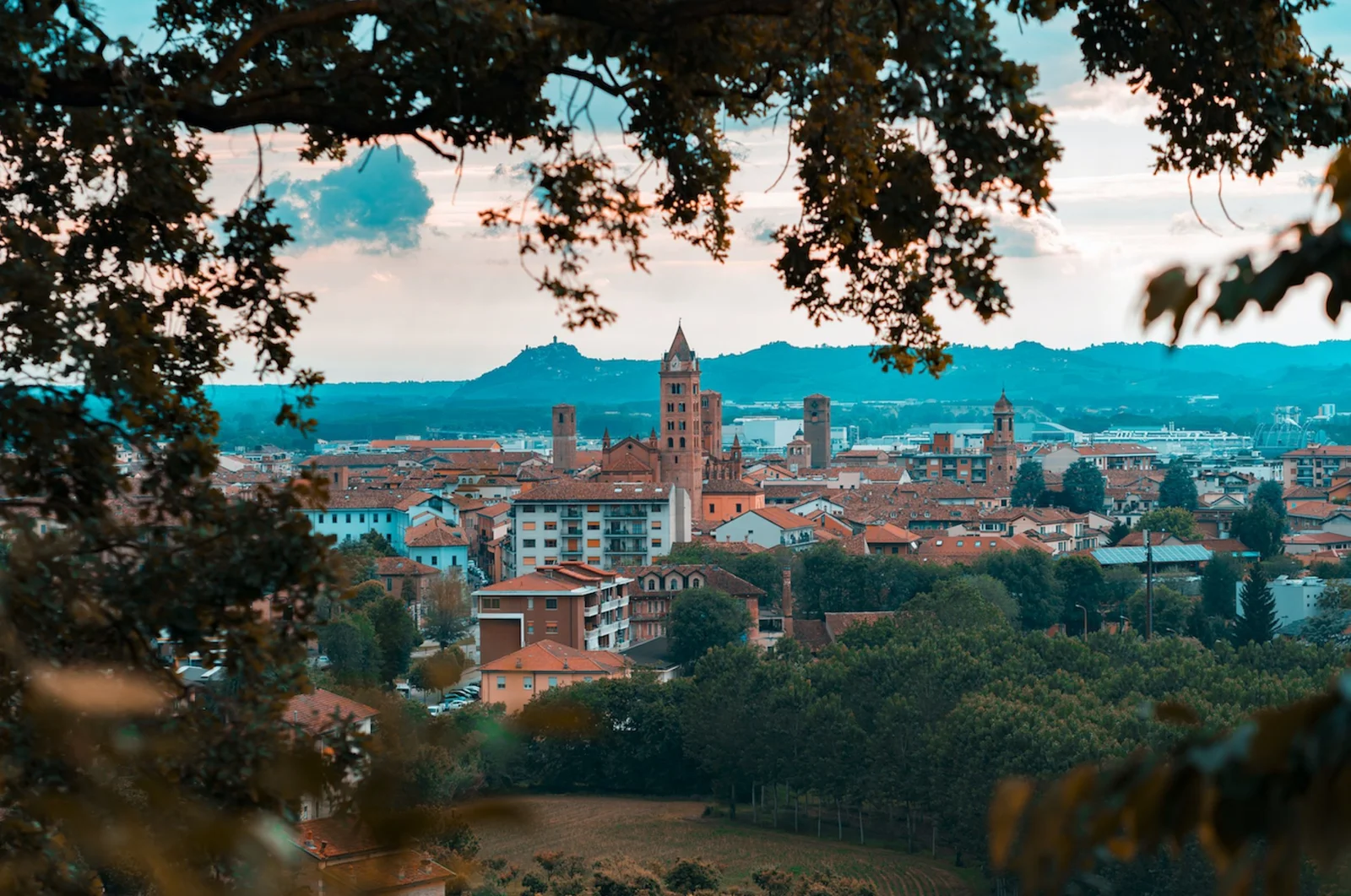
Quick answer: Alba’s residential geography was shaped by a transport decision. The confectionery manufacturer that dominates the town built a shuttle network to bring workers in from the surrounding valleys and take them home again, so the workforce never had to move to the factory. Which villages that network serves is still visible in where people live.
Industrial towns usually grow by pulling people out of the countryside. Alba did the opposite, deliberately, and the consequence is a district where the population stayed distributed across dozens of small villages instead of concentrating in one place. For anyone buying property in the Langhe, that history explains a pattern that is otherwise puzzling.
The transport decision and what it did
The manufacturer that grew up in Alba needed a workforce from a rural district of smallholdings, and it solved the problem by moving the workers rather than by asking them to move house. A shuttle network collected people in the morning and returned them in the evening, which meant a family could keep the farm and take the factory wage at the same time.
That arrangement is still in place for the Alba plant. Its effect on settlement is durable and it is measurable in the housing market rather than in any official document.
- A village on a route is within practical reach of factory employment without a car
- A village off the route depends on private transport, which changes who can afford to live there
- Because the network long predates modern commuting, the pattern is embedded in where families already are
- Demand in the served villages is resident and year round, not seasonal
For a buyer this is the local knowledge that portals cannot supply. Two villages 8 km apart, similar in appearance and price, can have quite different resident demand depending on whether the shuttle reaches them.
The seasonal campaign
Production is not level across the year. The Alba plant takes on in the region of 1,400 seasonal workers for the campaign, typically on contracts of around three months that may be renewed once or twice.
That is a large, recurring, time-limited accommodation requirement in a district whose rental stock is thin, and it produces a distinctive letting sub-market.
| Feature | Position |
|---|---|
| Volume | Around 1,400 seasonal posts |
| Typical contract | About three months, renewable once or twice |
| Timing | Set by the production calendar, not the market |
| Tenant profile | Price sensitive, short stay, often sharing |
| Competing supply | Limited; the district’s stock is small |
Whether that is an opportunity depends entirely on the owner. It suits a landlord prepared to run a genuinely seasonal product with shared occupancy and a defined vacancy period. It suits nobody who wants a single annual tenant and a quiet life, and a flat furnished and specified for a second-home buyer is the wrong product for it.
The other economy in the same villages
The Langhe are also a wine district and an internationally known landscape, and that economy competes for exactly the same housing.
Village houses restored as second homes or operated as short lets earn more per square metre than they do let to a worker, which pushes stock out of the residential market. The result is the pattern familiar from every attractive rural district in Europe: rising village prices, thinning local rental supply, and a widening gap between what a house costs and what a local wage supports.
- Second-home and short-let demand competes directly with worker housing
- The competition is strongest in the picturesque villages and weakest in the plainer ones
- A buyer’s choice of village is therefore also a choice of which market they are in
- Prices in the wine villages have been set by external buyers for some time
What this means for a purchase decision
Be clear which of three propositions you are buying, because they need different properties.
A residential letting asset. Buy in or near the town, or in a well-served village, with a specification aimed at a household. Returns are moderate, occupancy is high, and demand comes from the industrial and service economy rather than from visitors.
A seasonal letting asset. Buy something that can be let by the room, close to transport, furnished simply and durably. Accept a defined vacancy period and price accordingly.
A second home in a wine landscape. Buy the village house you actually want. Treat any letting income as incidental, because a property chosen for its view and its terrace is rarely the property either of the first two markets wants.
Mixing them is the common error. A restored farmhouse 12 km from the town on a hillside with no bus is a lovely house and it is not a letting business, whatever the vendor’s projections say. Each of the three needs its own arithmetic, built the way the rental yield guide describes.
What the town itself offers
Alba is a town of moderate size with an unusual amount of economic activity for its scale: a global manufacturer, a wine trade with international reach, an autumn truffle season that fills every bed in the district, and the service economy that follows all three.
Its residential market reflects that. Town apartments let readily to households working locally, prices are well below the levels the surrounding wine villages have reached, and the stock is a mixture of historic centre buildings and post-war expansion with the usual characteristics of each.
For an investor the town is the sensible default and the villages are the speculation. A town flat has a broad tenant base, low management burden and reliable occupancy. A village house has a narrower market, a higher price and a return that depends on visitors.
- Town stock: broader tenant base, easier management, lower entry price
- Village stock: higher price, narrower market, visitor dependent
- The autumn season fills the district but is measured in weeks, not months
- Winter demand in the villages is close to absent
The seasonal calendar in practice
The district has three distinct periods and a buyer letting property should model them separately rather than assuming an annual average.
The autumn is the peak. The truffle fair, first held in 1929, and the season around it run from October into early December, drawing national and international visitors; accommodation across the district is scarce and rates reflect it.
The spring and summer, from May to September, carry a steady wine tourism flow at lower rates and with longer stays, spread across the villages rather than concentrated in the town.
January through March is quiet everywhere except in the town, where ordinary residential life continues because the economy does. That contrast is the clearest single argument for buying in the town if the objective is income rather than use.
Diligence in the Langhe
Work through the due diligence guide first. Three problems then recur across purchases in this district.
Agricultural land. Many village and rural properties come with land, and land brings agricultural pre-emption and its own tax treatment. Where the land carries registered vineyard, the position becomes considerably more involved; the Chianti page sets out how vineyard entitlements behave, and the same framework applies in Piedmont.
Rural buildings. Barns, drying sheds and outbuildings are frequently registered as agricultural rather than residential, and converting one is a planning question rather than a construction question. Establish what it is before pricing what it could be.
Access and services. Hill properties reached by unmade tracks have access, water and drainage questions that are ordinary in the district and expensive to solve; the renovation cost guide ranges assume neither.
What the wine landscape designation adds
The hills around Alba carry an internationally recognised cultural landscape designation, inscribed in 2014, covering the vineyard areas of Piedmont, and that designation has planning consequences for anyone proposing to build or to alter a building in the protected zones.
The practical effects are familiar from any protected landscape: visibility from the surrounding hills matters, materials and colours are constrained, new volume is difficult, and the process involves an additional consent. A buyer intending to add a pool, a terrace or an outbuilding to a hillside property should establish the position for the specific parcel before agreeing a price that assumes the work.
The compensating benefit is the same everywhere: the landscape that makes the district worth buying into is protected from the development that would degrade it. Buyers who want the view and also want to build freely in front of it are asking for incompatible things.
The plant and the town’s balance
An employer of this scale in a town of this size creates a dependency that is worth stating rather than glossing. Founded in Alba in 1946, the group has grown into one of the largest confectionery businesses in the world, with more than 47,000 employees globally, and the town remains its founding site and its largest Italian plant.
For the town that has meant sustained employment and sustained investment across decades, including in the welfare and transport arrangements that this page began with. It has also meant a local economy whose largest single input is decided by a private company, and buyers should hold both facts at once rather than treating either as the whole picture.
Reading a Langhe village before buying in it
The villages differ far more than their appearance suggests, and four questions separate them.
Does it have year-round services, meaning a shop, a bar and a school run. A village that closes in November is a holiday location whatever the estate agent says.
Is it on a shuttle route or a practical bus route, which decides whether working households can live there.
How much of its housing is already second homes, since a village past a certain threshold has no resident market left and its property trades entirely on visitor appeal.
What is the road like in winter. Hill roads in the Langhe are narrow and exposed, and access in January is not what it is in September.
The truffle season and what it hides
The autumn event that fills the district is a genuine economic phenomenon and it distorts the picture a visiting buyer forms.
Anyone who first sees Alba in October sees a town at capacity: every restaurant full, accommodation scarce, rates high, and an atmosphere that suggests a market with continuous demand. The same streets in February are quiet, and the villages quieter still.
That gap matters because purchase decisions are frequently made in the autumn, on impressions formed at the peak. The correction is simple and few buyers make it: visit in winter, ask an agent for occupancy across a full year rather than for peak rates, and build any letting model on twelve months rather than on the weeks that made the impression.
Position and connections
Alba sits about 60 km south-east of Turin, roughly 90 min by road, and within 3 hours of Milan. That places it inside weekend range of two large northern cities and inside a comfortable transfer from their airports, which is what has allowed a district of small villages to develop an international second-home market at all.
The rail connection is slower than the road and the practical assumption for most visitors is a car, which makes parking a real attribute for any property intended for letting. In the villages that is usually straightforward; in the town centre it is not, and a flat without a space is materially harder to let to visitors than one with.
- About 60 km from Turin, roughly 90 min by road
- Within 3 hours of Milan and its airports
- A car is the practical assumption for visitors
- Parking is an attribute worth paying for on any letting property
Where this sits in Piedmont
The Piedmont guide covers the region, and the Langhe page treats the wider wine district of which Alba is the commercial centre. Turin is the regional capital and a completely different proposition, with the choice between it and Milan set out in the Turin and Milan comparison.
What distinguishes Alba from the other famous wine districts of Italy is that it has a large industrial employer with a genuine international business behind it, and that the employer organised the district’s daily movement long before anyone was buying second homes here. Read the routes and you are reading the residential market.
Frequently Asked Questions
Ferrero built a shuttle network that collects workers from the surrounding valleys in the morning and returns them in the evening, an arrangement designed so that people could take factory work without leaving their farms. It still runs for the Alba plant, and it is the reason the district's population did not concentrate in the town the way industrial employment usually forces.
It spreads it. A village on a shuttle route is a viable place to live for a household with a factory job in Alba; an otherwise identical village off the route is not, unless the household runs a car for the commute. That distinction does more to explain differences in demand between Langhe villages than any measure of charm.
Substantial and concentrated. The Alba plant takes on in the region of 1,400 seasonal workers for the production campaign, typically on contracts of about three months that may be renewed once or twice. That is a recurring accommodation requirement with a defined start and end, in a district with limited rental stock.
It is a real demand source and it is not an easy one. The stays are short, the tenants are price sensitive, and the demand appears and disappears on a schedule set by the plant rather than by the market. It works for a landlord willing to operate a genuinely seasonal product and is a poor fit for anyone wanting an annual tenant.
For some of it. The Langhe's wine and tourism economy has pushed village property toward second-home and short-let use, which competes directly with the housing that industrial and seasonal workers need. That tension is visible in prices and it is the central dynamic of the district's residential market.
They can be, provided the buyer is honest about which market they are entering. A restored village house for weekend and holiday use is a lifestyle purchase in a beautiful and internationally recognised landscape. The same house as a letting asset depends on which of the two demand sources it can actually serve.
Concentration, as anywhere. The counterweight here is that the wine economy and the tourism economy are genuinely independent of the manufacturer, so the district has more than one leg. That makes it more robust than a single-industry town, though the manufacturer remains the largest single influence on ordinary housing demand.
It is a working district with a wine landscape rather than a wine landscape with a working district attached. Prices are lower, foreign buyer depth is thinner, and the local economy is stronger. Buyers whose comparison is a Tuscan hill estate should read the Chianti page for how differently a vineyard purchase behaves.
Get an Italy property shortlist
Tell us your budget and region (Tuscany, Lake Como, Puglia, Milan, Sardinia). We reply within one business day with options matched to your goals.