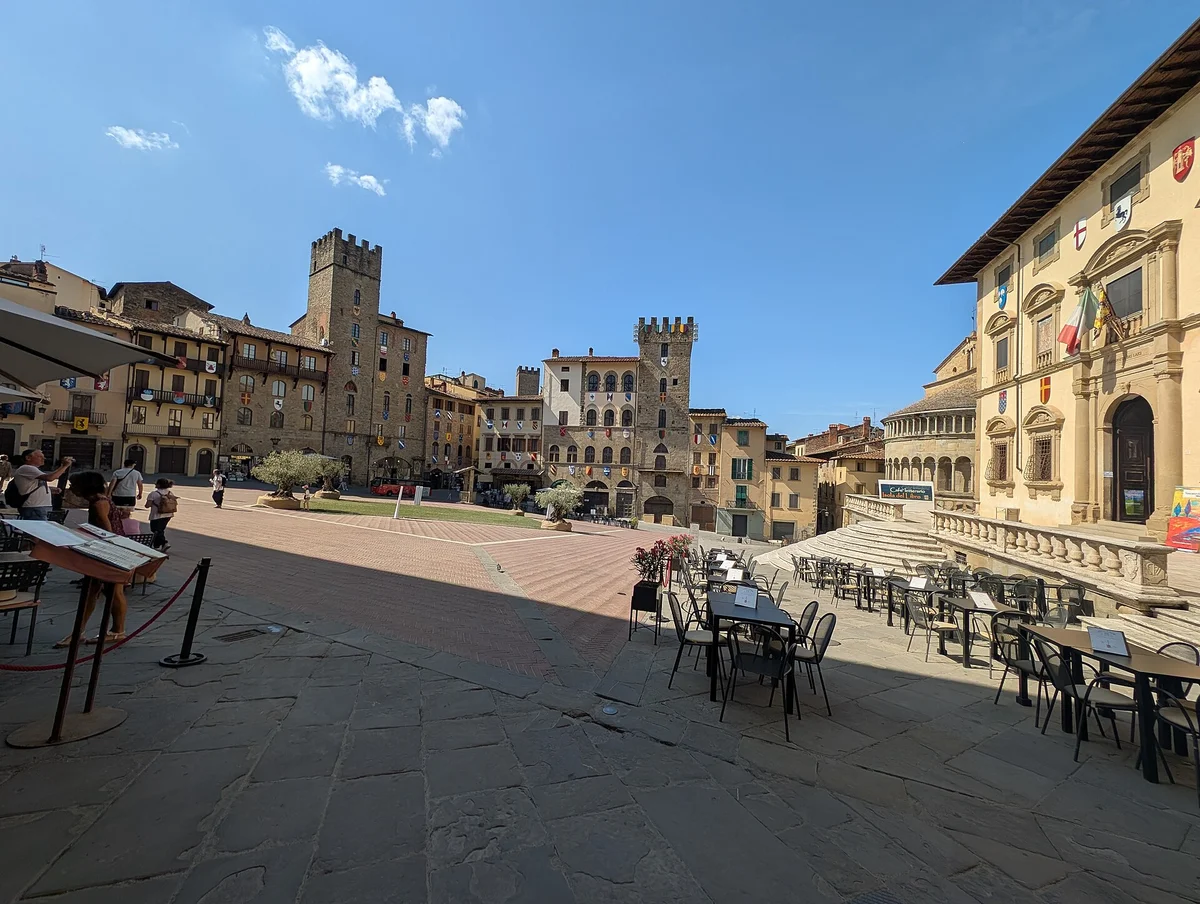
Quick answer: Arezzo runs on two calendars that most Italian towns do not have. A monthly antiques fair, in place since 1968, fills the centre on the first weekend of every month. A goldsmithing district of roughly 1,200 companies fills the city with a manufacturing workforce the rest of the time. Both are letting markets, and they want different properties.
Tuscan property is usually sold on a summer. Arrive in July, let in July and August, hold a beautiful asset that earns for eight weeks. Arezzo does not work that way, and the reason is a municipal decision taken in 1968 that turned out to have durable commercial consequences.
The fair and what it does to a year
The Fiera Antiquaria was founded on 2 June 1968 and it has run on the same rhythm since: the first Sunday of every month and the Saturday preceding it, across the historic centre. It is the oldest event of its kind in Italy and the largest, drawing dealers and buyers from across the country.
The effect on accommodation demand is unlike a seasonal market in four specific ways.
| Feature | Seasonal Tuscan market | Arezzo’s monthly cycle |
|---|---|---|
| Peaks per year | One, in summer | Twelve, one a month |
| Typical stay | A week or more | One or two nights |
| Guest purpose | Leisure | Commercial |
| Booking behaviour | Once | Repeatedly, same guests |
| Winter demand | Minimal | Present, at the same rhythm |
That last row is the commercially interesting one. A holiday property in inland Tuscany earns nothing between November and March. A centre property in Arezzo has a demand event in January, February and March, at rates that reflect scarcity on those specific nights.
How this changes the operating model
Serving a monthly cycle is a different business from serving a season, and the differences are operational rather than strategic.
- Minimum stay policy has to accommodate one and two night bookings, which most holiday-let templates refuse
- Cleaning and turnover happen twelve times or more a year at concentrated moments, not once a week through a season
- Pricing should be event-driven, with the fair weekend priced separately from the rest of the month, rather than by a seasonal curve
- Cash flow arrives in twelve small tranches rather than one block, which suits an owner paying a mortgage monthly
- Listing copy should address a dealer rather than a holidaymaker, which means parking, ground-floor access, early check-in and somewhere to put stock
Point five is worth expanding. A guest arriving to trade at a fair values a set of things a tourist does not: a place to park a loaded vehicle, a route from the vehicle to the flat that does not involve four flights of stairs, and the ability to arrive on Friday evening rather than at three on Saturday afternoon. Those attributes are cheap to identify when buying and impossible to add afterwards.
The national registration and reporting framework applies here as everywhere and is set out in the short-let rules. Nothing about the monthly cycle changes the compliance position; it changes the revenue shape.
The other calendar: what the city actually does
Underneath the visitor economy is a manufacturing one. Arezzo is one of Europe’s principal goldsmithing centres, with roughly 1,200 companies and more than 8,000 employees in the sector, alongside fashion, leather and agri-food activity.
That workforce is the city’s residential demand base, and it behaves in the ordinary way: annual leases, families, proximity to work and to schools, price sensitivity. It is invisible in the property material written for foreign buyers, which concentrates on the centre and the countryside, and it is the reason the town has a functioning year-round market at all.
For an investor the practical consequence is a choice rather than a blend:
- Centre stock serves the fair, the visitor economy and short letting, at higher gross rates, higher management intensity and the constraints of a protected historic centre
- Peripheral and suburban stock serves the workforce on conventional leases, at lower gross yields, far lower management burden and much steadier occupancy
Buying centre stock and letting it on annual leases wastes the location. Buying suburban stock and marketing it to fair visitors wastes the effort. The rental yield guide sets out how to model either, and the arithmetic differs more than the headline percentages suggest once management time is priced.
Which flat serves the fair well?
The attributes that matter are unglamorous and they are visible at a viewing, provided you know to look.
Ground-floor or lift access matters more than floor area, because guests arrive with stock and leave with more of it. A garage or a reliable parking place within a few minutes’ walk is close to essential, and in a historic centre it is scarce enough to command its own premium. Proximity to the fair’s footprint is valuable up to the point where it becomes noise, which means a street one block back is often better than a window directly over the stalls.
Beyond that, the requirements are modest. Fair guests are not looking for a designed interior; they are looking for somewhere clean, warm in February, easy to reach at nine on a Friday evening, and available again next month. A flat specified to holiday standards costs more to furnish and earns very little extra from this market.
- Lift or ground floor, verified rather than described
- Transferable parking, in writing
- Heating that works and is cheap to run in winter
- Simple, durable furnishing with a signed inventory
- A check-in method that does not require the owner to be present
What is the risk in each calendar?
Both have one, and they are not correlated, which is the argument for understanding both.
The fair’s risk is institutional. It is a municipally managed event with a long history, and its scale, its location within the centre and its regulation are decisions made by the comune rather than by the market. A change in how or where it runs would affect the sub-market that depends on it, and an owner whose entire case rests on twelve weekends should know that the twelve weekends are a policy as well as a tradition.
The gold district’s risk is concentration. A local economy built on one commodity sector responds to metal prices, to export conditions and to currency movements, and reported export values in the trade have moved sharply between consecutive years. Employment in such a district is more cyclical than in a diversified city of the same size, and a landlord serving that workforce is exposed to it.
The mitigation for both is the same and it is unglamorous: buy stock that has more than one possible tenant. A two-bedroom flat near the centre with parking can serve fair guests, a professional household and a family. A studio configured only for weekend visitors can serve one market.
What the fair does to the rest of the town’s economy
Twelve trading weekends a year support a permanent trade around them: restorers, framers, transporters, valuers and dealers with premises rather than stalls. That is a small but durable commercial base, and it explains why the centre has ground-floor uses that a town of this size would not otherwise carry.
For a residential buyer the relevant effect is on the ground floor of the building they are considering. A workshop below a flat brings deliveries, occasional noise and sometimes solvent use, all of which are ordinary and all of which are better known before completion than after. It also brings a commercial neighbour with an interest in the building’s maintenance, which is not always the case in a residential block.
Diligence specific to this city
Nothing in the standard checklist becomes optional here. Read the due diligence guide and then add three questions that only this city raises.
Access on fair weekends. Streets are given over to stalls and vehicle access is restricted. A buyer should walk the route from the nearest parking to the front door on a fair Saturday, not on a quiet Tuesday, because that is the experience the guest will have.
The condominium’s position on short letting. Buildings in a centre that receives commercial visitors twelve times a year have often already had this argument, and the regulation may address it. Read it before assuming.
Noise and setup. Stalls are erected early and dismantled late. A flat directly over the fair’s footprint is superb for a dealer and difficult for a family, which is another reason to choose which market the property is for before buying it.
What else fills the calendar?
The fair is the metronome, and two further events give the year additional structure. The Giostra del Saracino, the city’s historic joust in Piazza Grande, revived in its modern form in 1931, runs twice a year, in June and again in early September, and it fills the centre in a way an ordinary summer weekend does not. Around those, the city carries the normal Tuscan visitor flow at a fraction of the intensity seen in Florence or Siena.
The practical use of that is calendar construction. An owner letting centre stock can map a year in advance with some confidence: twelve fair weekends, two joust weekends, a summer baseline and a Christmas period. Very few Italian short-let markets can be planned that far ahead, because most of them depend on weather and on discretionary travel rather than on scheduled events.
- Twelve fair weekends, fixed to the first Sunday of each month
- Two joust dates, in June and September
- A modest summer baseline through July and August
- Weekday business demand from the industrial districts, which is small but not zero
A model for a centre flat
A worked illustration, using a shape that recurs rather than a headline. A two-bedroom flat of 71 square metres in the centre with a lift and a garage place, bought at €183,000 all in, operated for the fair calendar and let short otherwise.
| Line | Amount |
|---|---|
| Fair weekends, 12 at 2 nights | €4,320 |
| Joust weekends and summer baseline | €5,900 |
| Cleaning and turnover across the year | €2,150 |
| Utilities, insurance, platform fees | €2,400 |
| Net before tax and IMU | €5,670 |
The figures are illustrative and the structure is the point. A large share of the gross comes from fourteen scheduled weekends, the turnover cost is high relative to revenue because the stays are short, and the model is far less weather dependent than a rural Tuscan equivalent. An owner who dislikes frequent turnovers should let the same flat annually to a local household and accept a lower gross with almost no management.
Where does Arezzo sit in Tuscany?
Lower priced and less recognised than the famous towns, with a real economy that they largely lack. The inland Tuscany guide covers the wider area, Siena is the obvious comparison among the walled hill cities and is treated directly in the Arezzo and Siena comparison, and Florence is the liquidity benchmark that inland buyers implicitly price against. For land rather than town buyers, Chianti sets out what a rural estate purchase in this region actually involves.
Position helps as well. Arezzo sits about 80 km from Florence on the main line, which puts the larger city within roughly 60 min by train, and the same line carries visitors in the other direction on fair weekends. That connection has been in place since the 1860s, and the fair itself has run without interruption since 1968, which is why a provincial town of this size supports a national event at all.
The case for Arezzo is not that it is a cheaper version of somewhere else. It is that the town has demand in February, which almost nowhere else in inland Tuscany does, and that the demand arrives on a schedule published years in advance.
Arezzo stock reaches us rarely; what we do hold across the region is listed with asking prices on property for sale in Tuscany.
Frequently Asked Questions
The Fiera Antiquaria was founded on 2 June 1968 and takes over the historic centre on the first Sunday of every month and the Saturday before it. It is the oldest and largest event of its kind in Italy, which means the city receives twelve concentrated demand peaks a year rather than one seasonal one.
Because it inverts the assumptions built into holiday letting. A property here can be priced for twelve short high-rate weekends spread through the year rather than for a summer block, which changes minimum stay policy, cleaning frequency, cash flow timing and the type of guest a listing should be written for.
Dealers and buyers rather than holidaymakers, arriving for a specific commercial purpose. They book repeatedly, they arrive early, they want parking and storage more than a view, and a landlord who serves them well acquires a returning customer rather than a one-off booking.
Arezzo is one of Europe's principal goldsmithing centres, with roughly 1,200 companies and more than 8,000 employees in the sector. It supplies the city with a manufacturing workforce, which is the underlying residential demand beneath the visible tourist and fair activity.
It concentrates it. A district built on one commodity sector responds to metal prices, export conditions and currency, and export values in the trade have moved sharply from one year to the next. That is a concentration risk to be aware of rather than a reason to avoid the city, and it argues for stock that also serves non-industrial tenants.
It depends which calendar you are serving. A centre property serves the fair weekends and the visitor economy and carries the constraints of a historic centre. A property near the industrial areas serves the workforce on ordinary residential leases. Trying to serve both from one flat usually means serving neither well.
Access and parking, chiefly. Streets in the centre are given over to stalls, vehicle access is restricted, and both arrival and departure need planning. A landlord letting to fair guests should know exactly where a car can be left and should tell guests before they arrive rather than after.
It is a working city rather than a museum, with a real economy that does not depend on visitors. That produces lower prices, steadier year-round demand and less exposure to tourism policy than Florence or Siena, at the cost of the recognition that supports resale to foreign buyers.
Get an Italy property shortlist
Tell us your budget and region (Tuscany, Lake Como, Puglia, Milan, Sardinia). We reply within one business day with options matched to your goals.