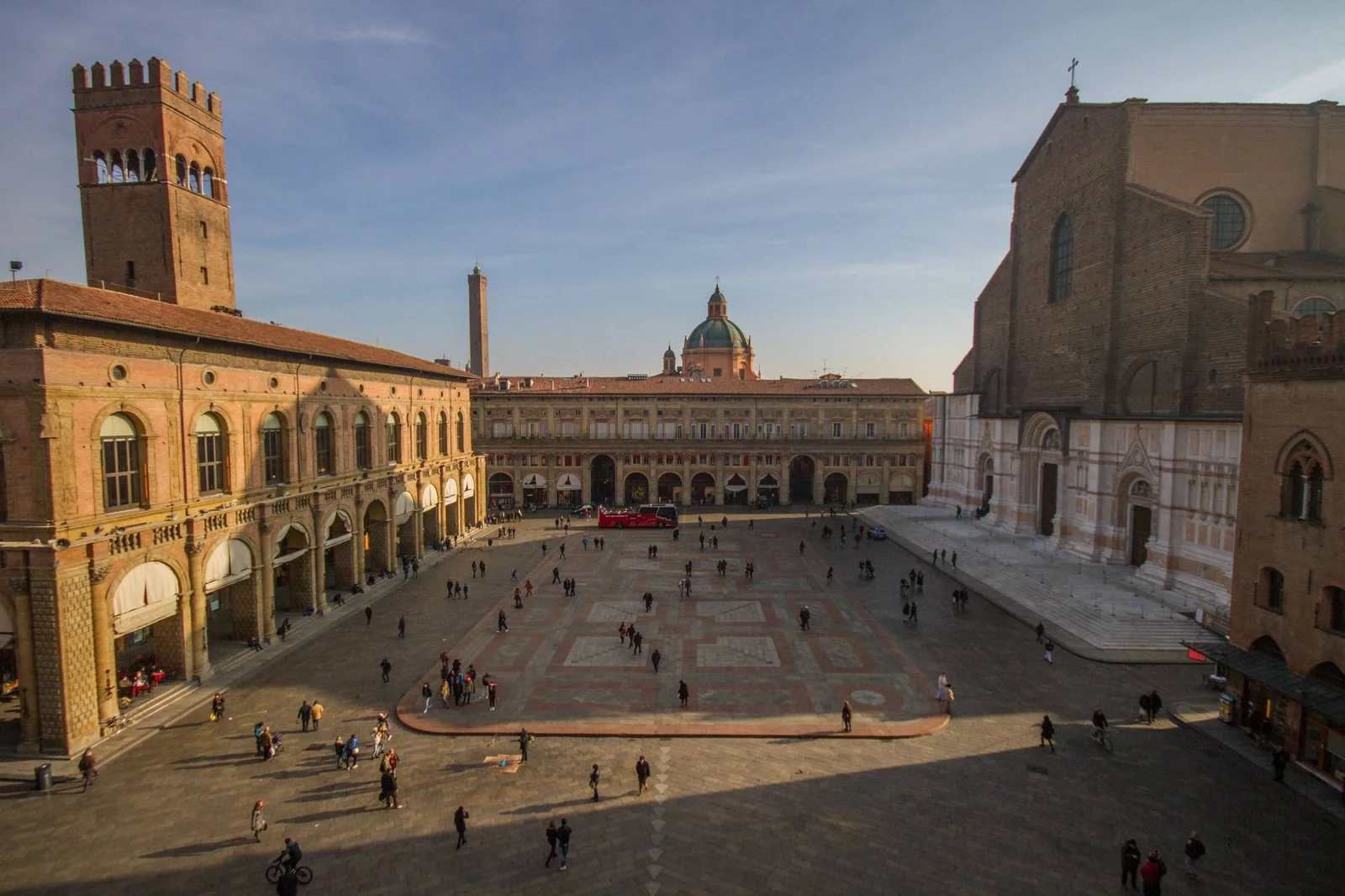
Quick answer: Bologna’s porticoes are not municipal infrastructure. The ground beneath them is private property, the public has a guaranteed right to walk on it, and the owners above are responsible for maintaining it. For a buyer, that turns a photogenic feature into a line in the condominium accounts.
The porticoes are the first thing anyone notices about Bologna and the last thing most buyers investigate. They are usually described as an amenity, which they are, and almost never as a structure with an owner, which they also are. The distinction decides who pays when one needs work, and the answer is the person who has just bought the flat above it.
Who owns the ground under the arches?
The private owners of the building. Bologna’s porticoes were built by private individuals under an obligation imposed by the city, on the understanding that the space would be publicly used, and the arrangement has survived essentially intact. The covered ground remains in private ownership; the public has free passage across it; and the maintenance burden stays with the owners.
Very few arrangements in Italian property are as counterintuitive to a foreign buyer. In most jurisdictions a surface the public walks on is a public surface, maintained from public funds. Here it is a private surface with a public servitude and a private bill, and the bill is not small.
| Element | Ownership | Who maintains it |
|---|---|---|
| Pavement of the portico | Private | The building’s owners |
| Columns and pillars | Private | The building’s owners |
| Vault or ceiling | Private | The building’s owners |
| Right of passage | Public | Guaranteed, not owned |
| Standards for the works | Public | Municipality and heritage authority |
What did the 2021 inscription change?
The porticoes were inscribed on the world heritage list on 28 July 2021, as a serial site made up of twelve components: porticoed groupings together with their surrounding built areas, ranging from the residential porticoes of Santa Caterina and the porticoed square of Santo Stefano through the commercial Pavaglione and Banchi, the academic porticoes of via Zamboni, the devotional portico to San Luca, the Certosa, the triumphal porticoes of Strada Maggiore, and, notably, twentieth-century work at the Barca district and the MAMbo building.
That range matters more than it first appears. The site is not a museum of medieval woodwork; it includes reinforced concrete from the modern period, which means a building of any age in the right place can be inside it.
For an owner, inscription does not add a new maintenance obligation. It raises the standard of supervision applied to how the obligation is discharged. Works are carried out under municipal guidelines for interventions in the porticoed areas of the historic centre and under the heritage authority’s oversight, which sets specification, materials and method rather than leaving them to the contractor. The comune has also signed a protocol with owners aimed at encouraging refurbishment of pavements, walls, pillars, ceilings and columns and the removal of graffiti, which is the clearest possible statement of where the burden sits and what it covers.
How does this arrive in the accounts?
As extraordinary works, voted by the assembly and apportioned by thousandths. That is the same mechanism as any other major repair, but three features make portico works distinctive.
They are exposed. A facade at the rear of a courtyard deteriorates unobserved. A portico is inspected daily by the entire city, and pressure to act arrives through the municipality rather than through the owners noticing.
They are supervised. Approvals take time and constrain the specification, which means a portico repair rarely goes to the cheapest quote and rarely happens quickly.
They are shared with the public. A pavement carrying pedestrian traffic wears differently from a private surface and needs attention on a shorter cycle than owners expect, measured in 15 years rather than in 40 years.
The diligence follows directly from that. Before an offer on a porticoed building:
- Obtain three years of administrator accounts and every set of assembly minutes for the same period
- Look specifically for a portico survey, a works resolution, or a municipal communication about the state of the structure
- Treat any approved but unstarted programme as a liability that transfers with the flat, in the ordinary way
- Ask whether the building has taken part in the municipal incentive protocol, and what that commits it to
- Read the condominium’s insurance position, since a privately owned surface used by the public is an obvious source of third-party claims
The condominium guide sets out how those documents are obtained and what a non-resident owner is entitled to see. For the rest of the purchase, work through the due diligence guide; the portico questions sit alongside it and replace none of it.
Where did the obligation come from?
The arrangement is medieval and it was imposed rather than chosen. The municipal statutes of 1288 required owners to build porticoes in front of their houses, at a time when the university was drawing a population the city had no room for and upper storeys were being extended over the street to accommodate it. The city’s response was to regulate the extension rather than forbid it: build over the street if you must, and the space beneath stays open to everyone.
The specifications that came with it were practical. Porticoes had to be high enough for a person on horseback to pass beneath, a clearance recorded in Bolognese feet and equating to a little over two and a half metres, and they had to be continuous so that the covered route worked as a route. Those two rules are why the network reaches over 62 kilometres today rather than existing as scattered fragments.
The point for a modern buyer is that this was never a public works programme. The city obliged private owners to build a public amenity at their own expense and to keep it, and nothing since has transferred that burden. Eight centuries later the obligation still runs with the building.
- The construction materials vary by period, from timber through stone and brick to reinforced concrete, with the inscribed components spanning work from the 1100s to the 1900s
- A portico can run along one side of a street or both, and can cover a square, a path or a passage
- Continuity is the feature that makes the network usable, and it is also why a single building’s neglected stretch is conspicuous
What happens if the owners do not maintain it?
The comune does not simply wait. Where a privately owned structure crossed by the public deteriorates to the point of risk, the municipality has the ordinary administrative powers to order works and, if the owners do not act, to carry them out and recover the cost. A porticoed building is unusually exposed to that mechanism because its condition is visible to everyone including the officials responsible.
For a purchaser the consequence is procedural. Any municipal communication about the state of the portico, whether a notice, a survey or an order, is a document that should be in the file before an offer. It is more predictive of the next five years than the condition of the flat itself.
Is the portico a liability or an asset?
Both, and the useful question is whether the price reflects which.
On the asset side, the feature is why the city looks the way it does and why demand for central addresses holds up. A porticoed ground floor gives a commercial unit a sheltered frontage, which is worth real money to a retail tenant, and a porticoed residential building has a covered approach that residents value in a climate with hot summers and wet winters.
On the liability side, the works are periodic, supervised and unavoidable, and they do not wait for a convenient moment in the owner’s holding period.
The mistake is not buying one. The mistake is buying one at the price of a building without one, on the assumption that the difference is aesthetic. A buyer who has read the minutes and priced the next cycle of works is making an informed purchase at a premium address. A buyer who has not is holding an unquantified obligation.
What does this mean for a commercial ground floor?
Ground-floor units under porticoes are among the most sought-after retail addresses in the city, and they come with their own version of the same problem.
- The tenant benefits from a sheltered frontage that the tenant does not maintain
- The landlord’s share of portico works is calculated on the unit’s thousandths, and a ground-floor commercial unit frequently carries a disproportionate share of a small building’s total
- Signage, lighting and any modification to the frontage run through heritage supervision, which slows fit-outs
- A lease drafted from a standard template will not allocate any of this, and should be amended before signature rather than argued about later
For an investor buying a mixed building, that means the portico appears twice: once in the residential apportionment and once in the commercial one, and the two do not offset.
How does the rest of Bologna compare?
This page holds one subject deliberately. The city’s demand drivers, its price bands, its student and hospital markets and its position against Milan are covered in the Bologna investment guide, and the choice between Bologna and Florence in the comparison of the two.
Within the region, the neighbouring cities offer the same broad economy without the same structural feature. Modena carries a different documentary legacy from the 2012 earthquakes, and Parma has a tenant class that no other Emilian city has. The Emilia-Romagna guide sets the three of them in context.
What is specific to Bologna, and to no other Italian city at this scale, is that a substantial part of its housing stock owns the pavement outside it. That is a genuinely unusual property right and a genuinely unusual property obligation, and it is the first thing worth establishing about any building here, ahead of the yield, the district and the view.
Does the burden fall evenly across the city?
No, and the variation is worth mapping before choosing a district. A short stretch of brick portico on a two-storey building in a side street is a modest obligation. A long run of stone columns on a principal street, inside a component of the world heritage site, attached to a building with a commercial ground floor, is a different order of commitment entirely.
Three variables drive it: the length of frontage the building carries, the material and complexity of the structure, and whether the location attracts supervision. A buyer comparing two flats at similar prices in different porticoed buildings is often comparing two very different future liabilities, and the difference is measurable from the street plus the minutes.
What should be in the offer letter?
Three conditions, none of them unusual to ask for and all of them commonly omitted.
The first is production of the condominium documents before the deposit becomes committed, with a defined period to review them. The second is a specific representation about approved but unstarted works, since this is the category that most often transfers unnoticed. The third is confirmation of the building’s position in relation to the world heritage site components and to the municipal guidelines, which determines what any future intervention will cost and how long it will take.
None of the three is a reason to walk away from a purchase. All three convert an unknown into a number, which is what diligence is for. The renovation cost guide covers what supervised heritage works cost once the position is known, and in a porticoed building the specification tends to sit above the ranges rather than within them.
Frequently Asked Questions
The building's owners do. The land covered by the portico remains private property while its use is public and free passage is guaranteed, an arrangement that dates back to the medieval obligation to build them. The consequence is that the burden of maintaining a piece of public thoroughfare falls on the private owners above it.
The pavement, the walls, the pillars and columns, and the ceiling of the portico, together with the removal of graffiti. Those are the elements the municipal incentive protocol addresses, and they are the elements that appear in a condominium's extraordinary works when a portico comes up for attention.
It changes the process, which changes the cost. The porticoes were inscribed on 28 July 2021 as a serial site of twelve components, and works on them run through heritage supervision with municipal guidelines for interventions in the porticoed historic centre. Specification, materials and approvals are all narrower than for an ordinary facade.
From the condominium's records rather than from the street. Three years of accounts and the assembly minutes that go with them will show any survey, any approved programme and any works voted but not started. A portico in visibly poor condition with nothing in the minutes is a cost that has not yet been scheduled, not a cost that does not exist.
No. The city has over 62 kilometres of porticoes and the inscribed site consists of twelve identified components with their surrounding built areas. A building can be porticoed, and subject to the ordinary maintenance burden and municipal rules, without sitting inside a component of the world heritage site.
Italian law makes the custodian of a thing responsible for damage it causes, and a privately owned surface crossed by the public is a clear application of that principle. Building insurance for a porticoed property should be read with that in mind, and a buyer should confirm what cover the condominium actually holds rather than assume it.
Frequently yes, and the burden is a known and priceable one rather than a hidden defect. What is not defensible is buying one at the price of an unporticoed building and being surprised by the first extraordinary works vote. The premium the address carries and the liability the structure carries are two sides of the same feature.
It sits underneath it. The city's demand drivers, prices and yields are set out separately, and this page deliberately does not repeat them. The portico question cuts across all of them, because it attaches to a building rather than to a district or a tenant type.
Get an Italy property shortlist
Tell us your budget and region (Tuscany, Lake Como, Puglia, Milan, Sardinia). We reply within one business day with options matched to your goals.