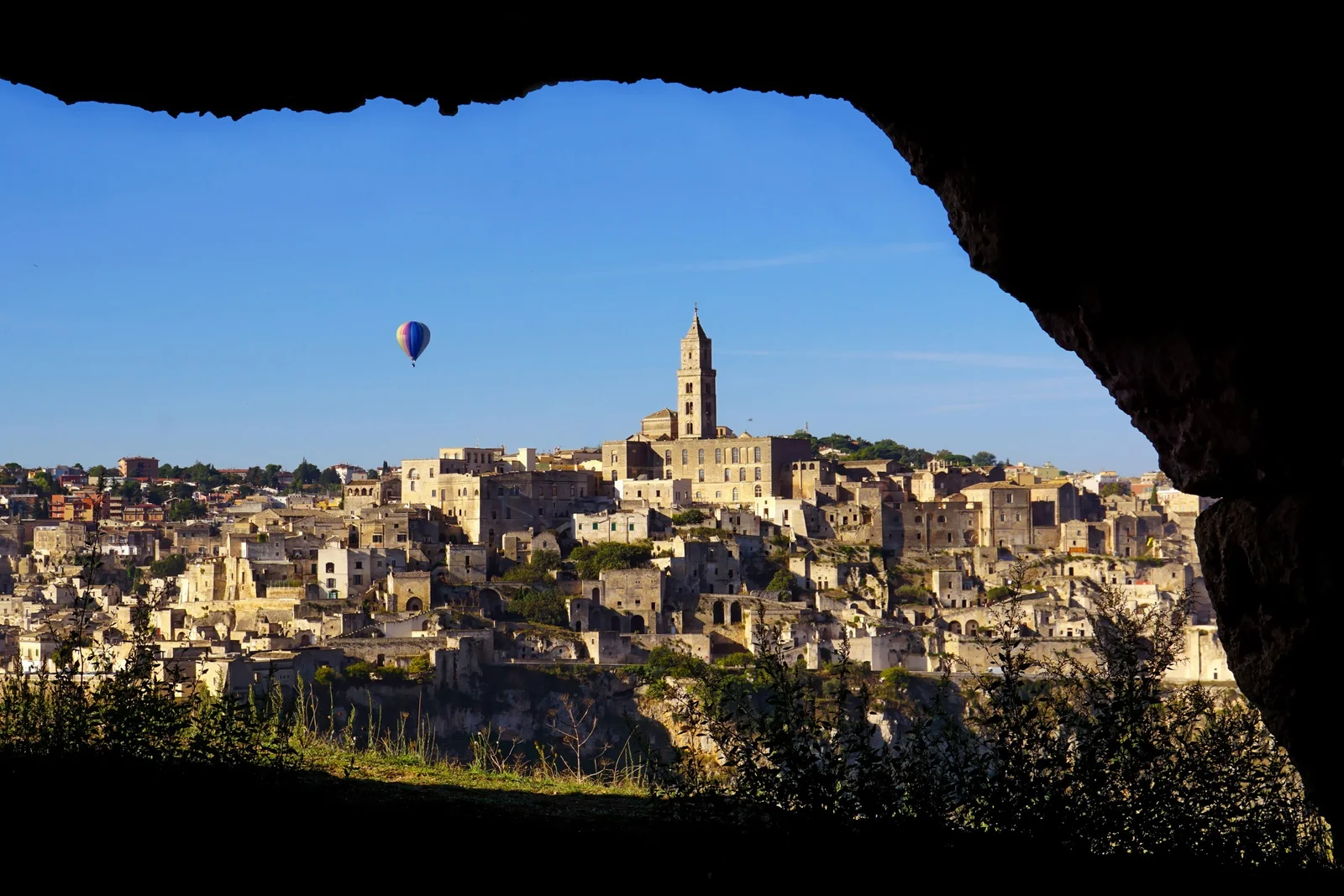
Quick answer: A large part of the Sassi is not sold, it is conceded. The State holds the property, the comune of Matera holds it on a ninety-nine year concession under law 771 of 1986, and individual cave houses reach private hands as thirty-year sub-concessions with restoration obligations attached. The first cohort of those sub-concessions is now reaching term.
The listing says a cave house in the Sassi di Matera with a view over the gravina. The price looks like a price. What is being transferred, in a meaningful share of cases, is a term right in State property with performance conditions attached, and a foreign buyer who does not establish which of the two situations applies is negotiating in the dark.
How did the State end up owning a UNESCO district?
The law of 17 May 1952 addressed what was then treated as a national scandal. It funded the evacuation of the two Sassi districts and the construction of new neighbourhoods for the people who lived in them, and around seventeen thousand residents, close to two thirds of the town, moved out to Serra Venerdì, Lanera, La Martella and Venusio.
The exchange was explicit. Families received new housing on nominal terms, and in return the old cave dwellings passed to the State. By the time the districts were empty, a substantial part of the historic fabric of Matera was public property, and it stayed that way through the decades in which the Sassi were simply abandoned.
That is the fact everything else rests on. The Sassi were not preserved by private owners choosing to hold; they were emptied by statute and the resulting stock was in State hands when the recovery began.
What did law 771 of 1986 set up?
Law 771 of 11 November 1986, titled the conservation and recovery of the Sassi districts of Matera, built the mechanism that is still running.
| Layer | Holder | Instrument | Term |
|---|---|---|---|
| Ownership | The State | Statutory | Perpetual |
| First level | Comune di Matera | Free concession under L. 771/1986 | Ninety-nine years |
| Second level | Private party | Sub-concession under the comune’s regulation | Thirty years |
| Purpose | Architectural, urban, environmental and economic recovery | Convention with obligations | Tied to the term |
The comune’s Ufficio Sassi administers the second level through a sub-concession regulation, and allocation has proceeded through implementation programmes rather than as a continuous open market. The consequence for a buyer is that a Sasso may reach them as a freehold, as an assignment of a sub-concession, or as neither because it is still unallocated public stock.
What obligations travel with a sub-concession?
Recovery, not occupation, was the purpose of the statute, and the instrument reflects it. The sub-concessionaire commits in the convention to carry out defined restoration work, and the regulation ties the renewal of the sub-concession to having done it. A holder who took the property, did nothing, and arrives at term with the work outstanding is not in a strong position to ask for another term.
For a purchaser taking an assignment from an existing holder, that turns three questions into diligence rather than curiosity:
- What did the convention require, in what timescale, and was it done
- Is there documentary evidence of completion accepted by the comune, rather than photographs of a finished interior
- How much of the term remains, since a wasting right with obligations behind it is worth less than the same interior with a fresh term in front of it
The restoration standard itself is not a light one. Working inside excavated rock, with heritage supervision and with the drainage and humidity problems that come with a hillside of interconnected cavities, is specialist work at specialist prices. The renovation costs guide covers the ordinary Italian ranges, and Sassi work belongs at the top of them rather than in the middle.
What is happening to the first cohort now?
The earliest sub-concessions were granted in the early 1990s, which means the thirty-year terms have been arriving at expiry through the mid-2020s. Administrative extensions have been authorised while the framework is reconsidered, with the fee updated by the national inflation index rather than reset to market.
The fee itself explains a good deal of the politics. Set in 1992 and moved only by indexation, sub-concession rates have been reported in the range of €0.60 to €2.30 per square metre per month. Against what a restored Sasso earns as tourist accommodation, that is a rounding error, and it is the reason the arrangement reads as a recovery subsidy rather than as a lease.
Two things follow, and a buyer should hold both at once. The term is short by the standards of the capital it invites, which is a genuine and openly discussed disincentive to investment. And the low fee is a real economic benefit that a market-rate renegotiation would remove. Anyone underwriting an assignment today is taking a view on how that tension resolves, and honesty requires saying that the outcome is not settled.
How does a buyer tell which title they are looking at?
Not from the estate agent’s description, and not from the frontage. The documents settle it and they are obtainable before any deposit.
| Document | What it establishes |
|---|---|
| Visura and estratto catastale | How the unit is registered and to whom |
| Atto di provenienza | Whether the seller holds ownership or an allocated right |
| Convenzione di subconcessione | The obligations, the permitted use and the term |
| Comune correspondence | Whether the recovery work was accepted |
| Certificato di destinazione urbanistica | What the planning instrument permits |
The due diligence guide sets out the general Italian file. Matera adds the third and fourth rows, and they are the ones a lawyer instructed from abroad is most likely to be told are unavailable. They are not unavailable; they are held by the comune, and asking for them is normal.
What does this do to financing and to letting?
Financing first. An Italian bank assessing a mortgage looks at what it could recover on enforcement, and a wasting term right with performance conditions is a weaker security than freehold. That does not make lending impossible; it makes residual term and completed restoration into pricing inputs rather than background. The non-resident mortgage guide explains the ordinary lending framework, and buyers should assume this asset sits outside its comfortable centre.
Letting second. A very large share of the recovered Sassi operates as tourist accommodation, and it works: the town’s visitor numbers rose sharply after the 2019 European Capital of Culture year and the district’s stock is genuinely scarce. But the permitted use of a sub-conceded unit comes from the convention, and the national registration framework in the short-let rules sits on top of it rather than replacing it. Operating tourist accommodation in breach of a convention with the comune is a different order of problem from a licensing irregularity.
What about the rest of the city?
Outside the two Sassi, Matera is a conventional small southern market and behaves like one. The districts built for the evacuated population are ordinary freehold, largely mid-century, and priced accordingly. The Piano, the upper town that was always inhabited, is the local prime residential address and trades as freehold apartments. The periphery is cheap and thin.
- Freehold stock outside the Sassi carries none of the concession questions and can be assessed with the standard Italian file
- Resale liquidity across the whole comune is shallow, which matters more than yield on a five-figure entry price
- Buyers comparing regional options should read the Matera and Potenza comparison, since the two Basilicata markets fail and succeed for opposite reasons
- Costs of acquisition follow the national pattern in the registration tax guide, with the caveat that a concession assignment is not a sale of property and should be characterised by a notary before anyone assumes the rate
The honest summary is that Matera contains two markets wearing the same postcode. One of them is freehold and ordinary. The other is a public recovery programme that has been running since 1986, is currently at the end of its first cycle, and hands a private buyer a document that has to be read rather than skimmed. When it is time to sell, the selling guide explains the ordinary process, but a concession assignment will not be an ordinary sale, and the exit deserves as much thought as the entry.
Frequently Asked Questions
No, and the mix is precisely why the question has to be asked about a specific address. Privately owned dwellings that were never ceded to the State exist alongside State property that the comune holds and sub-concedes. Two adjacent doors on the same lane can sit on entirely different legal footings, and nothing about the frontage tells you which is which.
Through the law of 17 May 1952, which funded the evacuation of the Sassi and the construction of new districts. Roughly seventeen thousand residents moved out, and in exchange for new housing they gave up their old dwellings to the State. The emptied cave houses became public property, which is the origin of everything that followed.
It set the recovery framework. The State conceded its Sassi property to the comune of Matera free of charge for ninety-nine years, for the purpose of architectural, urban and economic recovery, and the comune in turn allocates individual properties to private parties by sub-concession for a term of thirty years under its own regulation.
Renewal is not automatic and is conditional on performance. The regulation ties renewal to completion of the restoration work the sub-concessionaire committed to in the convention, so a holder who never carried out the agreed recovery has a weak claim. The first cohort granted in the early 1990s has been reaching term, and extensions have been granted administratively while the framework is revisited.
The sub-concession fee was set in 1992 and has moved only with inflation indexing, which leaves rates reported in the range of €0.60 to €2.30 per square metre per month. That is far below any market rent, and it is the reason the arrangement functions as a recovery incentive rather than as a revenue instrument for the comune.
Lending against a right that expires is a different proposition from lending against freehold, and the residual term drives it. A holder with decades left and a completed restoration is in a different conversation from one approaching expiry with obligations outstanding. Expect the question to be asked early and to shape the loan-to-value rather than to be a formality.
Use is governed by the convention and the comune's regulation, not by the owner's preference alone, so the permitted use has to be read from the documents rather than inferred from the neighbours. Given how much of the Sassi now operates as hospitality, this is the single most commercially important clause in the file.
No. The Piano, the modern districts built for the evacuated population and the periphery are ordinary freehold and trade like any small southern Italian city. The concession regime is specific to State property inside the two Sassi districts, which is why buyers should establish which market they are in before comparing prices per square metre.
Get an Italy property shortlist
Tell us your budget and region (Tuscany, Lake Como, Puglia, Milan, Sardinia). We reply within one business day with options matched to your goals.