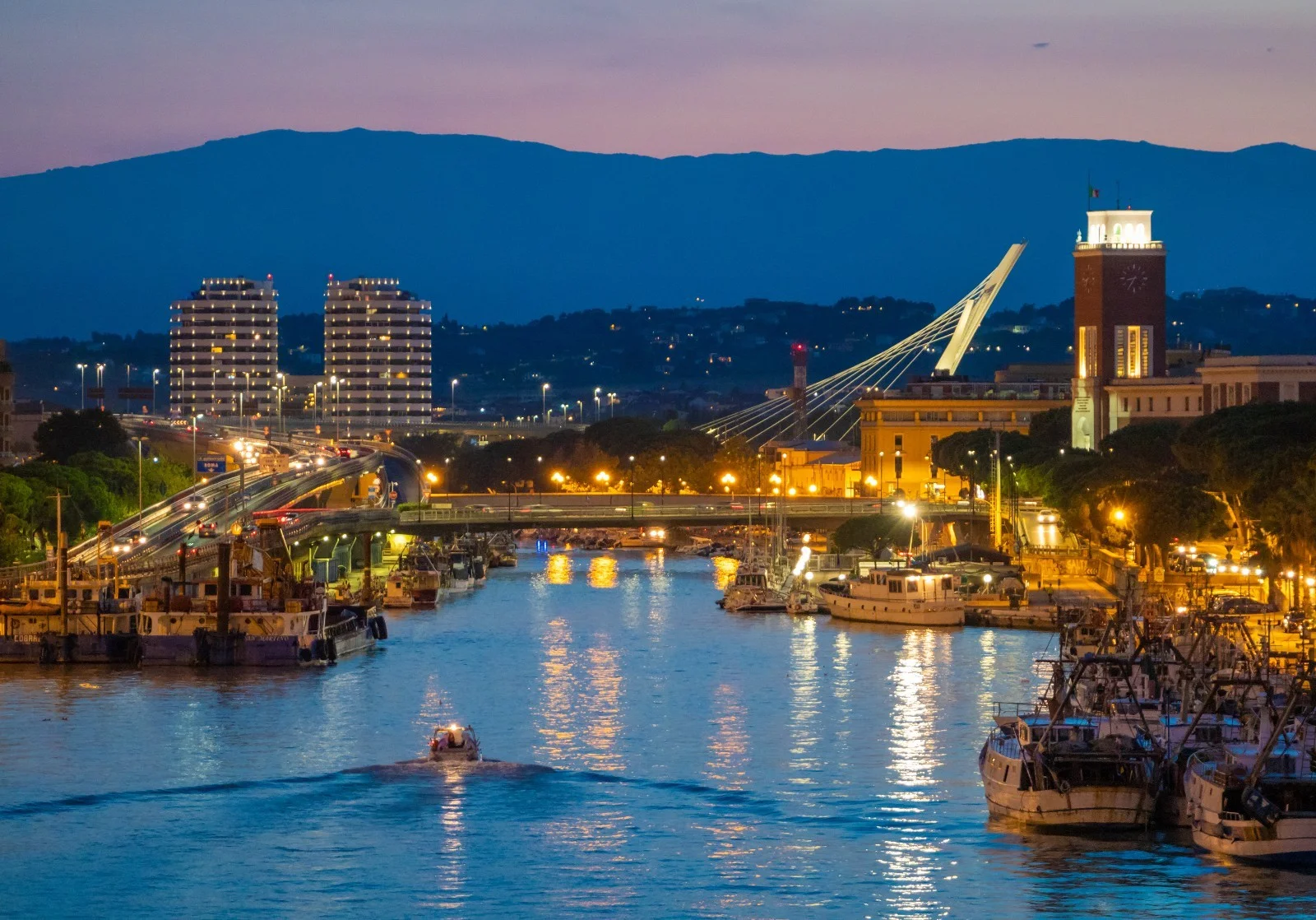
Quick answer: Pescara has almost no old town, because it was flattened in the war and rebuilt. What it has instead is a long seafront, and every commercial metre of that seafront sits on state property held under concessions whose legal basis has been contested for twenty years and is still not resolved.
Two facts define property in this city and neither of them is about the buildings. The first is that the war removed the old town, so the stock is modern by Italian standards. The second is that the asset everyone is paying for, the beach, is not for sale and never has been.
What a concession actually is
The Italian shoreline is public maritime domain. It cannot be bought. What exists instead is a concession: an administrative grant permitting a private party to occupy a defined stretch and to operate on it, typically a bathing establishment with its cabins, umbrellas, bar and services.
That produces an arrangement most foreign buyers misread on first encounter. The visible commercial infrastructure along an Italian beach looks like private property, is run like a business, is bought and sold as a business, and is not owned in the sense a building is owned. It exists at the pleasure of an administration, for a term, under conditions.
| Element | Status |
|---|---|
| The sand and the shoreline | State property, not saleable |
| The right to occupy and operate | Administrative concession, for a term |
| Removable structures | The concessionaire’s, and removable |
| Non-removable structures | Pass at the end of the concession, without compensation |
| Who decides | The administration, within a legal framework set nationally and by the EU |
Why this has been in dispute for two decades
Because a concession to use a scarce public resource for commercial gain engages European services law, which requires competitive selection rather than automatic renewal in favour of whoever holds the concession now.
Italian legislation has repeatedly postponed the moment when competitive procedures would apply. The most recent instrument, decree law 131 of 16 September 2024, converted by law 166 of 2024, extended maritime, lake and river concessions for tourist, recreational and sports use from 31 December 2024 to 30 September 2027, while modifying the framework for indemnifying outgoing concessionaires.
The courts have not accepted the postponements. Administrative rulings have consistently held that an automatic extension without competitive procedure conflicts with European law and must be disapplied, which leaves the sector in a position where a statutory deadline exists and cannot be relied on.
The indemnity question is the fault line. The 2024 legislation provides for fair compensation in respect of investments made in the last five years, on criteria to be defined, while establishing that structures which cannot be removed pass without payment when the concession ends. What an incumbent recovers, and therefore what an incumbent’s business is worth, depends on how that resolves.
What this means for a residential buyer
Not a title problem, and that is the first thing to be clear about. Buying an apartment on the seafront in Pescara involves no concession and no exposure to the dispute in a legal sense.
The exposure is environmental and commercial. What sits in front of the building, how it is maintained, what it costs to use and who operates it in three years are all outcomes of a process still under way. A buyer paying a premium for a seafront position is paying for an amenity whose management arrangements are unsettled.
Three practical questions follow, and all three are answerable locally:
- What occupies the frontage directly opposite, and is it a long-established operation or a recent one
- Has that stretch been the subject of any municipal or regional planning for the seafront, which several Adriatic comuni have undertaken
- What is the free beach provision nearby, since the balance between concessioned and free stretches is a municipal policy that affects how a location feels in August
A city without an old town
Pescara was heavily bombed during the Second World War and rebuilt afterwards, which makes it unusual among Italian cities of its size. There is very little medieval or early modern fabric, and the overwhelming majority of the housing stock dates from the reconstruction and the decades after it.
For a buyer that inverts the usual Italian diligence.
What disappears. Heritage supervision on ordinary buildings, the gap between a cadastral plan and a building altered over four centuries, shared structures of uncertain ownership, and the general problem of buying something older than the records that describe it.
What replaces it. The specific pathologies of twentieth-century Italian construction: variable concrete quality from the boom decades, poor thermal performance, flat roofs and balconies reaching the end of their lives, and lifts and services installed to standards long superseded.
Nothing in the due diligence guide is dispensable here; what changes is where the attention goes. On a 1960s or 1970s seafront block that means the condominium’s structural history and its forward plans, not the heritage authority.
- Ask for the condominium’s record of facade and balcony works, which on a marine exposure is the largest recurring cost
- Establish the state of the lift and whether a replacement has been voted
- Read the energy certificate as a running cost forecast rather than as a formality
- Check what the building’s heating system is and whether it is metered per unit
What a seafront position is actually worth
The premium a first-line building carries over one a street back is one of the most consistent features of Italian coastal pricing, and it is worth decomposing rather than accepting.
Part of it is the view, which is durable and cannot be taken away. Part of it is access, which is a matter of crossing a road and is worth less than buyers assume once traffic is considered. Part of it is prestige, which moves with fashion. And part of it is the amenity in front, which as this page has set out is a licensed activity whose future arrangements are unsettled.
Set against the premium are costs that are specific to a marine front line. Salt-laden air attacks concrete, reinforcement, railings, window frames and external plant, and a building in the front row incurs those costs at a rate that a building 200 metres inland does not. On a post-war block that shows up as facade and balcony programmes arriving more often and costing more.
- Ask the administrator how often the facade has been addressed over the past two decades
- Inspect balcony soffits and railings, which are the earliest visible sign of chloride attack
- Compare the condominium charges of a front-line building against one a street back
- Treat double glazing and external joinery as consumables on this exposure
Which part of the coast
The city’s seafront runs for several kilometres and it is not homogeneous. The northern stretch, the central stretch by the river mouth and the southern stretch differ in the density of development, in the mix of concessioned and free beach, and in how far the buildings sit from the water.
A buyer should walk the specific stretch in August rather than in April, because the character of a beachfront in high season is not predictable from its appearance out of season. The questions to answer are simple and they are answered on foot: how crowded, how noisy, how much free beach, how far to park, and what the frontage opposite the building actually is.
What holds the market up outside summer
Pescara is the largest city in Abruzzo and functions as one: a service economy, a university, regional administrative functions and a substantial permanent population. That is the argument for it over the smaller resorts on the same coast, which empty in September.
A residential letting model here can therefore rest on a year-round tenant base, with seasonal short letting as an option rather than as the whole proposition. Both routes can be modelled from the method in the rental yield guide, and the seasonal one needs the licensing position covered in the short-let rules.
Within the region, the Abruzzo guide covers the wider market, and Chieti sits directly inland with a very different profile, treated in the Pescara and Chieti comparison. Along the coast, Termoli to the south is the Molise equivalent and Scalea shows what the same proposition looks like much further down the peninsula.
The honest summary of Pescara is that it is a working Adriatic city with a modern housing stock, a genuine year-round economy and a seafront amenity whose future management is a live legal question. None of those three facts is what a listing photograph shows, and all three matter more than the photograph does.
Frequently Asked Questions
The State. Italian beaches are public maritime domain, and the bathing establishments occupying them do so under concessions granted by the administration. A seafront apartment owner buys the building and the view, never the sand, and the quality of what sits between the two is a matter of public licensing rather than private property.
Contested. Decree law 131 of 16 September 2024, converted by law 166 of 2024, extended maritime, lake and river concessions for tourist, recreational and sports use from 31 December 2024 to 30 September 2027. Administrative courts have repeatedly held that such automatic extensions must be disapplied as incompatible with European law.
Because a concession to occupy a scarce public resource for a commercial activity engages the services directive, which requires competitive selection rather than automatic renewal to incumbents. Italy has legislated repeatedly to postpone that, and the courts have repeatedly declined to apply the postponements.
The 2024 legislation provides for fair indemnity in respect of investments made in the last five years, according to criteria to be defined, while non-removable structures pass without compensation when a concession ends. That combination is the fault line in the whole dispute and it is not fully settled.
Through the environment rather than through the title. What is in front of the building, how it is run, whether it is refurbished and who runs it in three years are all functions of concession policy. A buyer paying a premium for a seafront position is paying for something whose management is subject to a process still under way.
Very little of one. The city was heavily bombed during the Second World War and rebuilt afterwards, so its stock is overwhelmingly post-war and later. That removes the heritage and conformity questions that dominate purchases in older Italian cities and replaces them with the questions that apply to twentieth-century construction.
Both, and it changes the diligence rather than reducing it. Lifts, parking and regular layouts are common, which most historic centres cannot offer. Against that, the construction quality of the boom decades varies enormously, energy performance is often poor, and the buildings are now reaching the age where major works arrive.
Pescara is the largest city in Abruzzo, with a service economy, a university and regional functions, and a substantial resident population. That gives it a year-round rental market that a purely seasonal Adriatic town does not have, which is the main argument for it over the smaller resorts along the same coast.
Get an Italy property shortlist
Tell us your budget and region (Tuscany, Lake Como, Puglia, Milan, Sardinia). We reply within one business day with options matched to your goals.