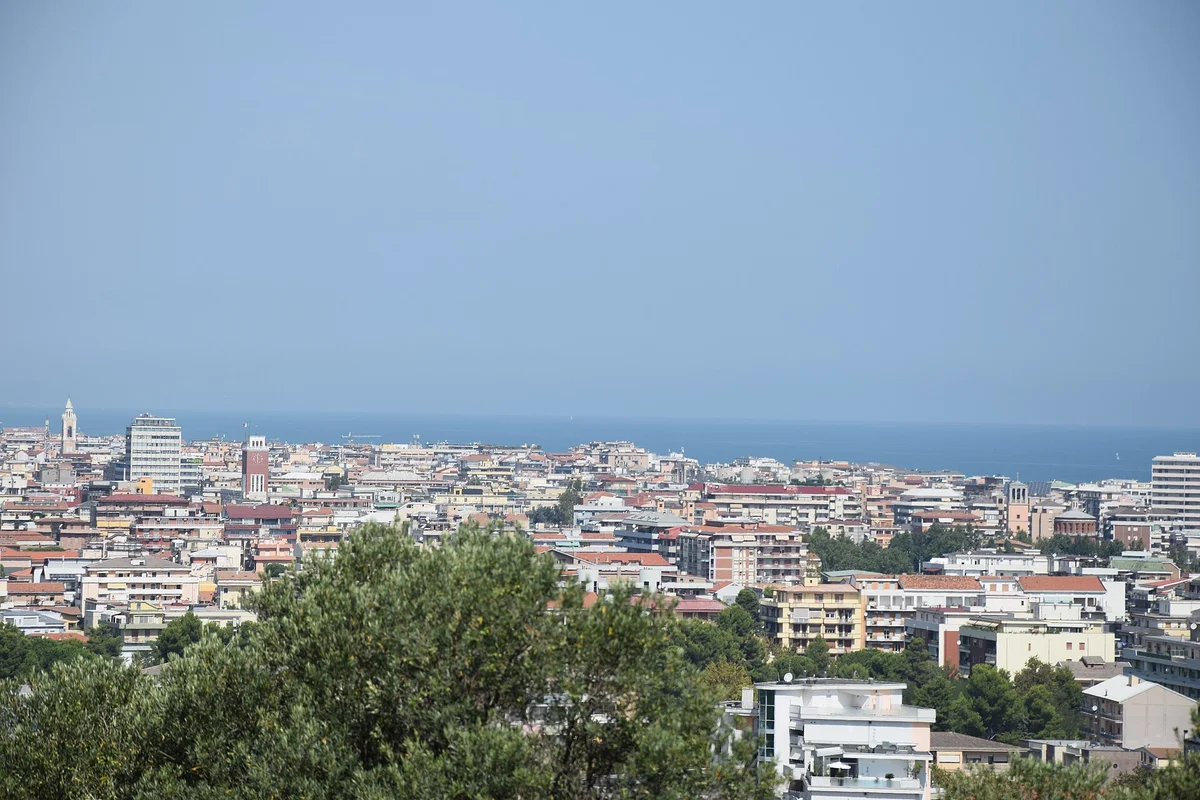
Quick answer: These two towns share one university and split it between them. Medicine, health sciences and the scientific disciplines are taught in Chieti; economics, architecture, engineering and the humanities in Pescara. A landlord’s tenant pool is decided by that split, not by the distance between the towns.
The two towns sit about 15 km apart with a motorway between them, roughly 20 min by road, and property comparisons of them usually turn on the sea. The more useful distinction is administrative: a single university has been split across two municipalities, and where each faculty sits determines where its students live.
Which campus, which town
Buy in Pescara if you want demand that does not depend on the university. It is the larger city, it has a coastal season, a service economy and a year-round resident base, and the students are one tenant class among several.
Buy in Chieti if you want the concentrated version at a lower price. The campus and the teaching hospital dominate, entry prices are lower, and a landlord serving that market has a clear and stable tenant profile.
The condition that reverses it: a change in the campus split. A university operating across two municipalities carries duplicated costs, and institutions rationalise. A decision to consolidate a school in one town would move its demand with it, and that risk sits almost entirely on the Chieti side.
How the split actually runs
The institution operates from two campuses, with Chieti as the legal seat holding the rectorate and general management, alongside a distance-learning centre at Torrevecchia Teatina in the province of Chieti.
| Discipline group | Campus |
|---|---|
| Medicine and health sciences | Chieti |
| Scientific disciplines | Chieti |
| Economics and business | Pescara |
| Architecture | Pescara |
| Engineering | Pescara |
| Humanities | Pescara |
Founded in 1965, the institution counts in the region of 30,000 students across 14 departments and three schools, including a school of medicine and health sciences and a school of economics, business, law and sociology. For two towns of this size that is a large population, and it explains why student letting is a serious part of both markets rather than a sideline.
What each faculty group implies for a landlord
The tenant profiles differ more than the labels suggest.
Medicine, in Chieti. Courses run longer than most, which produces tenancies measured in years rather than in a single cycle. The teaching hospital attached to the campus adds rotating clinical staff, who are professional tenants rather than students and pay accordingly. That combination makes Chieti’s student market steadier than an undergraduate town’s.
Economics and business, in Pescara. Shorter courses, higher turnover, and a cohort that overlaps with the city’s ordinary young professional market. A flat let to an economics student one year is let to a young employee the next without alteration.
Architecture and engineering, in Pescara. Longer courses with studio requirements, which pushes demand toward flats with a usable extra room rather than toward the smallest units.
- Chieti: long courses, hospital staff, steadier tenancies, lower rents
- Pescara: shorter courses, higher turnover, tenants interchangeable with young professionals
- Both: demand tied to an academic calendar that a coastal season does not match
- Pescara only: a second, unrelated summer market
What the two towns are, otherwise
They have almost nothing in common beyond the province.
Pescara is a modern coastal city, rebuilt after heavy wartime bombing, with essentially no historic centre and a housing stock that is post-war and later. Its seafront is public maritime domain held under concessions whose legal basis has been contested for two decades, which the Pescara page sets out. It is the largest city in Abruzzo with a service economy and regional functions.
Chieti sits inland on a ridge, with a long history, older building stock and the constraints that come with both. It is smaller and quieter, and its economy is more concentrated around the university, the hospital and public administration. The Chieti page covers it.
The practical consequences for a buyer are ordinary but worth listing. Pescara’s stock offers lifts, parking and regular layouts and carries the maintenance profile of twentieth-century construction on a marine exposure. Chieti’s older stock carries the usual Italian questions about the correspondence between the register and the building, which the due diligence guide covers.
The overlap that caps Chieti’s rents
The towns are close enough that students commute between them, particularly students with cars, and that has a specific market effect a landlord should understand.
Because a student studying in Chieti can live in Pescara and drive, Chieti’s rents are constrained by what is available in Pescara rather than set independently by demand at the Chieti campus. The reverse is weaker: fewer Pescara students choose to live in Chieti, because the coastal city has more to offer outside lecture hours.
That asymmetry means a Chieti landlord competes with the whole of Pescara’s supply while a Pescara landlord competes mainly within Pescara. It is the strongest argument for the coastal city on pure letting economics, and it is invisible in a rent comparison between the two towns.
Modelling the two properly
Use different assumptions rather than a regional average.
- In Pescara, model two demand sources: the academic year and the summer season, which peak at different times
- In Chieti, model one main source with a hospital component, on longer tenancies and lower rents
- Assume Chieti’s rent is capped by Pescara availability rather than by Chieti demand
- Price the void in Chieti over the summer, when the campus empties and there is no season to replace it
- Compare total annual return rather than headline rent, because the seasonal patterns differ
The rental yield guide sets out the method, and the Abruzzo guide covers the wider region including the mountain and coastal markets that neither of these towns represents.
For a structurally similar coastal-versus-inland question one region south, the Campobasso and Termoli comparison sets out two Molise towns with the same shape and a different answer, and Termoli is the nearest Adriatic alternative to Pescara at a smaller scale. Buyers at the lower end of the budget range will find the segment covered in buying under 200,000 euro, which comfortably contains both towns.
The seafront question, which only applies to one of them
A buyer in Pescara is buying into a city whose principal amenity is not privately owned. The beach in front of a seafront building is public maritime domain, and the establishments on it operate under concessions whose legal basis has been contested for two decades under European services law.
That has no effect on the title to an apartment and a considerable effect on the environment in front of it. What occupies the frontage, how it is run and who runs it in three years are outcomes of a process that is still under way.
Chieti has no equivalent question, because it has no coast. Its equivalent constraint is the ordinary Italian one for an older inland town: heritage supervision in the historic centre and the frequent divergence between what the register records and what has actually been built.
- Pescara: check what sits on the frontage opposite and how much free beach is nearby
- Pescara: expect marine exposure to accelerate facade and balcony maintenance
- Chieti: expect the older-stock questions, and instruct a surveyor accordingly
- Both: read the condominium accounts before committing
What a small budget actually buys
At the lower end of the range, the two towns offer different things for the same money.
In Chieti the money buys space: a larger flat, often in an older building, in a quieter town with a campus and a hospital nearby. The trade is a thinner resale market and greater dependence on the university staying put.
In Pescara the same money buys less space in a modern building with a lift and probably parking, in a larger city with a season and a broader tenant base. The trade is a smaller property and a higher entry price per square metre.
Neither is wrong. What is wrong is buying the larger inland flat on the assumption that it will let as easily as the smaller coastal one, because the tenant pools are not the same size.
What to ask a local agent in each town
In Pescara, ask what proportion of lettings are to students and what proportion to residents or seasonal visitors, and how the summer and the academic year interact. The answer establishes whether a specific address serves one market or two.
In Chieti, ask how much of the demand comes from the campus and how much from the hospital, and how many students choose to live in Pescara instead. The second number is the one that caps rents and agents know it.
In both, ask how long a plain two-bedroom flat takes to let, in weeks, in September and in February, and whether the local norm is an annual contract or an academic-year one. Two dates, one question, and the answers separate the towns more clearly than any price comparison.
What would change the comparison
A consolidation of the campuses is the obvious event, and it would move demand wholesale from one town to the other. Nothing suggests it is imminent and a landlord in Chieti should nonetheless know it is the risk they carry.
A resolution of the beach concession question would change Pescara’s seafront rather than its housing, by settling who operates the frontage and on what terms. That affects the environment a seafront property sits in rather than its title.
Neither event is predictable. Both are worth knowing about, because a buyer who has named the risk they are taking is in a different position from one who has not.
The short version
Pescara: larger, coastal, modern stock, a season on top of the academic year, and a seafront whose management is an unsettled public question. Broader tenant base, higher entry price, easier letting.
Chieti: smaller, inland, older stock, medicine and the hospital as the anchor, and rents capped by what is available on the coast. Concentrated tenant base, lower entry price, greater dependence on the campus staying put.
A landlord who wants two demand sources buys Pescara. A buyer who wants space at the lowest price and understands the concentration buys Chieti.
What the university does not guarantee
An institution of around 30,000 students supports both towns and it does not underwrite either.
Enrolment moves with demographics, and the southern Italian cohort that supplies much of the intake has been shrinking. Distance learning, which the institution already operates from a third site, changes how many students need to be physically present. And a split-site university carries duplicated costs that create a standing incentive to consolidate.
None of that is a prediction. All of it argues for buying stock that would let to someone other than a student if it had to, which in Pescara is straightforward and in Chieti means being near the hospital rather than merely near the campus.
Two towns, two building stocks
Pescara’s housing is overwhelmingly post-war, because the city was rebuilt after heavy bombing in 1943 and expanded through the 1960s and 1970s, so most of its stock dates from between 1950 and 1980. That produces lifts, parking and regular layouts, alongside the thermal performance and the ageing services of buildings now several decades old.
Chieti’s centre is older and its expansion later and smaller, which produces the ordinary Italian mix: historic stock under heritage supervision, and buildings that have been altered more often than the cadastral plan records, surrounded by post-war construction of the usual period quality.
A buyer should expect a survey in Chieti to spend its time on the fabric and a survey in Pescara to spend its time on the condominium’s programme of works. Both are necessary; they are not the same exercise.
Frequently Asked Questions
Because the university runs on two campuses in two different municipalities. Chieti is the legal seat and holds medicine, health sciences and the scientific disciplines. Pescara holds economics, architecture, engineering and the humanities. A student's discipline therefore determines which town they need to live in, and a landlord's tenant pool is set by the same split.
It counts around 30,000 students across 14 departments and three schools, including a school of medicine and health sciences and a school of economics, business, law and sociology. That is a substantial tenant base for two towns of this size, and it is why student demand shapes both markets.
Pescara, on breadth. It is the larger city with a coastal season, a service economy and year-round demand that does not depend on the university. Chieti is smaller, quieter and more dependent on the campus and the hospital, which makes it a more concentrated position at a lower entry price.
It is a longer one. Medical courses run for more years than most, and the teaching hospital attached to the campus supplies rotating staff on top of the students, which gives Chieti a steadier and more professional tenant profile than a pure undergraduate market would.
Any consolidation of the campuses. A split-site university is expensive to run and institutions periodically rationalise, and a decision to move a school from one town to the other would move the demand with it. That is the specific risk a Chieti landlord carries and a Pescara landlord largely does not.
Very little beyond the province. Pescara is a rebuilt modern coastal city with a seafront held under state concessions and no historic centre to speak of. Chieti sits inland on a ridge with a long history and older stock. They are neighbours in geography and opposites in almost every property respect.
It happens and it is not attractive. The towns are close enough that students do commute, and a tenant with a car in Pescara can reach the Chieti campus. What that means for a landlord is that the two markets overlap at the margin, so Chieti's rents are capped by Pescara's availability rather than existing independently.
Chieti, clearly. Entry prices are lower than Pescara's and the stock is older, which means a buyer working to a modest budget gets more space inland. The trade is a thinner resale market and greater dependence on the university remaining where it is.
Get an Italy property shortlist
Tell us your budget and region (Tuscany, Lake Como, Puglia, Milan, Sardinia). We reply within one business day with options matched to your goals.