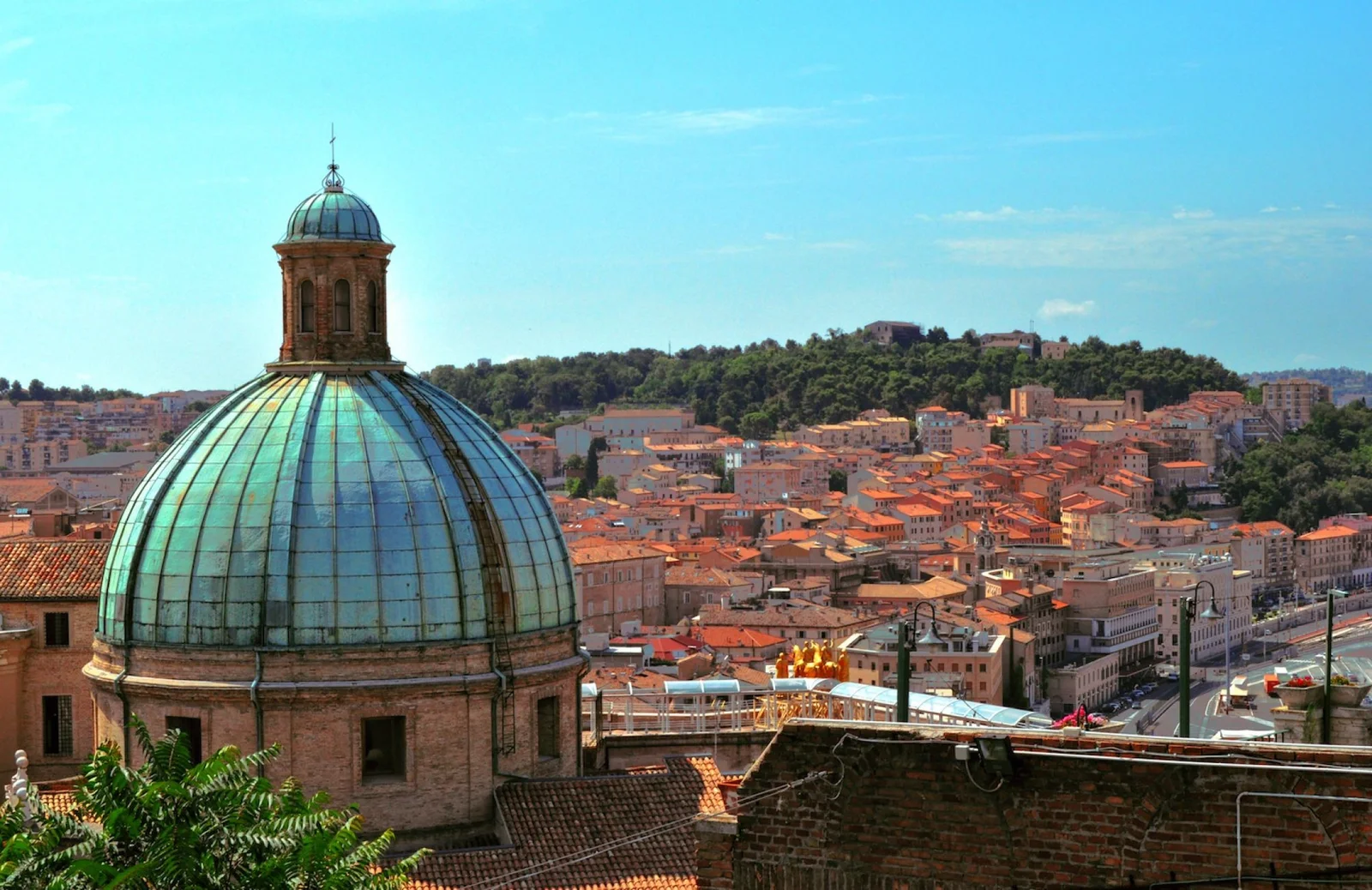
Quick answer: These two Marche towns are 60 kilometres apart and represent opposite bets. Urbino’s enrolled student body is roughly the size of its resident population, which produces exceptional occupancy and total dependence on one institution. Ancona spreads the same capital across four unrelated employers and gives up the occupancy.
Two university towns in the same region, one of which is a university with a town attached and the other of which is a working port city that happens to have a university. The distinction is not rhetorical; it decides what a landlord in each is actually exposed to.
Concentration or diversification
Buy in Urbino if you want occupancy and can hold a concentrated position. Student demand in a town of this ratio fills stock reliably, and a landlord who serves it well rarely has an empty room.
Buy in Ancona if you want the demand spread across employers that fail independently. A port, a hospital, a university and a regional government do not have correlated bad years.
The condition that reverses it: enrolment. Urbino’s numbers have been drifting down, and a landlord there is holding a position on one institution’s recruitment. If that trend steepens, the concentration that produced the occupancy produces the vacancy, and there is nothing else in the town to take up the slack.
The ratio, and why it is the whole story
Urbino had about 13,849 residents at the beginning of 2025 on national statistics, with the comune reporting a figure closer to 14,040. The university counts in the region of 14,400 enrolled students.
Not all enrolled students live in the town, and the two figures are not directly comparable in that sense. What the ratio establishes is the structure: this is a place whose population roughly doubles in term time and whose housing stock was built for the smaller number.
| Measure | Urbino | Ancona |
|---|---|---|
| Resident population | About 13,849 | A regional capital, an order of magnitude larger |
| Dominant demand source | The university | Port, hospital, university, administration |
| Occupancy pattern | High, academic calendar | Steady, year-round |
| Exposure | One institution | Four unrelated ones |
| Seasonality | Term time | None to speak of |
The number a landlord in Urbino should watch
Enrolment, published annually, and nothing else comes close in importance.
The trend is not favourable. Enrolment has fallen from a little over 15,000 five years ago to around 14,400. New matriculations have gone from roughly 4,700 to just under 4,500 over the same period, and the decline has been concentrated in students coming from southern Italy, which is the catchment most exposed to demographic decline and to competition from universities closer to home.
There is a counter-current worth noting honestly. Foreign matriculations rose from 108 to 195 between 2019/20 and 2023/24. That is a substantial proportional increase on a small base, and international students typically pay for better accommodation than domestic ones, so the effect on a landlord’s revenue is larger than the headcount suggests.
What a landlord should do with that:
- Read the annual enrolment figures rather than general property commentary
- Distinguish total enrolment from matriculations, since the second leads the first by three years
- Watch the international share, because it is where growth and higher rents both sit
- Specify accommodation for an international student rather than for the cheapest domestic one, if the international trend is the thesis
- Accept that this is a concentrated position and size it accordingly within a portfolio
What Ancona’s diversification actually buys
Lower yields and fewer surprises. The city’s demand comes from four sources that have nothing to do with each other.
- The port, with commercial traffic and ferry links to the eastern Adriatic, supporting employment and a steady flow of people
- The regional hospital complex at Torrette and the medical faculty attached to it, which produces rotating professional tenants
- The university, a normal Italian one with a normal academic calendar
- Regional administration, the steadiest tenant class of all
A landlord in Ancona whose student tenants disappear has three other markets. A landlord in Urbino has none. That is the entire trade, and it is priced: Ancona’s gross yields on comparable stock are lower, because the risk is lower.
Each town needs its own occupancy assumption rather than a shared one, worked through as the rental yield guide describes.
The building question is different in each
Urbino is a compact walled Renaissance town, protected in its entirety, on a steep site. Works are supervised, access for materials is difficult, and the stock is old and subdivided. A buyer there is buying into a heritage environment with the costs and the constraints that implies.
Ancona’s stock is mixed twentieth-century and its distinctive question is not the buildings at all but the ground. The landslide of December 1982 reshaped the city’s northern districts and left the best-documented urban slope in Italy, which the Ancona page sets out in full. Diligence there means reading constraint mapping alongside the ordinary file in the due diligence guide; in Urbino it means reading heritage constraints and access.
Two different letting operations
The practical work of being a landlord differs as much as the risk does, and buyers rarely price that.
In Urbino the product is a room in a shared flat or a small unit, let on the academic calendar, to tenants who arrive together in the autumn and leave together in the summer. Turnover is concentrated, marketing is seasonal, and the summer is either empty or filled with short lets to visitors, which is a different business run in the same building. Rents are modest per room and the aggregate can be good because the occupancy is high.
In Ancona the product is a conventional flat let on an annual contract to a household, a hospital worker or a public employee. Turnover is occasional, marketing is unremarkable, and the operation demands very little attention. Rents per square metre are lower than the Urbino room-by-room equivalent, and the management burden is a fraction of it.
- Urbino: room-by-room, academic calendar, concentrated turnover, higher gross, higher effort
- Ancona: whole-flat, annual contracts, minimal turnover, lower gross, minimal effort
- Urbino: summer is a separate decision every year
- Ancona: no seasonal decision at all
An owner living abroad should weigh that honestly. The Urbino model needs someone on the ground each September; the Ancona model needs someone available occasionally.
What would change the answer
Three developments would move this comparison, and a buyer holding either position should watch for them.
A sustained recovery in Urbino’s enrolment, particularly in international students, would strengthen the concentrated position and justify the higher gross. The international figures have been moving in that direction from a small base.
A significant expansion of institutional student housing in Urbino would compete directly with private landlords and compress the private market, which is the specific risk of a town where one institution is both the source of demand and a potential supplier of accommodation.
A change in Ancona’s port or hospital footprint would move the diversified market, though the fact that four sources would have to move together is exactly the point of holding it.
Which one to actually live in
If the property is for the buyer’s own use rather than for letting, the comparison inverts and it is not close.
Urbino is one of the most complete small Renaissance towns in Europe, walkable, cultured, and quiet outside term time. Ancona is a working port city, which is a compliment about its economy and not about its evenings.
That inversion is worth stating because a great many purchases in the Marche are made by people who intend to use the property for part of the year and let it for the rest. Those two objectives point in opposite directions here, and a buyer should decide which one is primary before looking at a single listing.
The price question, stated carefully
Neither town is expensive by national standards and the gap between them is smaller than the difference in character suggests.
Urbino’s constrained historic stock inside the walls carries a premium over the modern housing outside them, and the premium reflects both the setting and the fact that the walled town is where students want to be. Ancona’s prices vary by district more than by building type, with the hospital corridor and the better residential areas above the average and the older centre below it.
What a buyer should not do is compare the two on price per square metre and conclude anything. The Urbino figure describes a heritage town with one economy; the Ancona figure describes a regional capital with four. They are not measuring the same thing.
The useful comparison is total return over a holding period, built from realistic occupancy, realistic management cost and a realistic view of exit. That exercise usually narrows the gap and sometimes reverses the ranking, depending on the assumptions a buyer is willing to defend.
How to test the thesis before buying
Four checks, all cheap, and all of which a buyer can do from abroad.
Read the university’s published enrolment data for Urbino for the last five years, and the matriculation series alongside it. That is the demand curve.
Ask a local agent in each town what proportion of their lettings are to which tenant type, and how long units sit empty. Agents answer this readily and the answers differ sharply between the two.
Look at what institutional accommodation exists in Urbino and whether any expansion is planned, since that is the competition.
For Ancona, establish which district the property sits in relative to the hospital, the port routes and the 1982 constraint mapping, because all three change what the property is worth.
What each town is exposed to that the other is not
A short inventory, because concentration and diversification are abstractions until you name the specific risks.
Urbino is exposed to national higher education policy, to the demographic decline of the southern regions that supply a large part of its intake, to competition from universities closer to those students’ homes, and to any decision the institution takes about its own accommodation. It is also exposed, positively, to the growth of international recruitment.
Ancona is exposed to port traffic and to the shipping routes that use it, to national health service investment in the regional hospital, to the same higher education pressures at lower intensity, and to the specific geological constraint that shapes its northern districts.
Those two lists have almost nothing in common, which is the strongest argument for a buyer with capital in the region to hold something in each rather than to choose. The two towns are 60 km apart on the same road, which makes managing both from one base a practical proposition rather than a theoretical one, and puts a single agent, surveyor or manager within reach of both halves of the position without duplicating the professional relationships.
Where this sits in the region
The Marche guide covers the region, including the coastal towns north and south of Ancona that serve the holiday market rather than either of these two. Urbino and Ancona have their own pages.
For a structurally similar choice one region south, the Perugia and Assisi comparison sets out two Umbrian towns whose demand also comes from unrelated sources and fills in opposite months. And on the coast, Pescara and Termoli are the Adriatic markets a buyer would look at if the objective were a season rather than a tenant.
What each town looks like to a lender
Financing is where a concentrated market shows itself first, and buyers rarely think about it until the valuation stage.
A lender assessing an Urbino property is assessing an asset in a small market with one dominant demand source and a declining resident population. Valuations tend to be conservative and the loan-to-value reflects it.
Ancona is a regional capital with a diversified economy, and a lender treats it as an ordinary provincial city. Neither is difficult to finance and the terms differ, and a buyer relying on debt should establish the position before making an offer rather than after.
A note on using the property yourself
Both towns are pleasant and only one of them is beautiful in the way a foreign buyer usually means.
Urbino is a walled Renaissance town on a hill, compact, cultured and quiet outside term time, and it is one of the reasons the Marche appears on any list of underrated Italian regions.
Ancona is a working port and a regional capital, with a fine cathedral on its promontory and a great deal of traffic below it.
If the purchase is partly for use, that difference will matter more over a decade than any of the letting arithmetic, and it is worth being honest about which of the two motives is actually driving the decision.
The short version
Urbino: high occupancy from one source, falling enrolment, heritage constraints, a beautiful town, and a concentrated position that should be sized as one.
Ancona: lower yields from four unrelated sources, a documented geological constraint on part of the city, a working port economy, and no charm to speak of.
A buyer who wants income security buys Ancona. A buyer who wants occupancy and can carry the concentration buys Urbino. A buyer who wants a house to enjoy buys Urbino and stops reading the yield tables.
Frequently Asked Questions
Choose by whether you want concentration or diversification of demand. Urbino's letting market is almost entirely student, in a town whose enrolled student body is roughly the size of its resident population, which produces high occupancy and total exposure to one institution. Ancona spreads the same money across a port, a hospital, a university and public administration.
Urbino had about 13,849 residents at the start of 2025, with the comune reporting figures around 14,040, and the university counts roughly 14,400 enrolled students. Not all of those live in the town, but the ratio is unlike anything in a normal Italian market and it explains why the local rental market behaves as it does.
It has been falling. Enrolment is down from a little over 15,000 five years ago to around 14,400, and new matriculations have gone from roughly 4,700 to just under 4,500 over the same period, with the decline concentrated in students from the south. Foreign matriculations have risen from 108 to 195 between 2019/20 and 2023/24, which is growth on a small base.
Because there is no second demand source to absorb it. In a diversified town a 5% fall in student numbers is absorbed by other tenants. In a town where students roughly equal residents, the same fall is a direct reduction in the rentable population, and it shows up as vacancy rather than as a slightly softer rent.
Several unrelated demand sources: a working commercial port with ferry traffic, the region's principal hospital complex with its medical faculty, a university, and regional administration. Yields are lower and occupancy is steadier, and no single institutional decision moves the whole market.
Not necessarily, and it can be the better one for a landlord who wants high occupancy and is willing to hold a concentrated position. The point is to hold it knowingly and to watch the right number, which is enrolment, rather than watching general property indices that say nothing about this town.
They are very different problems. Urbino is a compact walled town of protected historic fabric, where works are supervised and access is difficult. Ancona's stock is mixed and its distinctive question is the ground rather than the buildings, following the 1982 landslide that reshaped the northern districts.
Urbino, by a distance. It is a small, beautiful, walkable town with a serious cultural life and no port traffic. Ancona is a working city that does not set out to charm anyone, and a buyer choosing it is choosing an economy rather than a place to spend August.
Get an Italy property shortlist
Tell us your budget and region (Tuscany, Lake Como, Puglia, Milan, Sardinia). We reply within one business day with options matched to your goals.