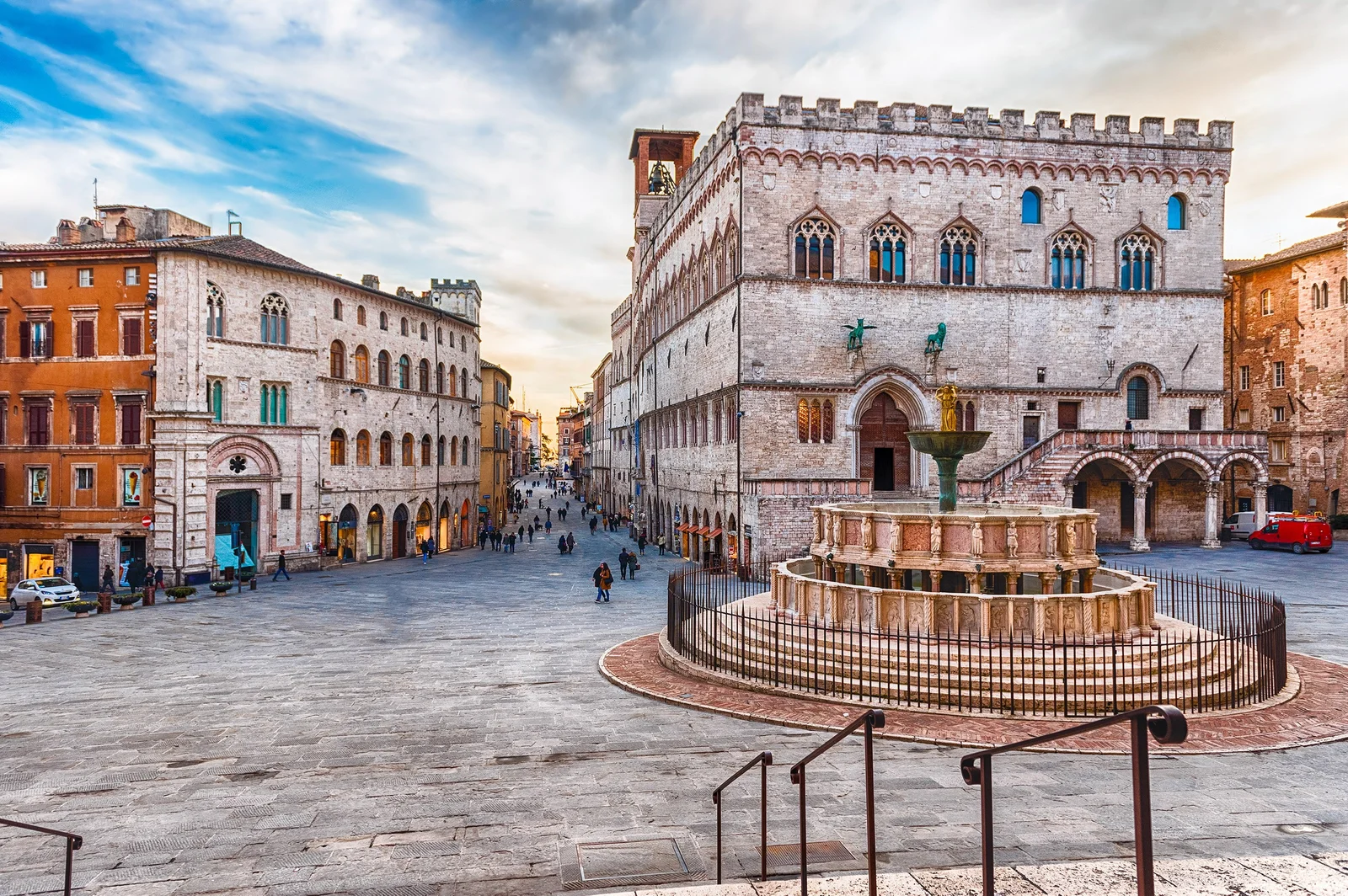
Quick answer: These two Umbrian towns are 20 kilometres apart and are usually presented as alternatives. They are better understood as complements, because the months in which each is empty are not the same months, and an owner holding one has a natural interest in the other.
Most comparisons between neighbouring towns ask which is better. This one asks a more useful question: given that both have real but differently shaped demand, what does an owner in each actually face, and does holding one make the other more or less attractive.
Income or a calendar
For steady occupancy, Perugia. Its rolling monthly intake produces something close to continuous letting, at modest rents, with frequent turnovers and a manageable operation.
For high rates on known dates, Assisi. Its demand clusters on a published calendar and commands premiums on those dates, with long quiet stretches between them.
The condition that determines which suits you: whether you want income or a calendar. An owner who needs regular monthly cash flow should hold Perugia. An owner who wants a property they can use themselves for most of the year, earning strongly on a handful of dates, should hold Assisi.
Why Perugia has no off season
The structure of the teaching. Courses for foreign students run in person with a minimum duration of four weeks, each proficiency level divided into micro-levels of one month. Completing a level takes two months at entry level and three at every level above it. Quarterly courses begin in January, April, July and October, and a student can enrol for one month or several at any point in the year.
The July cohort is the feature that matters. In a conventional university city the letting year empties from June to September and a landlord either finds a summer tenant or carries the void. Here the summer is the start of a cohort.
- Arrivals cluster on month boundaries, which makes turnovers predictable
- A stay is typically a quarter, which is longer than a holiday let and shorter than a tenancy
- Occupancy across a year is high because there is no structural void
- Rents per room are modest, and the return comes from the occupancy rather than the rate
The Perugia page sets out the market in detail, including the contractual question that a two or three month stay raises under Italian letting law.
Why Assisi clusters
A liturgical calendar. Easter moves between late March and late April and takes its demand with it. The town’s own historic festival falls in early May. The Porziuncola indulgence brings a distinct wave at the start of August, separate from general summer tourism. The feast in early October is now also a national civil holiday, restored by statute with effect from 1 January 2026.
That produces a year with several sharp peaks and long quiet stretches, particularly from November through to Easter. The Assisi page covers the calendar and the statutory change, and notes the additional feature that a private landlord there competes with a substantial supply of religious and pilgrim accommodation.
Putting the two calendars side by side
| Period | Perugia | Assisi |
|---|---|---|
| January to March | Cohort running from January | Quiet |
| Easter | Continuous | Peak, date moves |
| Early May | Continuous | Peak |
| June | Continuous | Moderate |
| July and August | Cohort starting in July | Indulgence peak, then summer baseline |
| September | Continuous | Moderate |
| Early October | Cohort starting in October | Feast and national holiday |
| November and December | Continuous | Quiet |
Read down the two columns and the complementarity is obvious. Assisi’s worst months are Perugia’s ordinary ones, and Perugia never has a month that is structurally empty.
The case for holding both
Twenty kilometres is close enough that one operation covers both.
A single local manager can service properties in both towns. One cleaner, one maintenance contact, one accountant and one set of relationships covers the pair. Marketing is different for each, but the administrative overhead is shared rather than doubled.
The combined revenue profile is steadier than either alone: high-rate concentrated nights in Assisi sitting on top of continuous modest income in Perugia, with the quiet periods offsetting rather than coinciding.
The obvious objection is capital. Two properties require more money than one, and a buyer with enough for one should choose rather than stretch. Two separate models are needed here, with occupancy assumptions that differ rather than a shared regional figure; the rental yield guide covers the method.
What each requires operationally
Perugia needs someone present at month boundaries, several times a year, to handle arrivals and departures. It needs a contract in the right statutory form for a stay of that length, registered properly. It needs a flat that is functional rather than decorative, and heating that a tenant can afford through an Umbrian winter.
Assisi needs short-stay operation on the peak dates, with the national licensing framework in the short-let rules complied with, and a check-in arrangement that works for guests arriving in a walled town with restricted vehicle access. It needs a property that guests can reach on foot with luggage.
Those are different jobs and a manager who does one well may not do the other. Anyone holding both should establish that early rather than assume one arrangement covers it.
What would change either case
For Perugia, a change in the course structure. The rolling monthly intake is unusual and it is what makes the market what it is; a shift to term-length teaching would remove the July cohort and with it the reason to prefer this town over an ordinary student city. That is a cheap thing to check annually.
For Assisi, the difference between the permanent and the exceptional. The national holiday recurs every year from 2026 and is a durable addition to the calendar. The eighth centenary falls in 2026 and does not repeat, so any figures from that year overstate a normal one. A seller quoting 2026 occupancy should be asked for 2024 as well.
The Umbria guide covers the wider region. For the same structural question one region away, the Ancona and Urbino comparison sets concentration against diversification in the Marche, and Arezzo in Tuscany is the closest example of a town whose demand also arrives on a published schedule rather than with the weather.
What the two markets pay
The revenue shapes differ enough that comparing headline rents is misleading.
A Perugia room let by the month produces a modest sum, repeated across most of the year, from a tenant who arrives on a month boundary and stays a quarter. The annual result comes from occupancy rather than rate, and the management cost is the frequent turnover.
An Assisi flat let short produces a much higher nightly figure on a small number of identifiable dates, and very little in between. The annual result comes from the rate on those dates, and the management cost is short-stay operation with all the cleaning and check-in that implies.
Expressed as an annual return on the same capital, the two can land close together while behaving completely differently through the year. An owner should choose on the behaviour rather than on the total, because the behaviour is what they will actually live with.
The regulatory position in each
Perugia’s question is contractual: a stay of two or three months has to be documented in the right statutory form, registered properly, and supported by whatever evidence that form requires. It is a paperwork discipline rather than a licensing one.
Assisi’s question is licensing: short-stay accommodation runs under the national registration framework and under whatever the comune has decided about tourist use of residential stock. A town with this profile has an active interest in that question, and municipal positions across Italy have been moving in one direction.
A buyer should check both before committing, and should note that they are different kinds of risk. A contractual error is fixable with better drafting; a licensing restriction is not fixable at all.
What a buyer should verify in each
For Perugia, the course structure and the cohort start months, from the institution rather than from an article, and any expansion of institutional accommodation that would compete with private landlords.
For Assisi, the comune’s current position on tourist use of residential stock, the condominium’s rules where one exists, and a realistic count of lettable nights in an ordinary year rather than in the centenary year.
Both checks cost an email and an hour. Both address the specific thing that would undo the thesis, which is what diligence is for.
The properties each market actually wants
Perugia wants a functional flat within walking distance of the school and the centre, with heating that works, reliable internet, durable furnishing and rooms that can be let individually. Money spent above that standard is not recovered from a tenant staying a quarter.
Assisi wants a self-contained unit that guests can reach on foot with luggage, in or near the walls, comfortable enough for a short stay at a good rate, with a check-in method that works when the owner is elsewhere.
Those are different products and a property bought for one rarely serves the other. A buyer holding both should buy each for its own market rather than looking for a single specification that covers the pair.
The short version
Perugia: continuous occupancy, modest rents, frequent turnovers, a contract question to get right, and a thesis that depends on the course structure staying as it is.
Assisi: high rates on published dates, long quiet stretches, a licensing question to get right, competition from religious accommodation, and a statutory holiday that has permanently improved the October week.
Held together they cover most of a year between them, which is the argument for treating them as a pair rather than as a choice.
The region behind both
Umbria is small, landlocked and unusually well supplied with towns that draw visitors, and it has none of the coastal seasonality that dominates most Italian second-home markets.
That gives both these towns a demand base built on institutions and events rather than on weather, which is what makes their calendars predictable years ahead. It also means the region is quiet in absolute terms compared with Tuscany, and prices reflect that.
For a buyer, the region rewards specificity. There is no general Umbrian market to buy into; there are individual towns with individual demand structures, and the difference between two of them 20 kilometres apart is larger than any regional average suggests.
What the numbers behind each look like
Perugia’s model is an occupancy story. A room let for 10 or 11 months of a year at a modest rent produces a result that a short season at twice the rent does not match, and the frequent turnovers are the price of it.
Assisi’s model is a rate story. Perhaps 80 nights a year across five identifiable windows, at rates that differ by a factor of two between the peaks and the baseline, with the rest of the year contributing very little.
Set side by side on the same capital, the two annual figures can land close together, with Perugia occupying perhaps 320 days of a year and Assisi 80. That is the same money arriving through two entirely different operations, and an owner should pick the operation they are willing to run rather than the total they would prefer to see. The Perugia landlord is running a small letting business with paperwork and turnovers through the year. The Assisi owner is running a holiday property with an intense few weeks, a long quiet stretch, and the freedom to use it themselves for most of the calendar. Those are different lives, not different spreadsheets. The advantages of the Perugia model are steadiness and predictability; its disadvantages are the administration and the fact that the owner cannot use the property. Assisi reverses both. What differs is the shape: one is a monthly income with administration attached, the other is a handful of profitable weeks and a property the owner can use the rest of the time.
Frequently Asked Questions
Because their empty months fall in different parts of the year. Perugia's language school intake starts monthly with quarterly cohorts in January, April, July and October, so its weakest periods are short and scattered. Assisi clusters on devotional dates and is quiet between them, particularly through the winter.
The structure of its courses for foreign students. Teaching runs in month-long micro-levels with a minimum of four weeks, a diploma takes two months at entry level and three above it, and enrolment is possible in any month. The July cohort is the specific feature that removes the summer void other student cities have.
A liturgical calendar rather than a meteorological one. Easter moves each year, the town's own festival falls in early May, the Porziuncola indulgence at the start of August and the feast in early October, which since 2026 is also a national civil holiday. Those are fixed points with quiet stretches between them.
On occupancy, yes. Perugia's model produces near-continuous letting with modest rents and frequent turnovers. Assisi's produces a smaller number of nights at much higher rates on identifiable dates. Which is better depends on whether the owner wants steady income or a manageable calendar.
Yes, and the fact that the troughs fall in opposite months is the whole argument for it. The towns are 20 kilometres apart, so one manager, one cleaner and one set of professional relationships can cover both, and the combined occupancy is steadier than either alone.
A change in the course structure. The rolling monthly intake is what makes that market unusual, and a move to term-length teaching would remove it. A landlord whose thesis rests on the July cohort should confirm annually that the cohort still starts in July.
The centenary. The eighth centenary of the saint's death falls in 2026 and will produce exceptional demand that will not repeat. The statutory holiday on 4 October is permanent and recurs; the anniversary is not. Any model built on 2026 figures overstates a normal year.
Assisi, for most buyers. It is smaller, quieter, walled and set on a hillside with a view across the valley. Perugia is a larger working hill city with a university, more services and more noise. The letting argument and the living argument point in different directions here, as they usually do.
Get an Italy property shortlist
Tell us your budget and region (Tuscany, Lake Como, Puglia, Milan, Sardinia). We reply within one business day with options matched to your goals.