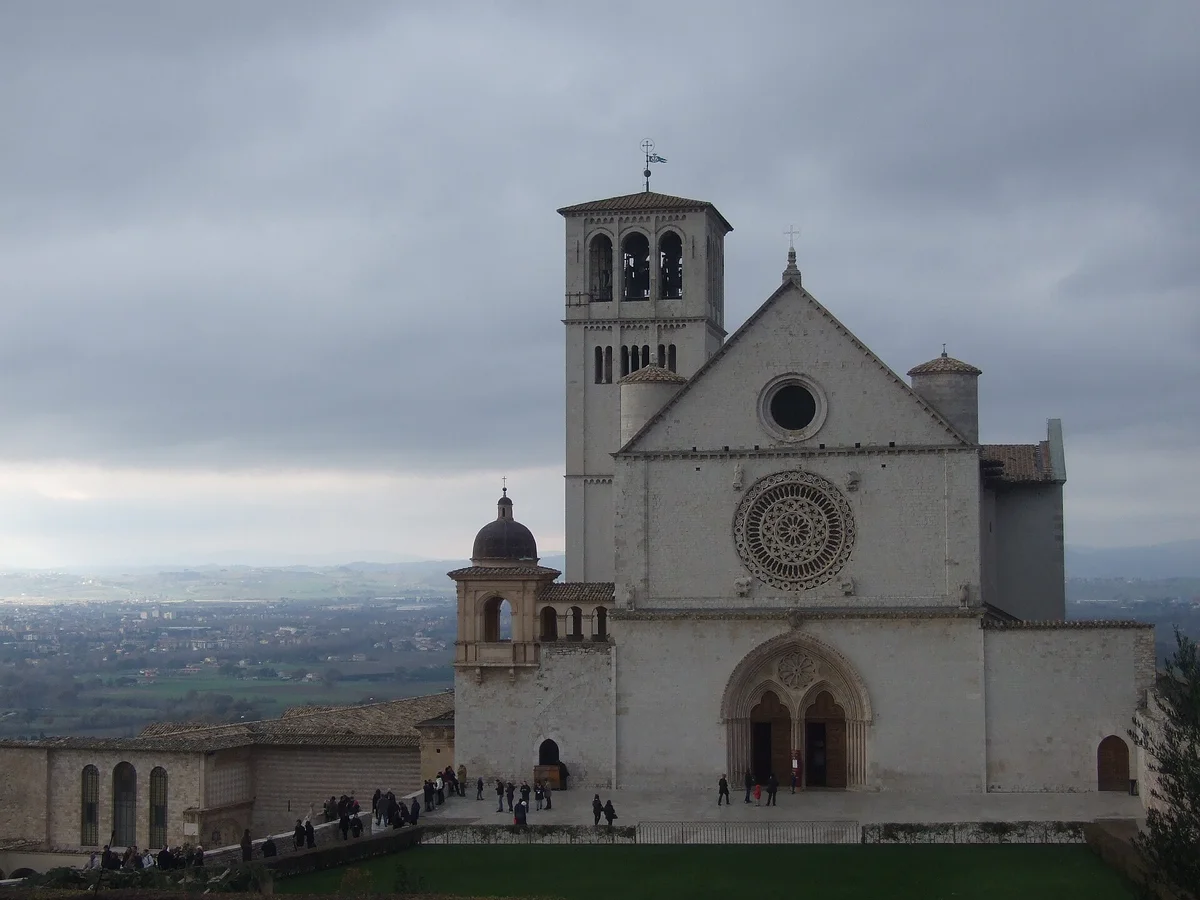
Quick answer: Assisi’s letting year is set by the church calendar and, since 2026, by statute. Law 151 of 8 October 2025 restored 4 October as a national holiday from 1 January 2026, in the eighth centenary year of the saint’s death. For a town whose entire visitor economy turns on that name, a fixed national closure in early October is a structural change to the demand curve.
Every Italian hill town is sold on the same year: quiet spring, busy summer, tail into September, nothing after October. Assisi has never actually run on that calendar, and from 2026 it runs on a different one by act of parliament.
What the law did
Law 151 of 8 October 2025, published in the Official Gazette on 10 October 2025, established the national holiday of Saint Francis of Assisi by amending article 2 of law 260 of 1949, the statute that governs Italy’s public holidays. The date takes effect from 1 January 2026 and falls on 4 October each year.
The history matters for judging whether it will stick. The date was a public holiday until law 54 of 1977 removed a group of observances from the calendar for economic reasons. The 2025 legislation reinstates one of them, was passed with support across the political spectrum, and arrives immediately before the eighth centenary of the saint’s death in 2026.
| Element | Position |
|---|---|
| Instrument | Law 151 of 8 October 2025 |
| Published | Official Gazette, 10 October 2025 |
| Amends | Article 2, law 260 of 1949 |
| Effective | 1 January 2026 |
| Previously | Suppressed by law 54 of 1977 |
Why a public holiday is a property fact
Because Italian domestic travel follows the closure of schools and offices with unusual precision. A national holiday on a fixed date creates a predictable movement of people, and where the holiday commemorates a figure identified with one specific town, a share of that movement has a destination.
The timing is what makes it commercially significant. Early October is the point at which hill-town demand normally begins its decline: the weather turns, the schools are back, and the season winds down through November. Inserting a fixed national closure at exactly that moment extends the workable letting year at its weakest edge rather than adding to an already busy summer.
Two cautions belong here, stated plainly. The centenary year will produce exceptional demand that will not repeat, and any model built on 2026 figures will overstate a normal year. And a holiday creates a long weekend rather than a week, which suits short stays and does nothing for owners whose minimum stay is seven nights.
What the rest of the year actually looks like
The Assisi calendar is devotional and it is not evenly spread.
- Easter, which moves between late March and late April and takes the demand with it, so a fixed seasonal pricing curve misprices it every year
- Early May, when the town holds its own historic festival and fills for a few days
- The start of August, when the Porziuncola indulgence brings a distinct wave that is not the same as the general August tourism
- Early October, the feast, and now the national holiday
- A summer baseline that is real but is not the year’s peak in the way it is elsewhere in Umbria
An owner who prices this town like a Tuscan hill village will underprice four periods and overprice July. Modelling occupancy properly, as the rental yield guide describes, is more rewarding here than in a market whose whole answer is summer.
The competitor a private landlord did not expect
A substantial part of the bed stock in and around Assisi belongs to religious institutions and pilgrim accommodation rather than to commercial operators. Those houses take individuals and groups, they are frequently attached to communities with their own reasons for existing, and their pricing does not respond to demand the way a commercial operator’s does.
For a private landlord that has three consequences.
The low end of the market is largely spoken for. Competing on price against a house whose objective is hospitality rather than margin is not a strategy.
The group market is largely spoken for as well. A parish travelling together is not looking for four separate apartments.
What remains, and what works, is the guest who wants something that sector does not provide: a self-contained flat with a kitchen, privacy, flexible arrival, and no institutional framework around the stay. That is a real and well-defined market, and it is where private stock in this town earns its return.
A model built on the real calendar
Take a flat within the walls: 63 square metres, two bedrooms, bought at €214,000 all in and operated as a short let. The figures below illustrate the shape rather than forecasting a result.
| Period | Nights let | Note |
|---|---|---|
| Easter week and the weekends around it | 9 | Moves between March and April |
| Early May festival | 4 | Fixed to the town’s own calendar |
| Porziuncola, start of August | 5 | Distinct from general August travel |
| Summer baseline, July and August | 22 | Lower rate than the peaks |
| Early October, feast and holiday | 6 | New in this form from 2026 |
| Weekends and shoulder periods | 34 | Spread across the year |
Roughly 80 nights, concentrated in five identifiable windows, at rates that differ by a factor of two between the peaks and the baseline. That is not a high-occupancy model and it is not meant to be. It is a model whose revenue is predictable years ahead, because the dates are published years ahead.
The mistake to avoid is filling the gaps at any price. Nights sold cheaply in November cost cleaning, wear and management time, and a flat that is worn out by low-rate winter bookings serves the paying weeks worse. Owners in this town do better by accepting the shape of the year than by fighting it.
What the eighth centenary changes
A centenary year concentrates attention, funding and visitors, and 2026 will do all three here. Public and ecclesiastical programmes cluster around the anniversary, and the town will be busier than a normal year across a longer span.
For a buyer, the discipline is to separate the permanent from the exceptional. The statutory holiday is permanent and recurs every year. The centenary is exceptional and will not. Any purchase underwritten on 2026 occupancy is underwritten on a year that will not repeat, and a seller quoting 2026 figures should be asked for 2024 as well.
What the buildings themselves carry
The historic centre was heavily damaged in the earthquake of 26 September 1997, and much of it was repaired or rebuilt in the years that followed under publicly funded reconstruction. A considerable share of the fabric therefore carries documented intervention from the late 1990s and early 2000s.
For a buyer this is useful rather than alarming, provided the file is obtained. What was done, to what standard, and whether it was signed off are questions with documents behind them at the comune’s technical office. A building repaired under a supervised programme and certified is better understood than an untouched building of the same age elsewhere.
Beyond the standard file described in the due diligence guide, three questions belong in an Assisi purchase:
- The reconstruction file for the building, where one exists, including the sign-off rather than a description of the works
- The heritage position, since the centre sits within a protected landscape and an internationally recognised complex, and exterior work is supervised
- The comune’s rules on tourist accommodation and any condominium restriction on it, which in a town of this profile are more actively debated than in an ordinary market
Inside the walls or outside them?
The choice is more consequential here than in most hill towns, because the two are almost different products.
Inside the walls, the stock is medieval and early modern, heavily supervised, frequently without lifts or parking, and within walking distance of everything a devotional visitor came for. It commands the peak rates on the peak dates and it is difficult and expensive to maintain. Vehicle access is restricted, which affects guests arriving with luggage and contractors arriving with materials in equal measure.
Outside the walls, on the slopes and in the valley below, the stock is newer, larger, cheaper per square metre, and comes with parking and often with outdoor space. It does not command the peak-date premium because the visitor who has come for a feast day wants to be able to walk to it, but it serves the summer baseline, the longer stay and the family market perfectly well.
- Inside: peak-date pricing, high maintenance, restricted access, no parking
- Outside: lower rates, easier operation, parking, a different guest
- Inside suits an owner optimising for a small number of high-rate nights
- Outside suits an owner optimising for a quieter operation and steadier occupancy
Neither answer is generally right. What is wrong is buying inside the walls and then operating the property as though it were outside them, or the reverse.
How this town differs from its neighbour
Perugia is 20 kilometres away and is a completely different letting proposition. Its demand comes from language students who arrive and leave monthly, giving it a rolling calendar with no true off season. Assisi’s demand clusters on fixed devotional dates and is close to absent between them in the winter months.
That difference is an opportunity rather than a ranking. The two towns’ vacancy troughs fall in different parts of the year, which is precisely the argument for treating them as separate markets rather than as two prices for the same thing. The Perugia and Assisi comparison sets the choice out directly, and Perugia has its own page.
For the wider region, the Umbria guide covers the market as a whole. Buyers comparing Umbrian hill towns with the better-known Tuscan ones should also read Siena, where the walled-town constraints are similar and the price level is not.
What the town does to protect itself
A place of this profile has an interest in not being consumed by the thing that brings people to it, and that interest expresses itself through planning and licensing rather than through sentiment. Buyers should expect the comune to take an active view on the conversion of residential stock to tourist use, on signage, on external alterations and on how many beds a street carries.
That is not an obstacle so much as a variable to check at the time of purchase, because municipal positions on tourist accommodation across Italy have been moving quickly and in one direction. A property bought on the assumption that a particular use will remain freely available is a property bought on an assumption. The safer position is to buy stock that works as a home as well as it works as accommodation, since the residential value is the one no municipal decision can remove.
Practical points before an offer
Buy for the calendar you will actually serve. A flat for devotional visitors needs to be walkable to the basilicas and easy to reach on foot with luggage. A flat for the summer baseline can be further out and will earn less on the peak dates.
Assume short stays. A holiday weekend produces two and three night bookings. A minimum stay policy designed for a beach market will exclude the very demand that distinguishes this town.
Check access and parking. The upper town is steep and vehicle access is restricted, which is a guest experience issue and a renovation logistics issue at the same time; the renovation cost guide ranges should be read with that in mind.
Register properly and early. National licensing applies here as everywhere and is covered in the short-let rules; a town under this much scrutiny is not the place to be casual about it.
Frequently Asked Questions
Law 151 of 8 October 2025, published in the Official Gazette on 10 October 2025, amended article 2 of law 260 of 1949 to reinstate 4 October as a national civil holiday from 1 January 2026. The date had been suppressed by law 54 of 1977, so this is a restoration rather than an invention, and it lands in the eighth centenary year of the saint's death.
Because it converts a religious observance into a day when schools and public offices across Italy close. For the one town in Italy most identified with that saint, a fixed early-October closure creates a domestic travel event at a point in the calendar when hill-town demand would otherwise be falling away.
It follows a liturgical rather than a meteorological pattern. Easter moves each year and moves the demand with it. Early May carries the town's own historic festival. The Porziuncola indulgence falls at the start of August. Early October now carries the feast and the national holiday. A model built on July and August misses most of it.
No, and this is the feature outside buyers most often miss. A substantial part of the bed stock in and around the town is provided by religious institutions and pilgrim houses, which are a different supply class with different pricing behaviour. A private landlord here competes with a sector that is not primarily commercial.
It shapes it. At the price-sensitive end, group and pilgrim demand is largely served by that sector, which means the private market that works best is the one serving guests who want something the religious houses do not offer: a self-contained flat, privacy, a kitchen and flexibility on arrival times.
Much of the historic centre was repaired or rebuilt after the earthquake of 26 September 1997 under a publicly funded programme, so a considerable part of the fabric carries documented late-1990s intervention. That is a diligence question with a document behind it rather than a reason for concern.
They sit 20 kilometres apart and have almost nothing in common as letting markets. Perugia's demand is educational and rolls over monthly. Assisi's is devotional and clusters on fixed dates. The two towns' vacancy troughs fall in different months, which is set out in the comparison of the two.
The centenary is; the holiday is not. A single anniversary year produces exceptional demand that should not be extrapolated. The statutory change to the calendar is permanent and is the part worth underwriting, because it recurs every year from now on.
Get an Italy property shortlist
Tell us your budget and region (Tuscany, Lake Como, Puglia, Milan, Sardinia). We reply within one business day with options matched to your goals.