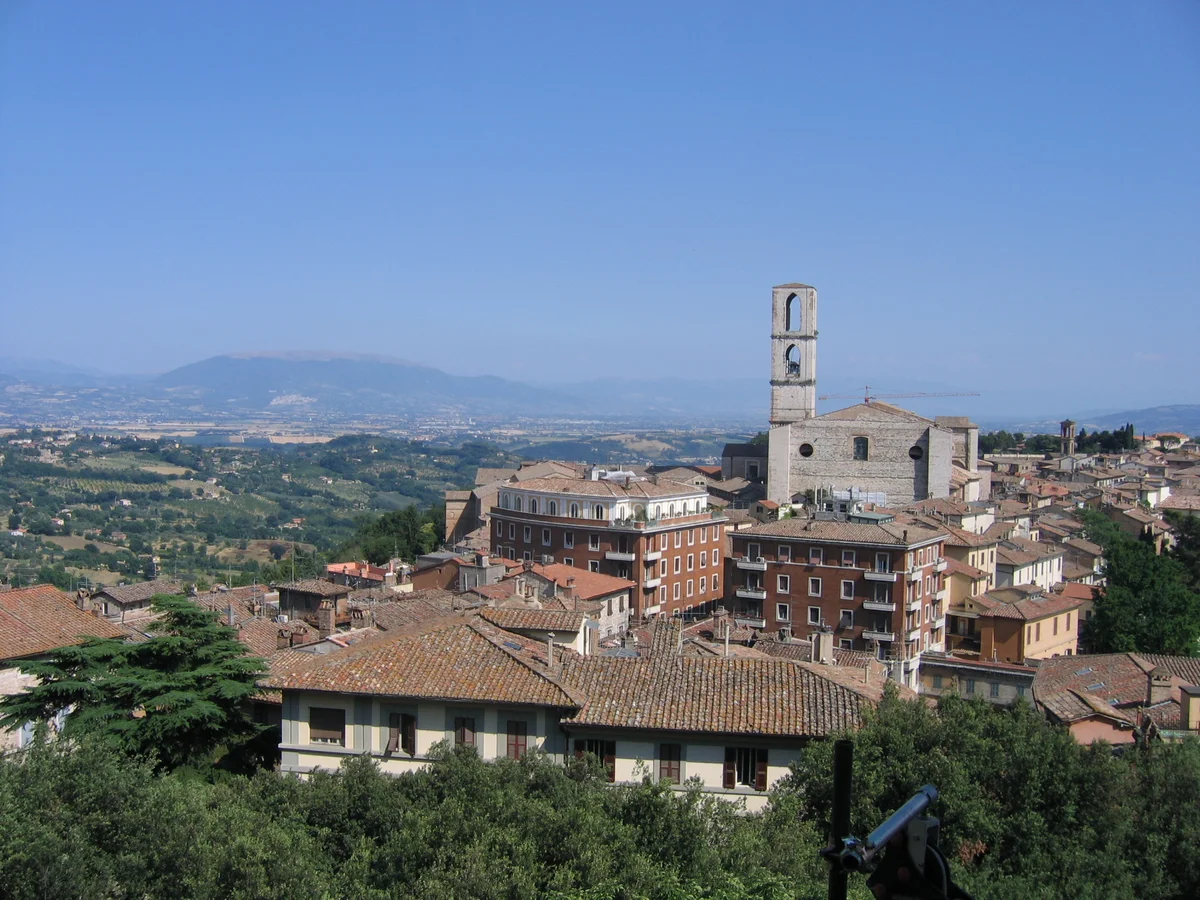
Quick answer: Perugia’s distinguishing tenant enrols by the month. The university for foreigners runs its language courses in month-long units, with quarterly cohorts starting in January, April, July and October and enrolment possible at any time. That produces a letting market with a rolling intake and no academic-year vacancy.
The city has had a university since 1308, and a separate institution drawing foreign students to it since 1921, and the way it organises its teaching is the reason the local letting market behaves unlike any other university town in Italy.
A student city usually has a hole in its year. Everyone arrives in September, everyone leaves in June, and a landlord either finds a summer tenant or accepts three empty months. Perugia does not work that way, and the reason is the structure of the courses at the institution that has drawn foreign students here for more than a century.
How the intake actually works
The Italian language and culture courses run in person with a minimum duration of four weeks, and each proficiency level is divided into micro-levels each lasting a month. To complete a level and obtain the diploma a student attends for 2 months at the entry level and 3 months at every level above it.
Quarterly courses begin in January, April, July and October, so the year contains 4 distinct cohort starts rather than one. Crucially, a student may enrol for one month or several at any point in the year, and placement is settled by an online test the month before the course starts, confirmed by an interview on the first day.
| Feature | Position |
|---|---|
| Minimum course length | Four weeks |
| Level structure | Month-long micro-levels |
| To complete entry level | 2 months |
| To complete higher levels | 3 months |
| Quarterly cohorts begin | January, April, July, October |
| Enrolment outside those months | Permitted |
Read that table as a letting calendar rather than as a prospectus. It describes a tenant who arrives on a month boundary, stays a quarter, and is replaced by another one, twelve times a year rather than once.
Why the July cohort changes the arithmetic
In a conventional university city the summer is the problem. Rooms empty in June, the market for short summer lets is thin unless the city is a tourist destination, and the owner carries three months of void or accepts a much lower rate.
A July intake removes that. The months that empty other student markets are, here, the start of a cohort. An owner with a room let from July to September is not scrambling for a summer tenant; they are in the middle of an ordinary term.
The effect on annual return is larger than it sounds, because void months do not merely reduce income, they also carry the standing costs. A unit achieving occupancy across eleven or twelve months at a given rent returns materially more than the same unit at the same rent achieving nine, and the difference compounds over a holding period.
What kind of property serves this tenant?
Modest, well located and reliably equipped. The specification list is short and it is not the one a foreign owner instinctively reaches for.
- Walking distance to the school and the historic centre, since these tenants generally do not have cars
- Furnished to a functional standard, with a signed inventory, and durable rather than decorative
- Heating that works and is affordable, because a hill city in Umbria is cold from November to March
- Internet that is genuinely reliable, which for this tenant is not a nice-to-have
- Configured either as rooms in a shared flat or as a compact self-contained unit
- A check-in arrangement that does not require the owner to be present, since arrivals cluster on the same few days
Money spent above that standard is not recovered. A tenant staying one term is not paying a premium for a designed kitchen, and the wear on a unit turning over four times a year argues for materials that survive rather than materials that photograph.
The contractual question
A stay of two or three months sits in an awkward place in Italian residential letting law, and getting the form right matters more here than in a market where every tenancy is annual.
Italian law provides a student tenancy form and a transitory form, and both are capable of covering a stay of this length. The choice affects how the contract is registered, how the income is taxed, and what documentation the landlord has to hold to support the form used. The cedolare secca guide explains the flat-rate election and where it applies; which contractual form to use is a question for a local professional, because the consequences of the wrong choice surface at the wrong moment.
What should be avoided is the informal arrangement. A tenant paying in cash on a handshake is a problem for the owner rather than for the tenant, and in a market with this much turnover the temptation is proportionally greater.
Where a unit is instead operated as short-term accommodation, the national framework in the short-let rules applies, and that is a genuinely different business from serving three-month students. Owners should choose one.
What else supports the market?
The school for foreigners is the distinctive element, not the whole of it. Perugia also hosts a large conventional university with Italian students on the usual academic calendar, a regional hospital, and the administration of the region, all of which supply longer-term tenants.
- The conventional university produces the standard September-to-June student market, at lower rates and longer terms
- The hospital produces rotating medical staff, a tenant class closer to a professional than a student
- Regional administration produces stable long-term households
- Tourism exists and is modest, concentrated on the centre and on events
A portfolio serving two of those is more robust than one serving the language school alone. The practical version of that advice is to buy units that can switch between a three-month rolling let and a nine-month academic one without alteration, which most well-chosen units can.
What the escalators changed
Perugia solved the problem of a city on a ridge with public mechanised links rather than with roads, most recently the automated line opened in 2008, and the practical geography of the city runs through them. A property’s relationship to those links, and to the car parks at their lower ends, matters more to a tenant without a car than its distance from the centre measured on a map.
For a landlord letting to students who walk, that translates into a simple test at the viewing: how long does it take to reach the school and the centre on foot, at night, carrying shopping, in February. Anything beyond about 15 min on foot, or a climb that a tenant will resent daily, shows up as vacancy rather than as a lower rent. A flat that passes that test lets every month. A flat that does not is a flat that shows well and is refused.
The same logic applies to the sale. Local buyers apply this test instinctively and remote buyers do not, which is why properties that look identical on a portal transact at visibly different prices.
Diligence in a hill city
Perugia’s historic centre is medieval, built on a ridge, and full of buildings that have been divided and redivided over centuries. Take the due diligence guide as the baseline and weight three of its items more heavily than you would elsewhere.
Access and floors. A fourth-floor flat with no lift in a city built on a hill is a harder let and a harder sale than the same flat elsewhere. Confirm what exists rather than what is described.
Heating and energy performance. Winter running costs are a live issue for a tenant paying for 3 months, and a cold hill city runs its heating from November into April, and a unit that is expensive to heat loses tenants to one that is not.
The condominium. Buildings divided into many small units generate more decisions and more disputes; the condominium guide covers what an owner can see and how liabilities transfer.
What the arithmetic looks like
An illustration for a three-bedroom flat of 96 square metres in a building within walking distance of the centre, bought at €167,000 all in and let by the room.
| Line | Amount |
|---|---|
| Three rooms at €390 a month | €14,040 a year at full occupancy |
| Realistic occupancy across the three rooms | 88% |
| Gross rent achieved | €12,355 |
| Condominium charges and heating borne by the owner | €2,180 |
| Management, cleaning between tenancies, repairs | €1,640 |
| Net before tax and IMU | €8,535 |
Two features of that model are specific to this market. The occupancy figure is high for a student let because of the July cohort, and it is the single largest driver of the result. And the management line is real: four turnovers a year per room is a different operation from one, and pretending otherwise is how remote owners end up disappointed.
An owner who prefers simplicity can let the same flat whole, to a family or to a group on one contract, at a lower gross and with a fraction of the administration. Both are legitimate; what does not work is budgeting the room-by-room gross and the whole-flat management effort.
The risk worth naming
Concentration again, in a different form. This market rests on the continued attractiveness of Italy as a place to learn the language, which depends on visa policy, on the cost of living relative to alternatives, and on the institution’s own recruitment. None of those is under an owner’s control, and all of them have moved in the past.
The practical mitigation is stock that works for more than one tenant. A flat near the centre with three real bedrooms serves language students, Italian students, a professional household and a family. A unit configured only for short monthly stays serves one market, and the more specialised the configuration, the more exposed the owner is to a change in that market.
What a buyer should verify about the institution
A thesis that rests on one school deserves one round of verification rather than an assumption, and the checks are quick.
Confirm the current course structure, since a change from monthly micro-levels to term-length courses would remove the rolling intake that makes this market what it is. The structure has been stable for years, and the institution has taught foreigners here since 1921, but stability is not a guarantee, and an enquiry costs an afternoon against a purchase held for a decade. Confirm the cohort start months, because the July cohort is the specific feature that fills the summer. And look at the accommodation the institution itself signposts or provides, since an expansion of institutional housing would compete directly with private landlords.
None of those is likely to change in a given year. All three are worth checking before committing capital to a thesis that depends on them.
Where this sits in Umbria
The Umbria guide covers the region. Within it, the useful contrast is with Assisi, 20 kilometres away and running on an entirely different calendar: devotional dates, a statutory holiday from 2026, and a thin winter. Perugia’s year is continuous and Assisi’s is clustered, which is why the comparison of the two treats them as complementary rather than as competitors.
The proposition here is unglamorous and durable. This is not a market where prices are about to move sharply, and it is not a trophy address. It is a small city where a specific institution generates a tenant flow that does not stop in August, and where an owner who serves that flow properly achieves near continuous occupancy that most Italian student markets cannot.
Frequently Asked Questions
In person, with a minimum duration of four weeks, and each level divided into micro-levels lasting one month each. Quarterly courses begin in January, April, July and October, but a student may enrol for one or more months at any point in the year. That structure is what produces a rolling rather than an annual intake.
Long enough to complete a level, which means two months at the entry level and three months at every level above it. The result is a tenant whose natural stay is a quarter rather than a term, which fits neither a nightly listing nor a nine-month student contract.
Because there is no long summer void. In a conventional university city the letting year has a hole in it from June to September. Here a cohort begins in July, which means the months that empty other student markets are working months, and the annual occupancy that results is higher for the same rent.
Furnished, close enough to walk to the school and the centre, with reliable heating and internet, and configured as rooms in a shared flat or as a small self-contained unit. What it does not need is a designer interior, and money spent on one is not recovered by a tenant staying twelve weeks.
Italian law provides forms for students and for transitory needs, both of which are capable of covering a stay of this length, and the choice affects registration, taxation and the evidence the landlord must hold. It is a question for a local professional rather than a template, because the wrong form is a problem that surfaces late.
More than an annual let and less than a holiday one. Arrivals and departures are clustered at month boundaries, which makes them predictable and schedulable, but there are several of them a year per unit. Owners who live abroad should price a local manager into the model rather than assume they will handle it remotely.
Not entirely. The city also hosts a large conventional university, a regional hospital and public administration, which supply longer-term tenants. The distinctive rolling demand comes from the school for foreigners, and a sensible portfolio serves both rather than betting on one.
The two towns fill in opposite months. Assisi's demand clusters on devotional dates and thins in winter; Perugia's runs continuously and is strongest when students arrive. The comparison of the two sets out why they are complementary rather than competing.
Get an Italy property shortlist
Tell us your budget and region (Tuscany, Lake Como, Puglia, Milan, Sardinia). We reply within one business day with options matched to your goals.