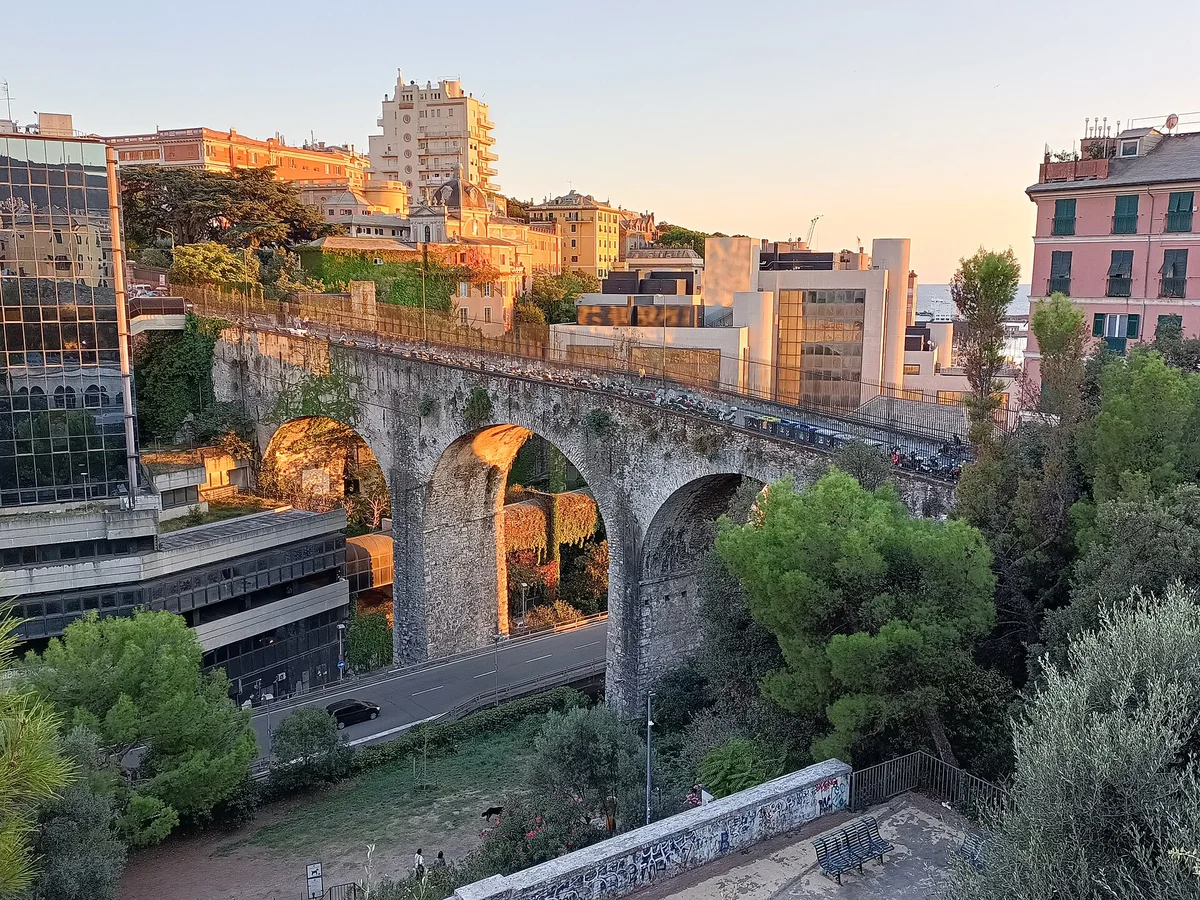
Quick answer: Genoa treats vertical movement as public transport. Twelve municipal lifts, two funiculars and a rack railway are part of the same network as the buses and the metro, and which of them serves an address does more to determine its practical accessibility than the number of metres to the centre.
Every city has an idea of what central means and Genoa’s is unusual. The city runs along a narrow strip between the sea and steep ground, and the neighbourhoods above the strip were reached historically by staircases and mule paths. What the twentieth century added was not roads but lifts, and the city never treated them as curiosities. They are line items in the transport network, and property behaves accordingly.
What does the network actually contain?
The municipal transport company operates a set of installations that would be tourist attractions elsewhere and are commuter infrastructure here.
| Installation | Type | Note |
|---|---|---|
| Twelve public lifts | Vertical and inclined | Ordinary network fare |
| Zecca to Righi | Funicular | Serves the upper city |
| Sant’Anna | Funicular | Short central link |
| Principe to Granarolo | Rack railway | Hillside above the station |
Ten of the lifts entered service between the early 1910s and the late 1970s, which tells you how long the city has been solving this problem. The Castelletto lift dates from 1909 and rises to the belvedere that appears on every postcard of the city. The most recent addition, the inclined lift at Quezzi, opened in 2015 and covers roughly 130 metres of travel between via Pinetti and via Fontanarossa.
The single fact that turns this from municipal trivia into a property consideration is the ticketing. One ordinary urban ticket, valid for 110 minutes from validation, covers buses, the metro, the funiculars and the lifts across the network. A resident going up a cliff face is making a journey, not visiting an attraction.
Why does this change how an address reads?
Property search tools measure horizontal distance because that is what a map gives them. In Genoa the binding dimension is vertical, and the two are only loosely related.
Consider two flats in the upper city, both 900 metres from the same central street. One sits 80 metres of elevation above a lift entrance that runs into the evening. The other sits on the same contour, 250 metres along it, with a staircase as its only connection. On a portal the two are near-identical. In use they belong to different markets, and local buyers price them differently without needing to explain why.
That produces four questions a remote buyer should ask about any Genoese address above the strip:
- Which installation serves it, and how far is the walk at each end
- What hours does that installation run, since a shorter operating day changes an evening commute more than a longer walk does
- What is its recent reliability and closure history, which the operator publishes and neighbours remember
- Is there an alternative link, or is the address dependent on a single machine
None of that appears in a listing, and all of it is obtainable before an offer.
What changed on 1 November 2025?
For roughly four years the city ran an experiment in free travel on the metro and the vertical installations. In its later form the entitlement ran through a dedicated pass reserved to residents of the metropolitan city between 14 and 70 years old, requested through the citizen’s online file after obtaining the transport card, and from 17 February 2025 also obtainable at ticket offices against an administrative charge. That pass was valid until 31 October 2025, and from the following day the metro and the vertical installations required an ordinary travel document again.
Two consequences follow for a buyer looking at hill addresses.
The first is arithmetic. A household whose daily route runs through a lift or a funicular has a recurring transport cost that a household on the level does not, and for four years that cost was zero. Restoring it does not change the ranking of addresses, but it changes the gap, and anyone who formed an impression of Genoa during the free period formed it under conditions that no longer apply.
The second is about residence. The entitlement was tied to residency in the metropolitan city, which means it never applied to a second-home owner or to a tenant who had not registered. Foreign owners reading about free city transport should note that the schemes of this type are usually resident schemes, and that residency in Italy carries tax consequences well beyond a travel pass.
What about the lift inside the building?
Public vertical transport solves the hillside. It does not solve the fourth floor, and a large share of Genoese buildings have no lift of their own.
Italian law treats installing one as removing an architectural barrier rather than as a discretionary improvement, and that changes the voting position materially. Under article 2 of law 13 of 1989, resolutions on works to remove architectural barriers are approved with the majority set by the second paragraph of article 1120 of the Civil Code, and such works may never be classed as merely ornamental under article 1121. Owners who vote against are exempt from the cost where the facility is capable of separate use, and may join later by contributing to it. The prohibition on works that prejudice the stability or safety of the building continues to apply.
The legal route being open is not the same as the works being possible. Genoese buildings are narrow, deep, tall and frequently built directly against rock, with stairwells that will not accommodate a shaft and facades under heritage supervision. The sequence that works is a structural opinion first, a heritage view second and an assembly resolution third, rather than an enthusiastic vote followed by the discovery that the building cannot take it.
How condominium decisions are taken, what a foreign owner can see of the accounts and how liabilities transfer with a flat are covered in the condominium guide. Costs for the works themselves sit in the renovation guide, with the caveat that a retrofit shaft in a historic building belongs at the expensive end of any range.
What does the hillside cost to own?
Vertical access has running costs that a level address does not, and they are predictable enough to model.
Deliveries are the first. Furniture, appliances and building materials reaching an address served only by a lift or a staircase are a specialist job rather than a standard one, and quotes reflect it. Owners who plan a renovation on a hill address should ask their contractor how materials will arrive before agreeing a price, because the answer moves the number.
Parking is the second. Above the strip, off-street parking is scarce and frequently sits some distance from the flat it serves, which makes a parking title worth verifying in writing rather than assuming from the agent’s description. A space that cannot be transferred, or that turns out to be a licence from a third party, is a common and expensive discovery.
Maintenance is the third. Buildings founded on rock and exposed to a maritime climate deteriorate in specific ways, and the works that follow are structural rather than cosmetic. The condominium’s history of extraordinary works tells a buyer more about the next decade than the state of the entrance hall does.
- Ask for three years of administrator accounts and the minutes that go with them
- Read the minutes for approved but unstarted works, which transfer with the flat
- Establish whether the building has a maintenance plan or a habit of emergency repairs
- Confirm how the building is reached by a van, not by a person
What makes the historic centre harder than it looks?
Genoa’s medieval core is among the largest in Europe and among the least standardised. Buildings there grew by accretion over centuries, and the legal shape of what a buyer acquires reflects that rather than a modern subdivision.
Four situations recur and each of them takes time to resolve.
Interlocking units are the first. A flat may occupy parts of two adjoining buildings, or a room may sit above a neighbour’s passage, so the boundary of the property is a matter for the deed and the plan rather than for the walls. Verifying that the plan matches the building is not a formality here.
Undivided common parts are the second. Courtyards, stairs, wells and passages are frequently shared between buildings rather than within one, which means the parties who must agree to a repair are not the parties on the entrance intercom.
Missing or partial permit history is the third. Alterations made across decades in a dense fabric produce gaps between what is registered and what stands, and the gap transfers to the buyer.
Ground-floor uses are the fourth. Commercial, storage and workshop uses persist at street level, and a residential purchase above one inherits noise, access and sometimes structural interaction with it.
- Commission a surveyor who works in the centre specifically, not one who works in the city generally
- Treat any purchase where the seller cannot produce a coherent plan as a project rather than a home
- Budget the professional fees as a fixed cost rather than a percentage, because they do not scale down with a low price
- Allow calendar time for the enquiries, since the answers come from several offices and none of them is in a hurry
The reward for that work is real. Prices in the centre are among the lowest of any major Italian city, the buildings are extraordinary, and the parts of it that have been carefully restored have held value. The failures are almost never people who paid too much. They are people who bought a building they had not understood, in a fabric where understanding takes longer than a weekend and costs more than a survey elsewhere would.
Where does the rest of the city sit?
The vertical question does not apply everywhere, and the parts of Genoa where it does not are the parts most foreign buyers look at first.
- The historic centre. Dense medieval fabric on the flat, with the most complicated buildings in the city: shared structures, unclear boundaries and long histories of alteration. Prices are low for a reason and the due diligence file is not optional here.
- The eastern seafront districts. Level, better built, more expensive, and the traditional address for professional households. Vertical links matter less and parking matters more.
- The western districts. Working port and industry, cheaper, and the place where the vertical network’s older installations do the most daily work.
- The Levante towns beyond the city. A different market that trades on the coast rather than on the city, and one that the Liguria guide covers alongside Santa Margherita Ligure and Savona.
For buyers weighing the region against a lake market, the Liguria and Lake Como comparison frames that choice, and the Genoa and Florence comparison sets out how differently the two cities’ buyers behave.
Genoa’s reputation among foreign buyers is that it is cheap for what it is. That is true, and the reason usually given, that the city is industrial and unglamorous, is only half of it. The other half is that a great deal of its housing stock is difficult to reach, and the city solved that problem with public machinery rather than with roads. Learning to read which machine serves which address is the local knowledge that separates a good purchase here from a cheap one.
Genoa is the value entry to this coast, and the rest of what we hold in the region is priced on property for sale in Liguria.
Frequently Asked Questions
Twelve public lifts, two funiculars on the Zecca to Righi and Sant'Anna routes, and the Principe to Granarolo rack railway, all operated by the municipal transport company as part of the ordinary network. One urban ticket covers them alongside buses and the metro, which is what makes them transport rather than tourist attractions.
Most are historic infrastructure still in daily service. Ten of the lifts entered service between the early 1910s and the late 1970s, the Castelletto lift dating from 1909 and reaching the city's best known belvedere. An eleventh opened in late 2010 and the inclined lift at Quezzi, with roughly 130 metres of travel, opened in 2015.
Because in a city built on slopes, horizontal distance describes very little. A flat 40 metres of elevation above a lift entrance can be closer in practical time to the centre than one on the same contour with no vertical link. Portal search radii measure the wrong axis, which is why local buyers and remote buyers reach different conclusions from the same listings.
It was, for a period. Free use of the metro and the vertical installations ran as an experiment for around four years, latterly through a pass reserved to residents of the metropolitan city aged between 14 and 70, obtained through the citizen's portal after applying for the transport card. That arrangement ended and from 1 November 2025 a valid ticket is required again.
It restores a recurring cost that had been removed, for households whose daily route depends on a lift or funicular. It is not large in absolute terms, but it is a running cost attached to the address rather than to the flat, and it belongs in a comparison between a hill address and a level one.
Often yes, and the law makes it easier than an ordinary improvement. Removing architectural barriers is approved by the assembly under the majority in article 1120, second paragraph of the Civil Code, and such works are never treated as merely ornamental. Dissenting owners are exempt from the cost of a facility capable of separate use, and may later join by contributing.
Space and structure. Genoese buildings are frequently narrow, deep and built against rock, with stairwells too tight for a shaft and facades under heritage supervision. The legal route being available says nothing about whether the building can take the works, which is a question for a structural engineer before it is a question for the assembly.
It is old, dense and highly variable, and the historic centre contains some of the most complex buildings in Italy. That is the reason the ordinary Italian diligence file matters here more than the low prices suggest, and the reason a survey should precede rather than follow an offer.
Get an Italy property shortlist
Tell us your budget and region (Tuscany, Lake Como, Puglia, Milan, Sardinia). We reply within one business day with options matched to your goals.