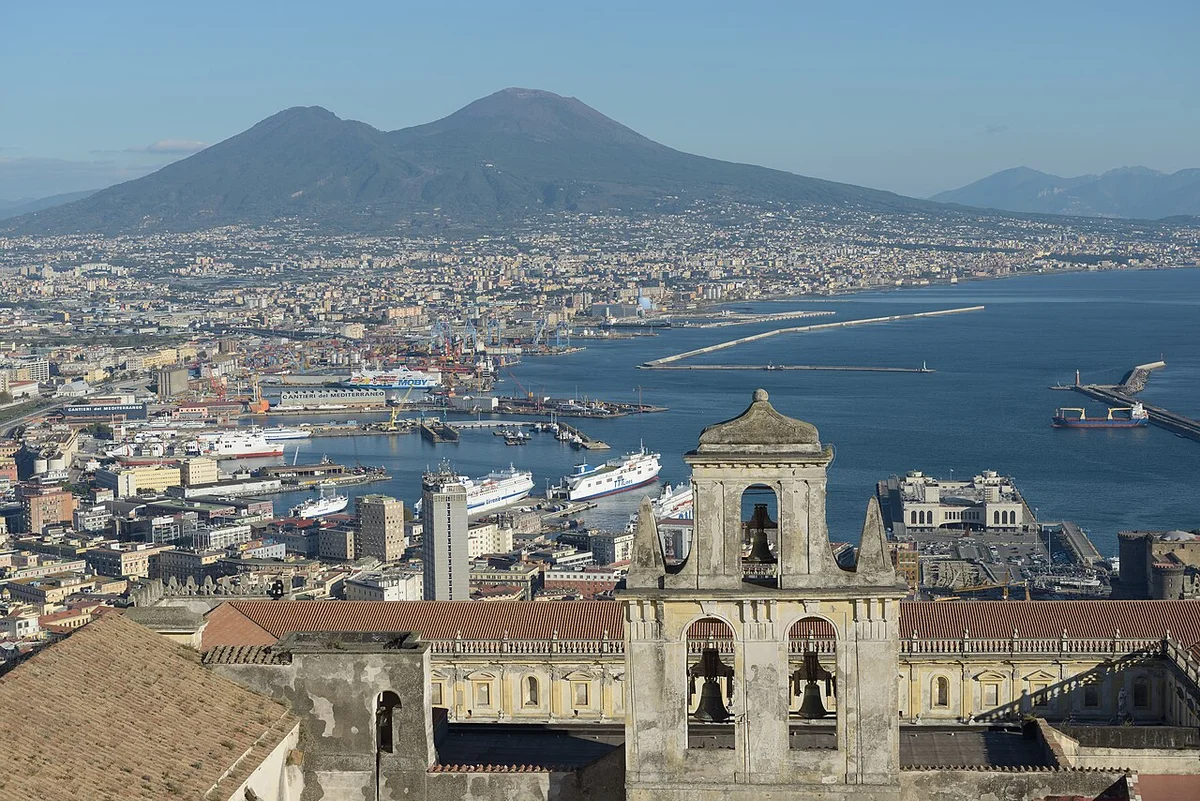
Quick answer: The instrument that decides what can be built in Naples is not the municipal plan but volcanic emergency zoning. The Vesuvian red zone has forbidden new residential volume since 2003, and after the bradyseismic escalation of 2023 the same logic was extended west to a perimeter that includes Bagnoli, Fuorigrotta, Soccavo, Pianura and part of Posillipo.
Most guides to Naples sort the city by view and by price per square metre. The city sorts itself differently. Two active volcanic systems bracket it, one to the east and one to the west, and each has produced a body of planning law that overrides the ordinary municipal instrument. Where an address falls in relation to those two perimeters determines what may be built on the parcel, what documentation exists about the building, and what the emergency plan says happens to the neighbourhood in a crisis. None of that appears in an asking price.
Which authority actually limits building in Naples?
The answer is regional and national emergency legislation, not the comune. A Neapolitan address can be fully compliant with the municipal planning instrument and still sit under a prohibition that the comune has no power to lift, because the prohibition comes from a regional law written to reduce the population exposed to a volcanic hazard.
That produces a hierarchy foreign buyers rarely expect:
- The national emergency plan draws the zones and is maintained by the civil protection department
- Regional law converts the zones into urban planning rules that bind the comuni inside them
- The comune applies those rules through its own instrument and its building permits
- The individual deed is unaffected in its ability to transfer, but the parcel’s development capacity is set two levels above the notary
For the ordinary seismic classification that applies to every Italian comune regardless of volcanoes, our seismic zones guide sets out the four-zone national framework and what it changes about construction standards. The Neapolitan volcanic layer sits on top of that and behaves differently.
What does the Vesuvian red zone prohibit?
Regional law 21 of 10 December 2003 carries the title of urban planning rules for the municipalities in the high volcanic risk area of the Vesuvian zone. Its article 5 states the operative prohibition: no building permit may be issued for interventions that increase residential building, and the comuni inside the zone may not adopt planning provisions that allow new residential volume or the settlement weight that would come with it.
Eighteen municipalities fall inside the perimeter: Boscoreale, Boscotrecase, Cercola, Ercolano, Massa di Somma, Ottaviano, Pollena Trocchia, Pompei, Portici, San Giorgio a Cremano, San Giuseppe Vesuviano, San Sebastiano al Vesuvio, Sant’Anastasia, Somma Vesuviana, Terzigno, Torre Annunziata, Torre del Greco and Trecase.
| Element | Position under L.R. 21/2003 |
|---|---|
| New residential volume | Prohibited inside the red zone |
| Sale of existing dwellings | Unaffected |
| Renovation within existing volume | Governed by ordinary rules |
| Municipal planning discretion | Cannot restore what the law removed |
| Stated aim | Long-term reduction of exposed population |
The commercial consequence for anyone buying in Portici or Torre del Greco is a supply floor. New apartment blocks are not coming, because the instrument that would permit them cannot be adopted. Whether that supports prices or reflects a risk the market is discounting is a judgement, but it is a structural fact about the sub-market rather than a cyclical one, and it has held for over two decades.
What changed at the Campi Flegrei after October 2023?
The caldera west of the city entered an intensified phase of ground uplift, and on 12 October 2023 the government adopted Decree Law 140, titled urgent measures for the prevention of seismic risk connected to the bradyseismic phenomenon in the Campi Flegrei area. Its article 2 ordered an extraordinary plan of seismic vulnerability analysis covering public and private buildings inside a defined intervention zone in the comuni of Pozzuoli, Bacoli and Naples.
That instruction produced something unusual in Italian property. A general survey programme walked through an urban area and recorded structural information about individual private buildings, and the results are administrative records rather than the private opinion of a seller’s surveyor.
The planning half followed a year later. Regional government resolution 485 of 24 September 2024 set out the approach, and a regional bill on urban planning rules for the prevention of bradyseismic risk in the Campi Flegrei area went to the regional council in November 2024, extending the Vesuvian model: avoid any increase in residential settlement weight, which in practice removes new volume from the perimeter.
Because that framework has moved more than once since 2023, the current text should be checked for the specific parcel rather than assumed from a summary. What has not moved is the direction of travel, which is toward the Vesuvian answer.
Which Naples addresses sit inside the bradyseismic perimeter?
This is where the subject stops being about Pozzuoli. The red zone identified in the emergency planning covers a resident population of 84,961, and the split is instructive.
| Component of the red zone | Residents |
|---|---|
| Pozzuoli | 44,639 |
| Naples: Bagnoli, Soccavo, Pianura, Fuorigrotta, Posillipo | 30,389 |
| Bacoli | 9,933 |
| Total | 84,961 |
Just over a third of the exposed population lives in the city of Naples rather than in the caldera comuni. The districts named include Fuorigrotta, which is dense mid-century residential stock around the stadium and the university’s engineering faculty, and part of Posillipo, which is the most expensive residential address in the metropolitan area.
A buyer looking at a sea-view apartment on the Posillipo ridge and a buyer looking at a two-bedroom flat in Fuorigrotta are, on the planning question, in the same conversation. Very few property listings for either address mention it.
Bagnoli sits inside the same perimeter while simultaneously being the city’s largest brownfield regeneration site, on the footprint of the former steelworks. Any underwriting of Bagnoli that rests on future residential delivery has to reconcile that ambition with a regional framework built to prevent exactly the increase in residential settlement weight that a large delivery would represent.
What does a vulnerability survey mean for one flat?
The extraordinary plan surveys buildings, not apartments, and it produces an assessment of the structure rather than a verdict on habitability. For a purchaser this is an asset, because it is information that does not exist for equivalent buildings in Milan or Bari.
Practical use of it looks like this:
- Establish whether the building was included in the survey programme, which depends on its position inside the intervention zone
- Ask the administrator, in writing, for any survey correspondence held in the condominium’s records
- Read the assemblea minutes for the two years following the survey, because a result that indicates work usually appears first as a vote rather than as a document
- Treat any approved but unstarted structural programme as a cost that transfers with the flat, in the ordinary way that Italian condominium liabilities do
- Compare the picture against the renovation cost guide before deciding what a structural intervention would actually cost
The pattern to avoid is treating the survey as reassurance. It is a measurement. What matters is what the building’s owners decided after reading it, and that decision lives in the condominium’s records, which our condominium rules guide explains how to obtain and read.
How does this change the questions asked before an offer?
The standard Italian diligence list applies here in full, and the due diligence guide sets out its seven items. Naples adds four questions on top of it, and all four are answered from public documents rather than from the seller.
| Question | Where it is answered |
|---|---|
| Which perimeter, if any, contains the parcel | Civil protection intervention zone map |
| What the parcel is permitted to become | Certificato di destinazione urbanistica |
| Whether the building was surveyed | Condominium records and comune correspondence |
| What the emergency plan assigns to the address | Municipal civil protection plan |
The fourth question deserves a note. Italian municipal emergency plans assign evacuation destinations and routes at neighbourhood level, and the assignment is public. For an owner who will let the property to families or run it as a short-let, knowing what the plan says about the address is operational information, not background reading.
Where does this leave the rest of the city?
Outside the two perimeters, Naples is governed by ordinary planning plus heritage supervision, and the binding constraint changes completely.
- Vomero and the eastern hills. Mid-century and later stock on the funicular and metro lines. The constraints that decide a purchase here are the condominium regulation, lift and structural upgrade programmes, and the parking title, which is frequently non-assignable and worth more than buyers expect.
- Chiaia and the seafront. Older, denser, more heavily supervised. Facade and window work runs through the Soprintendenza, and lead times rather than costs are what surprise foreign owners.
- The historic centre. UNESCO inscribed, with unpermitted alteration accumulated over decades. The gap between the cadastral plan and the building as it stands is the single most common finding, and it transfers to the buyer at the deed.
- The eastern periphery. Cheaper per square metre and outside the volcanic perimeters, but with transport quality that varies street by street rather than district by district.
Short letting sits across all of these and is regulated at national and municipal level rather than by the emergency plan; the short-term rental rules explain the CIN requirement and where the comune’s own restrictions attach.
What should a foreign buyer take from all this?
Three things, and none of them is a reason to stay away from the city.
First, the perimeter is a supply fact. In the Vesuvian comuni it has removed new residential volume for more than twenty years, and the western perimeter is moving the same way. Any thesis about Neapolitan property that assumes new delivery needs to state which side of the line the delivery would sit on.
Second, the western districts are better documented than their neighbours, not worse. The vulnerability programme created records that a buyer can ask for, and asking for them is the difference between underwriting a building and guessing at it.
Third, the questions above are answered before a deposit, not between compromesso and deed. Two of the four documents are held by the comune and take days rather than weeks, and the cost of obtaining them is negligible against a purchase in a city where the planning framework is genuinely unusual.
Naples and the coast south of it are priced very differently, and both appear on property for sale in Campania.
Frequently Asked Questions
Yes. Nothing in the bradyseismic legislation restricts the sale or ownership of an existing dwelling, and Pozzuoli, Bacoli and the western districts of Naples transact normally. What the rules restrict is the creation of new residential volume, which is a planning constraint on the land rather than a constraint on the transfer of a flat that already exists.
The area identified for intervention covers the whole of Pozzuoli and Bacoli and part of Naples itself: Bagnoli, Fuorigrotta, Soccavo, Pianura and part of Posillipo. Roughly 30,000 of the red zone's residents are Neapolitans rather than Puteolans, which surprises buyers who assume the phenomenon is confined to Pozzuoli.
It is the emergency measure adopted after the 2023 escalation of ground uplift at the Campi Flegrei. Its article 2 ordered an extraordinary plan of seismic vulnerability analysis on public and private buildings inside the intervention zone, which is why individual buildings in Pozzuoli and Bagnoli now carry survey results that did not exist before.
The Vesuvian red zone has been under an explicit planning ban since regional law 21 of 10 December 2003, whose article 5 forbids permits that increase residential building across eighteen municipalities. It is the older and better-tested instrument, and the Campi Flegrei rules were drafted to extend the same logic westward.
It affects what you can verify rather than what the seller asks. A building that has been surveyed under the extraordinary plan has documentation about its structural condition that comparable buildings elsewhere in Italy do not have, and a buyer who requests it is better informed than one relying on a visual inspection and the year of construction.
No. The eastern hill districts and the historic centre sit outside both volcanic perimeters and are governed by ordinary planning rules plus heritage supervision. Their binding constraints are the Soprintendenza and the condominium, not the emergency plan, which is why diligence on a Vomero flat and a Bagnoli flat asks different questions.
It should change which addresses you compare and which documents you ask for. A perimeter that removes future residential supply has one effect on existing stock and another on land, and a buyer who understands which side of the line an address falls on is making a different decision from one who reads a district name on a portal.
The civil protection department publishes the intervention zone map, the comune holds the planning instrument that applies to the parcel, and the certificato di destinazione urbanistica states what the land permits. All three should be in the file before a deposit, because the regional framework has moved repeatedly since 2023.
Get an Italy property shortlist
Tell us your budget and region (Tuscany, Lake Como, Puglia, Milan, Sardinia). We reply within one business day with options matched to your goals.