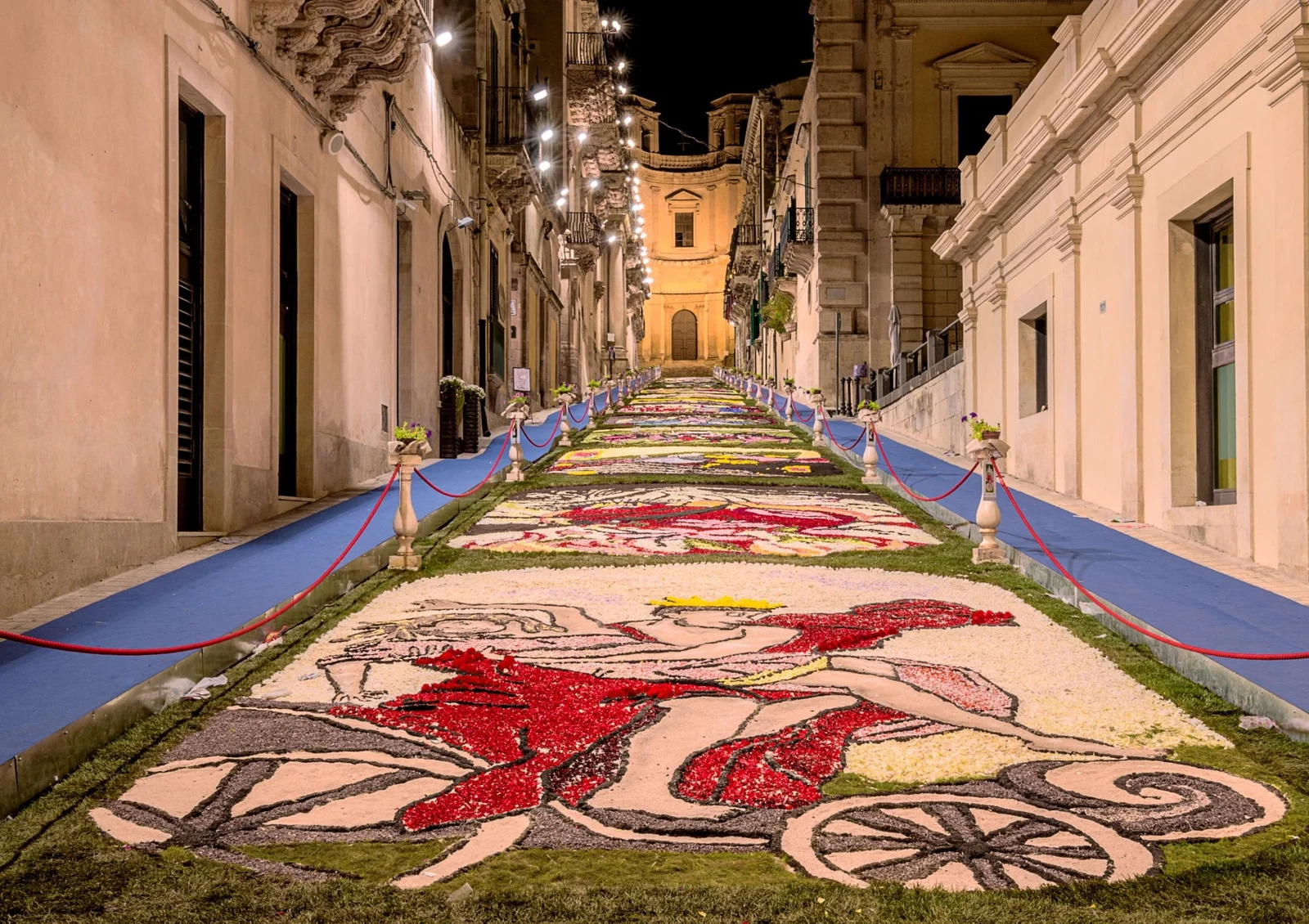
Quick answer: Noto is unusual among Italian towns in having almost no age diversity. The earthquake of 1693 destroyed it and reconstruction rebuilt it within a few decades, in one stone and one construction technique. The whole stock therefore behaves alike, ages alike and needs work at the same time.
Most Italian historic centres are an accumulation. A medieval core, a renaissance palace, a nineteenth-century infill, a post-war repair. Diligence in such a town is largely about establishing which of those you are buying. Noto is the opposite case, and it changes what the questions are.
Why the town has no age diversity
The earthquake of 1693 devastated south-eastern Sicily, destroying entire settlements and, as the historical accounts put it, erasing the urban memory of the area. Reconstruction over the following decades produced a unified late baroque environment across a group of towns, with shared architectural and artistic solutions.
Eight of those towns were inscribed on the world heritage list in 2002 as the late baroque towns of the Val di Noto: Caltagirone, Militello in Val di Catania, Catania, Modica, Noto, Palazzolo Acreide, Ragusa and Scicli.
The consequence for a purchaser is that the usual first question, what period is this building, has a single answer for most of the town. That is convenient, and it is also the source of the specific risk this page is about.
One type, one failure mode
The reconstruction used what was locally available: a soft, pale limestone that carves readily, worked into the elaborate elevations the towns are known for, over load-bearing masonry walls with timber floors.
That combination produces a predictable set of conditions.
| Element | Behaviour | What it means for a buyer |
|---|---|---|
| Carved limestone elevation | Surface decay with exposure and moisture | Recurring maintenance, not a one-off restoration |
| Load-bearing masonry | Walls carry the loads | Internal reconfiguration is structurally constrained |
| Timber floors | Deflection, insect and moisture damage | A survey item, and a cost when it appears |
| Roofs of the same generation | Reach the end of their lives together | Concentrated demand on the local trade |
Because every building shares those characteristics, they present the same problems, and they present them at broadly the same time.
Why simultaneous ageing is the real risk
In an ordinary town, buildings of different periods reach their major intervention cycles at different moments, which spreads demand across the local building trade. Here the spread does not exist.
Three practical consequences follow.
The specialist trade is small and busy. Working carved limestone under heritage supervision is a craft, the number of firms able to do it well in any one town is limited, and when several buildings need the same work in the same year they compete for the same people.
Quotes and availability decouple. A buyer can obtain a reasonable price or a prompt start, and frequently not both. Renovation timetables here should be built with that assumption rather than around it.
Public works compete with private ones. Restoration of civic and religious buildings draws on the same trade, and a major public project absorbs capacity that private owners would otherwise use.
The renovation cost guide sets out the national ranges. Work of this type sits above them, and the scheduling constraint is as important as the price.
What the diligence should actually look at
Start from the due diligence guide. On a building of this type, four investigations account for most of what a buyer can usefully learn.
- The condition of the external stonework, assessed by someone who works with this material rather than by a general surveyor
- The state of the timber floor structures, which is not visible from a viewing and is the most common expensive surprise
- The roof, its covering and its structure, and when it was last addressed
- The heritage position of the specific building, including what the supervision requires for any exterior work
To that list add a fifth item that is specific to a single-period town: ask what work the neighbouring buildings have had. Shared walls in a continuous terrace mean that a neighbour’s neglect is your structural problem, and a street where several owners have already carried out work is a materially better prospect than one where nobody has.
What UNESCO inscription changes
Inscription in 2002 applies at the scale of the town rather than to individual monuments, which is what makes it consequential for ordinary residential buyers. Exterior work runs through supervision, materials and methods are constrained, and the management framework has objectives that a private owner’s preferences do not override.
That is a cost and a protection at the same time. The reason the town looks the way it does, and the reason property in it commands what it does, is that the constraint has been applied consistently. A buyer who resents the supervision has generally misunderstood what they are buying.
What a survey should actually be commissioned to do
A general condition survey of a building like this tells a buyer very little, because the answer is known in advance: masonry, stone, timber, all around 300 years old. What is worth paying for is a targeted investigation of the three things that vary between buildings.
The first is the stonework’s depth of decay. Surface erosion is universal; how far it has gone, and whether structural elements are affected, is not. That requires someone who has repaired this material to look at it.
The second is the timber. Floor and roof structures of this age fail at their bearings, where the timber enters the masonry and where moisture collects. Opening up at one or two points tells a buyer more than an hour of visual inspection.
The third is water. Roof, gutters, downpipes, and the way water is shed from the elevation, because almost every problem in a building of this type is ultimately a water problem that was allowed to continue.
- Commission the survey before the offer, not between compromesso and deed
- Ask for a written scope rather than accepting a standard report
- Require the surveyor to open up where necessary, with the seller’s consent negotiated in advance
- Treat a refusal to allow investigation as information in itself
Letting and the operating question
Noto is substantially a short-let market, seasonal in the Sicilian pattern with a long shoulder either side of the summer peak. Registration and reporting follow the national position set out in the short-let rules.
What is specific is the mismatch between a maintenance-heavy asset and a concentrated earning period. A building that needs recurring specialist attention earns for perhaps six months of the year, and the maintenance has to be scheduled in the months when it does not. Owners who plan works for the spring, then find the season starting, end up either losing weeks of income or deferring the work another year, and deferring stonework is how a maintenance item becomes a restoration.
- Schedule works for the deep off season and commit to the dates early
- Treat facade maintenance as an annual line rather than a decade event
- Build the operating model on a six month season, not on twelve
- Confirm that any condominium or shared structure allows the works you intend
What a coherent town does to value
Single-period building stock has commercial consequences as well as maintenance ones, and they run in both directions.
On the positive side, the coherence is the product. A street where every elevation belongs to the same moment is why visitors come and why the town commands what it does. That is a durable attraction rather than a fashion, protected by supervision that keeps it intact, and it supports values in a way that a mixed streetscape does not.
On the negative side, coherence removes the cheap option. In a town with buildings of many periods, a buyer priced out of the best fabric can buy a plainer building nearby. Here there is no plainer building; there is the same building in worse condition. That compresses the range of entry points and pushes buyers with modest budgets toward properties that need the most work.
The practical response is to accept that the condition spectrum, not the architectural spectrum, is what a budget buys along. A buyer with limited funds is choosing a project, and should price it as one from the start rather than hoping to find a bargain that is also finished.
- The floor of the market is a building needing structural work, not a cheaper building type
- Finished, certified properties trade at a clear premium and sell faster
- Half-finished projects are the hardest asset to sell here, as everywhere
- Budget for the whole project before committing, since stopping midway destroys value
Practical sequence for a purchase
- Establish the heritage position and what exterior work would require, before falling in love with a facade
- Obtain a specialist assessment of the stonework and the timber structures
- Get a real quotation from a firm that works in this town, with a start date rather than an intention
- Confirm the position of shared walls and of the neighbouring buildings’ condition
- Only then set the price you are prepared to pay, working backwards from finished value
The wider Val di Noto question
Because eight towns were rebuilt together, a buyer choosing among them is choosing between variations on one proposition rather than between different markets. That is genuinely useful, because it means the diligence learned in one town transfers to the others, and it means comparisons between them can be made on the things that actually differ.
What differs is scale, accessibility and the depth of the visitor economy. A larger town has more services, more year-round life and a deeper resale market. A smaller one is cheaper, quieter and harder to sell. Coastal access varies, and so does the distance to an airport, which for a short-let owner is the single most influential logistical fact about a location.
What does not differ is the building. The same stone, the same construction, the same age, the same supervision. A buyer who has understood one of these towns technically has understood all eight, which is an unusual advantage in Italian property and is worth using deliberately: view across several of them, and choose on the economics rather than on the architecture, because the architecture is close to constant.
Access is the other constant
For a market that depends on visitors, the journey from an airport is a structural fact rather than a detail. South-eastern Sicily is served from Catania and from Comiso, and drive times from either run to roughly 60 min to 90 min depending on the town. That is long enough to shape booking behaviour: guests arriving from northern Europe generally hire a car, which means parking matters, and it means a property reached only on foot through a pedestrian centre needs a solved parking answer rather than a hopeful one.
It also shapes the length of stay. A journey of that length discourages two-night bookings and encourages weeks, which suits an owner with a maintenance-heavy asset because it reduces turnovers. Owners here generally do better setting a minimum stay of 4 or 5 nights than chasing weekend traffic that the geography does not supply.
Where this sits in Sicily
Syracuse and its island of Ortigia is the closest comparison and has a longer, more mixed history, which makes its building stock more varied and its diligence more like a mainland town’s. Palermo is a different case again, a patchwork of periods and conditions governed building by building under a detailed plan. Taormina is a resort market whose economics have little to do with any of them.
The Sicily guide sets out the island as a whole, and the Sicily and Puglia comparison frames the wider southern choice.
The case for Noto is that it is one of the most coherent historic environments in Europe, at prices far below what comparable coherence costs on the mainland. The case against buying carelessly is that the coherence extends to the problems, and a buyer who has not budgeted for a building type that ages all at once has budgeted for a different town.
Baroque stone houses around Noto are the cheapest restoration entry we cover in Sicily; see them priced on property for sale in Sicily.
Frequently Asked Questions
Because it was destroyed and rebuilt in one campaign. The earthquake of 1693 razed the towns of south-eastern Sicily, and reconstruction in the first decades of the eighteenth century produced a coherent late baroque built environment across eight settlements. Very little of what stands predates that, which is unusual anywhere in Italy.
Caltagirone, Militello in Val di Catania, Catania, Modica, Noto, Palazzolo Acreide, Ragusa and Scicli, inscribed in 2002 as the late baroque towns of the Val di Noto. Inscription brings supervision of exterior work and a management framework, and it applies at town scale rather than to individual monuments.
Surface decay of a soft local limestone that was chosen because it carves easily, combined with the behaviour of load-bearing masonry with timber floors. Buildings across the town suffer the same problems at the same rate, which makes the local restoration trade specialised and the cost predictable.
Because it removes the diversification a normal town provides. Where buildings span four centuries, major intervention cycles are staggered. Here they coincide, which concentrates demand on a small pool of specialist contractors and means that a good quote and a fast start are not always available at the same time.
No. It is a reason to have the facade assessed by someone who works with it, and to budget maintenance as a recurring item rather than as a one-off restoration. A carved elevation is the reason the property is worth what it is; treating its upkeep as an unexpected cost is the error.
Exterior work runs through heritage supervision, and within a UNESCO component the specification, materials and method are narrower than for an ordinary building. Interior work is more open but is still governed by the planning instrument and by the structural reality of load-bearing walls.
Substantially, yes, and it is seasonal in the Sicilian pattern with a long shoulder either side of summer. That makes the operating question one of matching a maintenance-heavy asset to a concentrated earning period, which is a different exercise from letting a modern apartment.
Palermo's old city is a patchwork of periods and conditions governed building by building. Syracuse's Ortigia shares more with Noto but has a longer and more mixed history. Noto is the purest case of a single-period town, which makes it the easiest of the three to generalise about and the least forgiving of a generic approach.
Get an Italy property shortlist
Tell us your budget and region (Tuscany, Lake Como, Puglia, Milan, Sardinia). We reply within one business day with options matched to your goals.