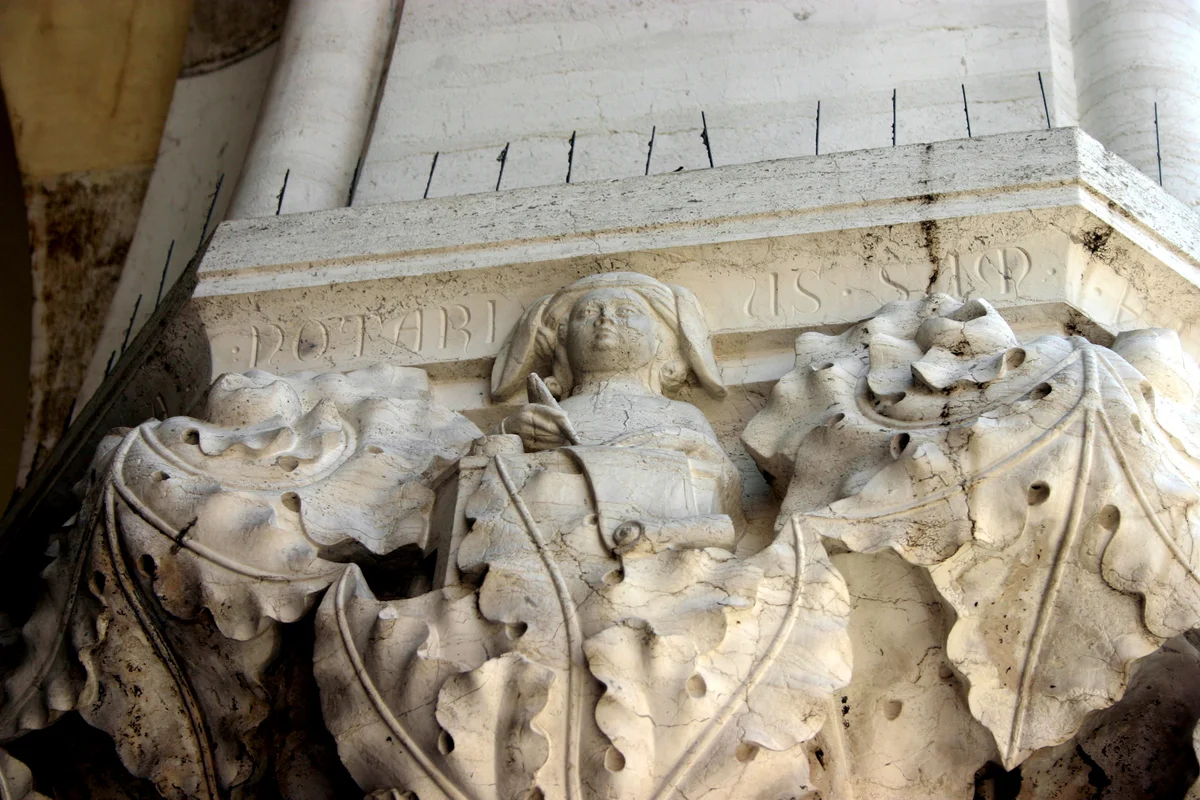
The rogito: what signing actually achieves, and what it does not
Quick answer: The rogito is the final deed of sale, drawn by a notaio acting as a public official. Signing transfers ownership between the parties. Ownership good against everyone else arrives only when the deed is transcribed in the land registers, and the days in between are the one genuinely exposed moment in an Italian purchase. Since 2017 you can close that gap for free, by asking the notaio to hold the price until transcription. Almost no foreign buyer asks.
What the notaio is and is not doing for you
An Italian notaio is not a solicitor acting for a side. They are a public official, appointed by the state, neutral between buyer and seller, and personally liable for the correctness of the act they draw.
What that means in practice is worth stating precisely, because foreign buyers routinely assume more and occasionally assume less.
The notaio does verify the identity and capacity of the parties, confirm the seller’s title back through the chain, check the land registers for mortgages, charges, seizures and pending claims, verify that cadastral data matches the property, collect and pay the transfer taxes, and register and transcribe the deed.
The notaio does not negotiate for you, value the property, survey its condition, check whether the building works were permitted, tell you the price is too high, or advise you on whether the purchase is a good idea. Those are the jobs of a geometra and of your own lawyer, and their absence is what turns an otherwise clean rogito into a bad purchase.
The distinction matters most on planning and building compliance. The notaio records the seller’s declarations about permits and conformity. Recording a declaration is not the same as verifying it, and unpermitted works survive a perfectly executed deed.
Registration and transcription are two different things
This is the part that gets flattened in English explanations, and the difference is the whole subject of this page.
Registration is a tax act. The notaio files the deed with the Agenzia delle Entrate within 30 days and pays the transfer taxes. It gives the deed a certain date. It does not make your ownership public.
Transcription is the act that enters the transfer in the registri immobiliari, the land registers held by the Conservatoria. This is what makes your purchase enforceable against third parties: what lawyers mean by opposability.
Until the deed is transcribed, a registered purchase is not effective against anyone but the seller. In the gap a creditor of the seller can register a charge, or a competing deed can be transcribed first, and priority in the Italian system runs from the moment of transcription rather than from the moment of signature. The same register carries transfers on death, which is where Italian inheritance law for foreign owners picks up.
The window is usually short. A competent notaio transcribes within days. But it is not zero, and you are entitled to ask when they intend to do it, and to be told.
The deposit protection nobody asks for
Italian law has already solved the gap, and the solution is free.
Introduced in 2013 and reshaped by the competition law of 2017, the rule is that either party may require the notaio to hold the balance of the price in a dedicated account until the transfer is transcribed. From 29 August 2017 it operates on request rather than automatically, which is precisely why it goes unused: nobody requests what nobody mentions.
Money held this way is unusually well protected. It sits in an account designated for the purpose, segregated from the notaio’s own assets. It does not form part of their estate on death, does not fall into any marital property regime, and cannot be attached by their creditors. Critically for a buyer, it also cannot be attached by the seller’s creditors while it is held.
The practical effect is that the seller receives the money when, and only when, your ownership has been made public. A charge appearing in the gap becomes the seller’s problem rather than yours.
Two things follow. Ask for it in the compromesso rather than on the day, because a seller who has planned around receiving the funds at signature will resist a late request. And expect some resistance regardless: sellers dislike the delay, and agents sometimes present the request as unusual. It is a statutory right, and the reason it feels unusual is that foreign buyers rarely know it exists.
The other protection: transcribing the compromesso
The deposit closes the gap at the deed. A second mechanism closes the much longer gap before it, between the preliminary contract and completion, and it is equally unknown to foreign buyers.
A compromesso can itself be transcribed in the land registers, under article 2645-bis, provided it is made as a public act or as a private deed with authenticated signatures. Transcribing it gives the buyer a prenotativo, a reservation effect: from that moment the eventual purchase takes priority over anything registered against the seller afterwards. The protection extends beyond competing sales to seizures, sequestrations and judicial mortgages, which are exactly the events that ruin a purchase between signing and completion.
The protection is deliberately time-limited. It ceases, and is treated as never having existed, if the final deed is not transcribed within 1 year of the date the parties agreed for it, and in any case within 3 years of the preliminary being transcribed. Those two limits run together, so a compromesso naming a completion date 6 months out gives protection until 18 months from that date at the outside.
Whether to use it is a question of exposure rather than of principle. It costs more than an unregistered compromesso, because it requires the notaio and carries its own registration tax. It earns that cost where the risk is real: a long gap to completion, a purchase off plan, a seller whose financial position you cannot assess, or a deposit large enough that losing it would matter. On a resale completing in 8 weeks from a seller with a clean title, most buyers reasonably skip it.
What it is not is exotic. Between transcribing the compromesso and depositing the price at the deed, Italian law offers a buyer two complete answers to the question “what if something is registered against the seller before I am on the register”, and a foreign buyer who knows about both is protected end to end for a marginal cost.
What happens on the day
The rogito is read aloud in full, in Italian, by the notaio. That is not ceremony; it is a condition of the act.
The parties, or their attorneys, then sign. Payment is made by bankers’ draft or traceable transfer, and Italian rules require the means of payment to be declared in the deed itself. Keys change hands unless the contract provides otherwise.
Two practicalities catch foreign buyers.
If you cannot attend, you sign through a procura, a power of attorney. It can be granted before an Italian consulate abroad, or before a local notary with an apostille and a sworn translation into Italian. Consular appointments are the single most common cause of a postponed completion, so start 4 to 6 weeks ahead rather than 2.
If you do not speak Italian, the notaio must be satisfied that you understood what was read. Where you do not, the act requires an interpreter and normally two witnesses, or a deed drawn in two languages. Arrange it in advance. Turning up expecting the agent to translate is not sufficient, and a notaio who proceeds anyway is exposing the act to challenge.
The taxes that fall due at the deed
The notaio collects and pays the transfer taxes on the day, which is why the money must be with them before signature.
| What is being bought | Tax at the deed |
|---|---|
| Resale from a private seller, prima casa | 2% registration tax on cadastral value, minimum EUR 1,000 |
| Resale from a private seller, second home | 9% registration tax on cadastral value, minimum EUR 1,000 |
| New build from a developer, prima casa | 4% VAT on the price |
| New build from a developer, second home | 10% VAT on the price, or 22% on luxury categories |
Resale purchases from a private seller are taxed on the cadastral value rather than the price, under the prezzo-valore mechanism, which is usually well below what you paid. The full mechanics are in Italian registration tax, and the whole closing stack including the notaio’s own fee is in what buying in Italy costs to complete.
Reading the deed before you sign it
The rogito is read aloud, but hearing 20 pages of Italian legal prose once is not the same as having checked it. Ask for the draft in advance, which any notaio will provide, and read it against six things.
The parties and their capacity. Names, tax codes, and marital property regime. An Italian seller married under comunione dei beni normally needs both spouses to sign, and a deed missing a spouse is a deed with a problem.
The property as described. Cadastral sheet, parcel and subaltern numbers, and the boundaries, checked against the planimetria rather than against the listing. Garages, cellars and parking spaces have their own subaltern numbers, and a buyer who assumed the cellar was included finds out here.
The price and the means of payment. Both must appear. Italian rules require the deed to state how the money moved, including the agency commission and the agent’s own tax code.
The seller’s declarations. On building permits, cadastral conformity, energy performance and, where relevant, condominium arrears. These are declarations rather than verified statements, and their value is that a false one gives you a claim afterwards. Make sure they are actually present and specific.
The urbanistic references. The building permit numbers and any amnesty or sanatoria applications. A deed on a property built before 1 September 1967 uses a different declaration, and the date matters.
What is not there. Any easement, right of way or shared-access arrangement you were told about verbally should appear. If it does not, it does not exist as a right, whatever the agent said.
Where something is wrong, the moment to fix it is before signature. The notaio will not proceed with an act they know to be defective, but they will proceed with one that is merely disadvantageous to you, because that is not their question.
Before you get to the deed
Almost everything that goes wrong at a rogito went wrong earlier.
The searches, the conformity check, the condominium position and the boundary questions all belong before the compromesso, because after it you are committed and your leverage is gone. The sequence is set out in due diligence before the compromesso, and the wider purchase order in buying property in Italy as a foreigner.
One item belongs specifically to rural purchases and is invisible on paper: whether a neighbour has been using part of the land or the access track long enough to have acquired a right to it. A clean deed conveys what the seller owns, and possession can have quietly removed part of that.
Weighing the rogito stage
What protects you here
- The notaio is a public official, personally liable for the act, and their searches on charges and title are thorough
- Priority runs from transcription, and a competent notaio transcribes within days
- The deposit mechanism removes the gap risk entirely, at no cost, on request
- Means of payment must be declared in the deed, which makes the money trail explicit
- The deed is read aloud in full, so nothing is buried in small print
What it does not protect you from
- Building and planning irregularities, which are recorded as declarations rather than verified
- Physical condition, which nobody at the deed has inspected
- Whether the price is sensible, which is not the notaio’s question
- Rights acquired by possession over boundaries and access
- A translation you did not arrange, which delays completion rather than fixing it
The pattern is consistent: the rogito reliably answers who owns what and whether anything is registered against it, and answers nothing about the building itself. Budget for the professionals who cover the rest, and use the deposit right that covers the gap the deed leaves open.
Sources
Italian rules on the deposit of the price with the notaio, introduced by Law 147 of 2013 and amended to operate on the request of a party by the competition law of 2017 with effect from 29 August 2017; the 30-day deadline for registration of deeds with the Agenzia delle Entrate; the distinction between registration for tax purposes and transcription in the registri immobiliari as the act conferring effect against third parties. Checked 7 September 2026.
Frequently Asked Questions
The rogito is the final deed of sale, drawn up and read aloud by a notaio as a public official. Signing it transfers ownership between the parties. What makes that ownership good against everyone else is the later transcription in the land registers, which is a separate step.
Between you and the seller, yes. Against third parties, not until the deed is transcribed in the registri immobiliari. In the gap between signing and transcription a creditor of the seller can still register a charge that takes priority, which is the risk the deposit mechanism exists to remove.
Yes, and it costs nothing extra. Since 29 August 2017 either party may require the notaio to hold the balance of the price in a dedicated segregated account until the transfer is transcribed. Those funds sit outside the notaio's own estate and cannot be seized by the seller's creditors. It has to be requested; it is not automatic.
Thirty days from the deed to register it with the Agenzia delle Entrate and pay the transfer taxes. Transcription in the land registers follows. In practice a competent notaio transcribes within days rather than weeks, and you are entitled to ask when they intend to.
No. A buyer who cannot travel signs through a power of attorney, a procura, granted before an Italian consulate or before a foreign notary with an apostille and a sworn translation. Arrange it weeks ahead: consular appointments are the usual cause of a delayed completion.
The deed is in Italian and the notaio must be satisfied you understood it. Where you do not speak the language the act requires an interpreter and normally two witnesses, or a bilingual deed. This is a formality with real consequences, and improvising it on the day is how completions get postponed.
Get an Italy property shortlist
Tell us your budget and region (Tuscany, Lake Como, Puglia, Milan, Sardinia). We reply within one business day with options matched to your goals.