Apartments for sale in Arezzo, and what the asking prices leave out
Quick answer: Restored lift-served flats in Arezzo start around EUR 220,000 for a two-bedroom in the Giotto corridor and run to EUR 380,000 for a three-bedroom with parking. The citywide average is near EUR 1,450 per square metre while centro bands reach toward EUR 2,382, a spread of roughly 65% inside one small city. That spread, not the headline price, is what decides whether a purchase here was well bought.
Arezzo is the cheapest of Tuscany’s major cities and the least marketed. Buyers arrive from the Florence and Siena search, find the same floor area at a third to a half of the price, and then have to work out what the discount is actually for.
Where the flats actually are
Three parts of the city carry almost all the apartment stock a foreign buyer will be shown.
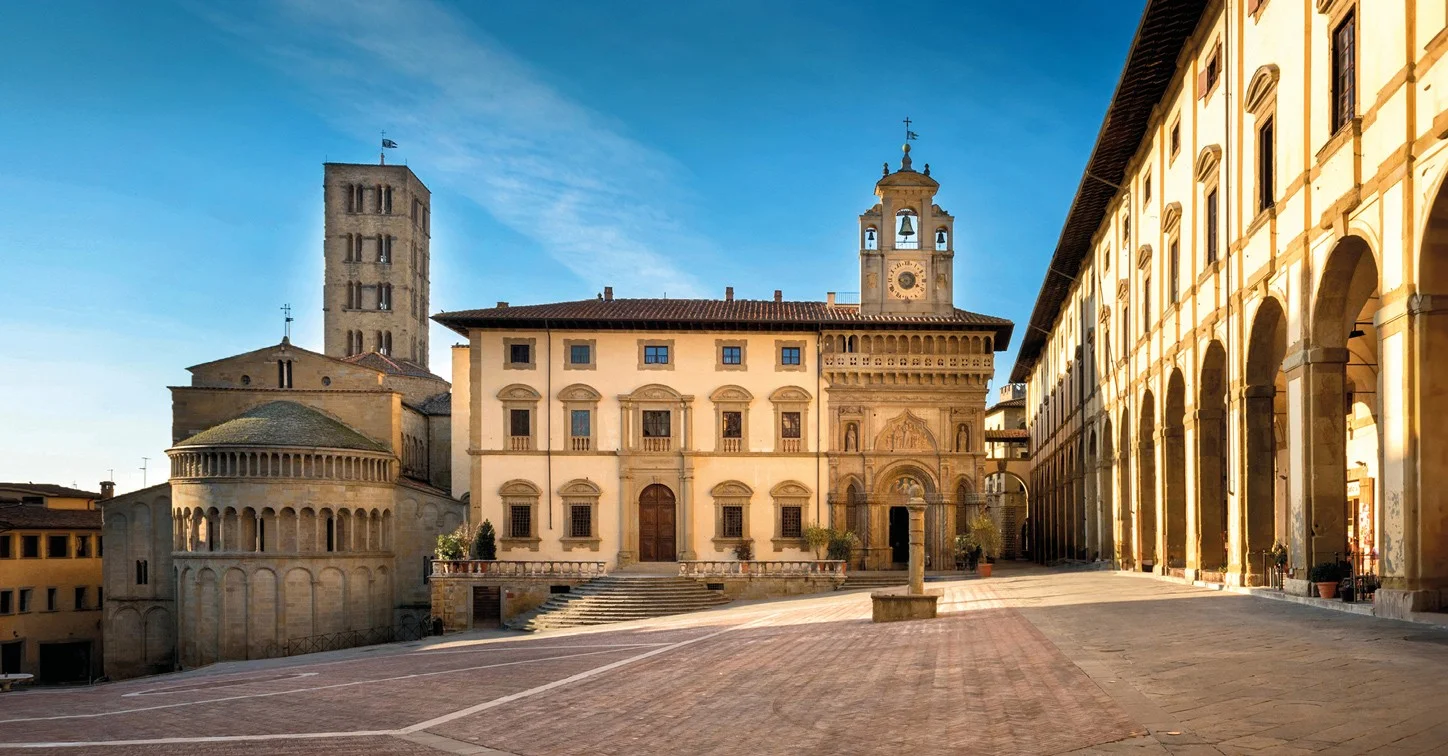
Inside the wall ring, around Piazza Grande and the Corso, the buildings are old and the flats are characterful, small and frequently without a lift or a parking space. Prices are the highest in the city and the constraints are the tightest.
The Giotto and XXV Aprile corridors are where most transactions happen. These are 1970s to 1990s condominiums, lift-served, sometimes with a garage on the deed, five to fifteen minutes on foot from the historic centre. Two-bedroom flats here are the EUR 220,000 to EUR 280,000 bracket that draws foreign enquiry.
The Piero della Francesca residential zones and the outer periphery trade walkability for space. A 75 to 90 square metre flat runs EUR 180,000 to EUR 240,000, and the trade is car dependency.
| Getting out of Arezzo | Approximate time |
|---|---|
| Piazza Grande on foot | 5 to 15 minutes from centro stock |
| Florence Santa Maria Novella by rail | 60 to 75 minutes |
| Florence by car on the A1 | 70 to 90 minutes |
| Rome by car on the A1 | 90 to 120 minutes |
| Montepulciano and the Val d’Orcia | 45 to 60 minutes |
| Florence Peretola airport | 80 to 100 minutes |
The A1 position is the practical argument for Arezzo over the smaller hill towns. Two of Italy’s largest cities are inside a two-hour drive, which matters both for letting and for the day you sell. The wider inland picture is in the Tuscany inland property guide, and the city itself in the Arezzo area guide.
What the money buys
| Stock | Typical size | Asking range |
|---|---|---|
| Two-bedroom, Giotto corridor, lift | 65 to 80 sqm | EUR 220,000 to 280,000 |
| Two-bedroom inside the walls | 70 to 85 sqm | EUR 250,000 to 320,000 |
| Three-bedroom with parking | 90 to 105 sqm | EUR 300,000 to 380,000 |
| Periphery, car dependent | 75 to 90 sqm | EUR 180,000 to 240,000 |
In June 2026 there were 52 flats listed across the Giotto and centro corridors aimed at buyers from outside the city. Median asking on lift-served two-bedroom stock was EUR 245,000, which works out at about EUR 2,380 per square metre.
Set that against the citywide average of roughly EUR 1,450 per square metre and the picture becomes clear: the flats marketed to outsiders sit at the top of the local range, not the middle. That is not a scandal, it is what marketed inventory looks like everywhere. It does mean the asking price is a starting position rather than a valuation.
The renovation label is where the money hides
The single most useful distinction in Arezzo is between genuinely turnkey stock and flats described as restored that are not.
A large part of the corridor inventory sits in buildings with pre-1980 shared heating systems. Where those have not been regularised, the mechanical and electrical work plus the paperwork that follows costs the buyer somewhere between EUR 15,000 and EUR 40,000. None of it appears in the listing, and the vendor is not the party who pays it.
Two habits protect against this. Commission an engineer’s inspection before accepting the word restored, and decline any file that arrives without three years of the condominium administrator’s accounts. The second request is refused more often than it should be, and a refusal is itself an answer.
There is a seasonal wrinkle. Arezzo’s antiques fair fills the first weekend of every month and drives autumn viewing volume hard. That is exactly when documentation gets skipped in the rush, so a purchase decided between September and November deserves more paperwork discipline rather than less. The general sequence is in due diligence before the compromesso.
The lift, and why it is not a detail
Most of the pre-1990 condominiums along the Giotto corridor face lift modernisation at some point, and the vote can land after you have bought.
The certificate has an expiry date and the building has a maintenance history, and both belong in the file before the offer. Where a modernisation is pending, the special assessment is a number that should come off the price rather than a surprise in the first year of ownership.
Tenants make this concrete. A flat let to hospital or university staff loses its tenant if the lift is out for a month, because a walk-up on the third floor is not the thing they agreed to rent. That is why the certificate and the parking deed do more for the letting economics here than the kitchen does.
What it lets for
The tenant market is hospital staff, university fellows and domestic professionals, on twelve-month furnished leases rather than tourists. That gives Arezzo a duller, steadier profile than the Tuscan cities that live on short lets.
Median furnished twelve-month comparables reach about EUR 920 a month. On the EUR 245,000 median asking price that is 4.5% gross before tax. Bought better, at EUR 230,000 with a EUR 950 rent, the same flat produces EUR 11,400 a year and 4.95% gross.
Those are gross figures. What survives is smaller: the comune sets IMU on cadastral value, cedolare secca takes 21% on a long furnished lease, and the condominium takes its share. The arithmetic for turning one into the other is in the Italian rental yield guide.
Two timing points matter more than they look. Enquiry rises 25% to 30% above the winter baseline around the September intake, so a flat listed in February is competing in a thinner market than the same flat listed in late August. And spring asking prices run 6% to 9% above the OMI closed range on corridor two-bedroom stock, with the gap widest exactly where the lift certificate and parking deed are missing.
What a year of ownership costs
Buyers model the purchase and forget the holding, which in Italy is where a thin yield turns negative.
On a EUR 245,000 flat the recurring lines are the municipal property tax, charged on cadastral value rather than on what you paid, the condominium contribution, and the tax on rent. Condominium charges on the lift-served corridor stock run in the region of EUR 900 to EUR 1,800 a year, more where a modernisation fund is being built up. Cadastral values in Arezzo sit well below asking prices, which works in the owner’s favour on both the annual tax and the purchase tax, and the number is read off the cadastral extract rather than estimated.
The point of setting these out before the offer is not that they are large. It is that they are knowable in advance, and a gross yield quoted without them is not a yield at all. A commercialista will model the net position on the actual cadastral figure in an afternoon, and doing that before the preliminary contract costs nothing while doing it afterwards costs whatever the gap turns out to be.
One line deserves separate attention on older corridor buildings. Where a lift modernisation or a facade intervention has been voted but not yet billed, the obligation follows the flat rather than the seller. That is a question for the administrator’s minutes, not for the agent.
Arezzo against the alternatives inland buyers actually consider
| Arezzo centro | Siena centro | |
|---|---|---|
| Entry for a restored two-bedroom | About EUR 220,000 | Above EUR 350,000 |
| Gross yield | 4.5% to 5.5% on long leases | 3% to 5%, largely short lets |
| Who rents it | Hospital, university, local professionals | Visitors |
| Recognition abroad | Domestic name | UNESCO, globally known |
| Resale enquiry from abroad | Thinner | Deeper |
The honest summary is that Arezzo wins on cash flow and loses on every branding measure. A Siena flat is easier to sell to a foreign buyer in five years; an Arezzo flat pays more while you hold it and costs a third less to enter. Which matters depends on whether the purchase is an income position or an exit position, and the two markets are set side by side in Arezzo against Siena.
Florence belongs in the comparison only as a reference point. At portal averages near EUR 4,737 per square metre it is a different asset class, and buyers usually arrive at Arezzo having already priced Florence and set it aside.
Who this suits, and who it does not
It suits a buyer who wants a working Italian city rather than a holiday one: year-round tenants, an hour from Florence, a small centro that is genuinely lived in, and an entry price that leaves capital for something else later. It also suits a Florence owner who wants a second position without a Florence basis.
It does not suit a buyer whose plan depends on short letting. Licensed short-let inventory in the centro is limited and carries the national registration requirements, and the antiques-fair peaks are a handful of weekends rather than a season. Nor does it suit anyone who needs the resale market to be deep and international, because it is not.
Before you wire anything
- Three years of condominium accounts, read rather than filed
- The lift certificate, its expiry, and any pending modernisation vote
- An engineer’s view on the heating system where the building predates 1980
- The parking deed, if one is claimed, checked as a deed rather than a habit
- The cadastral position against the actual layout, per the visura catastale
- OMI closed comparables in the same quartiere rather than the asking median
- The full non-resident closing stack, ordinarily 10% to 15% on top of the price
The last of those is the one foreign buyers most often underestimate, and it is broken down in the cost of buying property in Italy. The eligibility position and the documents a non-resident needs are in buying property in Italy as a foreigner.
One habit is worth more than the rest of the list. Instruct your own lawyer, not the agent’s recommendation, and have them read the file before the preliminary contract rather than before completion. In Arezzo the recurring findings are dull and fixable if they are found in time: an unregularised boiler, a lift vote nobody mentioned, a garage everybody assumed was included.
Sources
Immobiliare.it portal aggregates for Arezzo and Florence, June 2026; Agenzia delle Entrate OMI reference bands for Arezzo quartieri; listing counts and asking medians compiled from the Giotto and centro corridors in June 2026; lease comparables from furnished twelve-month listings in the same period. Prices are asking unless described as closed. Checked 7 September 2026.
Frequently Asked Questions
Restored two-bedroom flats with a lift start around EUR 220,000 in the Giotto corridor and EUR 250,000 to EUR 320,000 inside the walls. Median asking on lift-served two-bedroom stock in June 2026 was EUR 245,000, about EUR 2,380 per square metre, against a citywide average nearer EUR 1,450.
Arezzo is an inland working city rather than a tourism brand. Florence portal averages sit near EUR 4,737 per square metre and Siena centro entry above EUR 350,000. Arezzo trades international recognition for a lower basis and a year-round tenant market.
Yes. EU citizens buy freely, and buyers from reciprocity countries follow the ordinary Italian route with a codice fiscale and a notarial deed. An urban flat avoids the land-registry complications that rural Tuscan property in the same province often carries.
Three years of condominium accounts, the lift certificate and its expiry, and whether the pre-1980 heating system has been regularised. A pending lift modernisation vote is a price issue rather than a footnote, because tenants will not take a walk-up substitute during a long outage.
Not in spring. Listings are timed for the September intake, and on Giotto corridor two-bedroom flats the gap between asking and the OMI closed range typically runs 6% to 9%. The gap is widest where the lift certificate and parking deed are missing from the file.
Along the Giotto and XXV Aprile corridors, often yes, and a documented parking deed materially changes how quickly a flat lets or resells. Inside the wall ring parking is scarce and rarely attached to the deed at all.
Get an Italy property shortlist
Tell us your budget and region (Tuscany, Lake Como, Puglia, Milan, Sardinia). We reply within one business day with options matched to your goals.