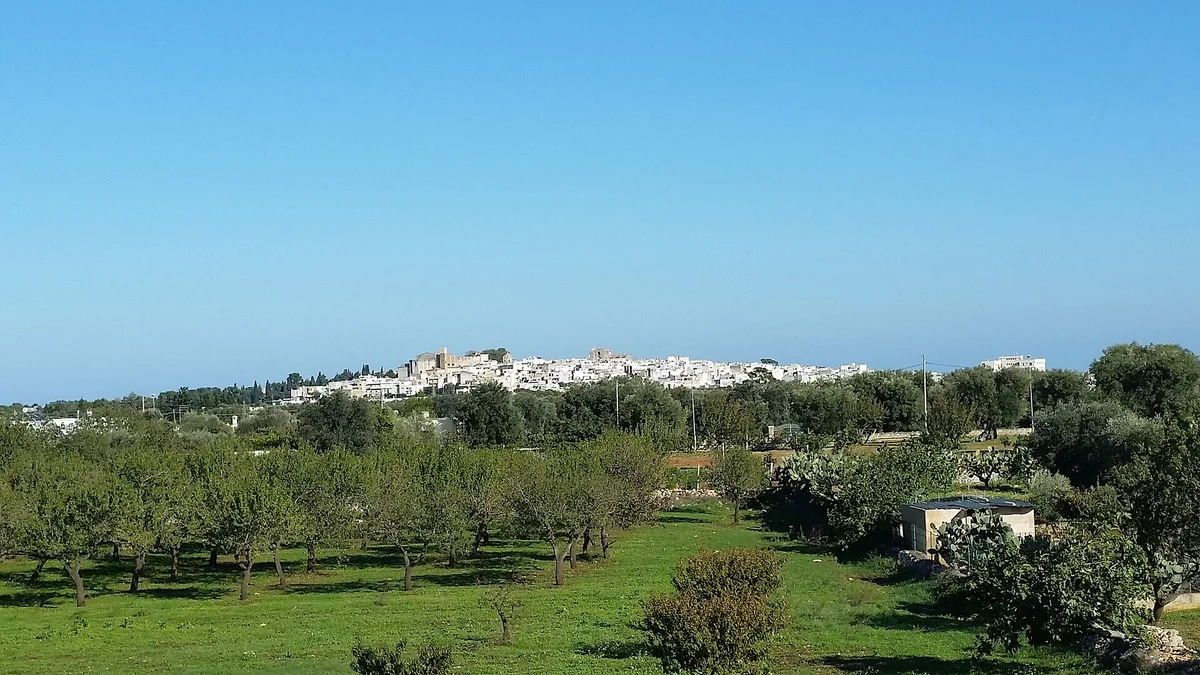
Quick answer: The reason this stretch of Adriatic coast looks the way it does is a protected area with roughly 1,200 hectares of state nature reserve on land and 600 hectares of marine protected area, divided into four zones by degree of protection. That zoning, not the municipal plan alone, decides what a property here can become.
Buyers arrive in this part of Puglia because the coast is undeveloped, and then propose to develop on it. The undeveloped condition is not an accident of the market; it is the product of a protection regime that has been in place for decades, and understanding its structure is the difference between a purchase that works and one that stalls.
What the protected area is
Torre Guaceto sits on the Adriatic coast of upper Salento, a few kilometres from the centres of Carovigno and San Vito dei Normanni and around 17 km north of Brindisi. It combines two instruments: a marine protected area extending to roughly 600 hectares at sea, and a state nature reserve of roughly 1,200 hectares on land, together covering about 8 km of coastline.
Management is by a consortium bringing together the municipal administrations of Brindisi and Carovigno with an environmental organisation, an arrangement that has given the area unusually active stewardship for an Italian protected site.
The zoning is the operative part. Four zones are identified on the basis of the degree of naturalness of the territory and the corresponding management objectives.
| Zone | Character | Practical effect |
|---|---|---|
| A | Integral reserve | The most restricted; access and activity minimal |
| B | General oriented reserve | Strongly protected, limited intervention |
| C | Protection zone | Constrained, with more permitted activity |
| D | Economic and social promotion | The zone where development activity is contemplated |
A parcel’s zone is therefore the first fact to establish about it, and it is a matter of record rather than of interpretation.
What the constraint actually controls
Not ownership, and not the ability to buy or sell. What it controls is action, and the list is longer than buyers expect.
- Building and alteration, including works that would be routine outside the area
- Excavation, which is why a pool is a different question here from a pool elsewhere
- Water abstraction, on top of the separate Puglian regime governing boreholes
- Vegetation management, including clearance and planting
- Access, both by vehicle and on foot, which is managed rather than open
- Activities on the water, governed by the marine zoning rather than by the land one
For a buyer proposing to restore a masseria and add a pool, a terrace and a drive, that is four separate consents rather than one building permit, potentially involving the comune, the reserve’s managing body and the regional authorities.
The questions to ask before an offer
- Which zone does each parcel fall in, confirmed against the reserve’s mapping rather than described
- What does the certificato di destinazione urbanistica say the municipal instrument permits
- What consents would the intended works require, and from which bodies
- Does the property have an authorised water supply, and is the authorisation current
- What access rights exist, in writing, and are they seasonal or year round
Item four deserves emphasis. Water in this part of Puglia is a constrained resource governed in its own right, and rural properties frequently depend on boreholes whose authorisation status is unclear. An unauthorised abstraction is not a saving inherited with the property; it is an exposure.
Everything in the due diligence guide still has to be done; the five questions above are additional to it, not a substitute.
Does protection help or hurt?
Both, and the balance is favourable, which is worth saying plainly because buyers tend to treat constraint as pure cost.
What the regime removes is optionality. An owner here has fewer choices than an owner 30 kilometres down the coast, and some perfectly reasonable projects are not available.
What it delivers is the coast itself. Stretches of the Adriatic without this level of protection have been developed intensively over the past fifty years, and their property markets now compete on price rather than on setting. The reason a property near Torre Guaceto commands what it does is precisely that the alternative outcome was prevented.
A buyer who wants an undeveloped coast and also wants to build freely on it is asking for two incompatible things. Choosing the first knowingly is a sound decision; discovering the trade-off after completion is not.
Buying a masseria near a reserve
The characteristic property of this district is the masseria: a fortified farm building, frequently large, frequently in poor condition, and frequently accompanied by land. It is the purchase most foreign buyers come here to make and it is the one where the constraints bite hardest.
Three questions decide whether a specific masseria is a project or a trap.
What is it registered as? Agricultural buildings are not dwellings, and converting one is a planning question governed by regional and municipal rules on rural building conversion. The answer is frequently narrower than a buyer expects.
What does the land carry? Olive trees in Puglia may be subject to protection in their own right, water abstraction is regulated, and any parcel inside the reserve carries its zone’s restrictions.
How will the works be delivered? Rural sites need access, water, power and drainage before construction begins, and inside or adjoining a protected area the route and the method may themselves need consent.
A masseria that answers all three well is a fine purchase and there are plenty of them. One that answers none is a beautiful building nobody has been able to do anything with, which is generally why it is for sale.
What the reserve does for a letting business
Owners letting property in this district should understand that the protected coast is the product, and that its management is what sustains it.
Managed access means visitor numbers on the protected beaches are controlled, which keeps the experience worth travelling for and distinguishes this stretch from the crowded alternatives. It also means an owner cannot promise guests unrestricted beach use, and should describe the arrangements accurately rather than optimistically.
The season here is the Puglian one: a strong summer, good shoulder months either side, and a quiet winter. A letting model should be built on that shape rather than on a year-round assumption, and the property should be specified for a summer market.
The zone is a fact, not an opinion
The single most useful discipline for a buyer here is to insist on the zone in writing and to distrust every description that avoids it.
Vendors and agents describe properties as near the reserve, adjoining the reserve, inside the park or with reserve views, and none of those phrases has a legal meaning. The parcel either falls in zone A, B, C or D, or it falls outside the perimeter, and that determination is made from mapping held by the managing body and reflected in the municipal instrument.
A buyer who obtains it has converted the most important variable in the purchase from a matter of impression into a matter of record. A buyer who does not is relying on the vendor’s characterisation of a constraint that limits what the vendor can sell.
- Ask for the parcel identifiers, not the address
- Obtain the zone determination from the mapping, in writing
- Cross-check it against the certificato di destinazione urbanistica
- Have a local technician confirm what the zone permits for your intended use
Where this fits in Puglia’s coastal market
The wider region is covered in the Puglia guide. Nearby, Ostuni is the established international market of the upper Salento with its own heritage constraints, the Valle d’Itria inland is the trullo country that draws restoration buyers, and Cisternino is a smaller version of the same. Further south, Lecce carries a completely different set of obligations attached to its land rather than to a reserve boundary, and Polignano a Mare shows what a developed and heavily visited stretch of the same coast looks like.
How the protection was built up
The area’s status was assembled in layers rather than created at once. Protection on land dates from 1981, when the state nature reserve was established. Italy’s framework law on protected areas followed in 1991, and the marine protected area and the management consortium took shape after it. The four-zone structure and the current management arrangements are the product of that accumulation.
For a buyer the relevant implication is that documents of different dates say different things, and only the current mapping and the current municipal instrument are operative. Material describing the area’s rules from the 1990s or the 2000s should be treated as history.
Access matters too: Brindisi airport is roughly 30 min away by road and Bari about 90 min, which places this coast within a comfortable transfer for the northern European market its letting season depends on.
The season and the numbers behind it
Letting on this coast runs from May to September, with July and August carrying the strongest rates by a wide margin. Outside that window demand falls away quickly, and a property specified for summer use earns little between November and March.
That shape has two implications for the arithmetic. Occupancy measured across a whole year will be low even for a successful property, so any yield figure quoted on peak-season rates alone is misleading. And the fixed costs of a rural property with a garden, a pool and a well continue from October to April, which is where an optimistic model usually fails.
- Model demand from May to September only
- Concentrate the rate expectation in July and August and discount the rest
- Carry the standing costs across the whole year in the model
- Confirm what the property costs to hold when nobody is in it
A short comparison of the local options
Buyers looking at this stretch of coast are usually choosing between three things and it helps to name them.
A property inside or adjoining the reserve buys the setting and accepts the constraint. Optionality is lowest, protection is highest, and what is bought is largely unchangeable.
A property in the surrounding countryside outside the perimeter has the landscape without the reserve’s rules, subject to ordinary planning and to whatever landscape protection applies regionally. More can be done; less is guaranteed about the neighbours.
A property in one of the hill towns nearby, in the white towns inland, is a different asset entirely: an urban property in a walkable centre, with heritage rules rather than nature rules, and a letting market that runs on the town’s own appeal.
Each is defensible. What produces disappointment is buying the first while planning for the second.
Costing a project inside a constrained landscape
Works here run longer and cost more than the same works outside a protected area, for reasons that are procedural rather than material.
Consents take time and they are sequential rather than parallel, since one body frequently wants to see another’s decision. Specifications are narrower, which removes the cheapest options. Access for machinery may be limited by the same rules that make the setting attractive. And the pool of contractors experienced in working under these conditions is smaller than the pool of contractors generally.
The renovation cost guide sets out the national ranges. For a project inside or adjoining a reserve, a buyer should plan on the upper end of them, on a longer programme, and on professional fees that reflect a consenting process rather than a single application.
None of that is a reason to avoid this coast. It is the reason the coast still exists in the condition that brought the buyer here, and it should be in the budget from the first calculation rather than added after the offer is accepted.
Carovigno new-builds price below Ostuni for the same specification, which the listings on property for sale in Puglia show directly.
Frequently Asked Questions
A protected area on the Adriatic coast of upper Salento a few kilometres from Carovigno, consisting of a marine protected area of roughly 600 hectares and a state nature reserve of roughly 1,200 hectares on land. It is managed by a consortium of the municipalities of Brindisi and Carovigno together with an environmental organisation.
Into four zones by degree of naturalness and management objective: zone A as integral reserve, zone B as general oriented reserve, zone C as a protection zone, and zone D as an area for economic and social promotion. Which zone a parcel falls in determines what may be done there, and the difference between them is large.
No. Property inside and adjoining the protected area transacts normally. What the zoning changes is what an owner may do: building, alteration, excavation, water abstraction and access are all governed by the reserve's rules on top of the ordinary municipal ones.
That depends on the zone and on the authorisations, and it is exactly the kind of question that should be answered before an offer rather than after. A pool involves excavation, water supply, discharge and a visual impact in a protected landscape, and each of those engages a different consent.
Water abstraction is regulated in its own right in Puglia, independently of the reserve, and inside a protected area the position is tighter still. A property whose water supply depends on an existing borehole should have that borehole's authorisation checked, since an unauthorised one is a liability rather than an asset.
Access to a protected coast is managed rather than open, with routes, seasons and sometimes numbers controlled by the managing body. That is a large part of why the coast here is in the condition it is, and a buyer should understand the arrangements rather than assume the beach behaves like an ordinary Italian one.
It does both and on balance it supports them. The constraint prevents the coastal development that has degraded comparable stretches elsewhere in Puglia, which is precisely what makes this coast desirable. What it costs is optionality: an owner has fewer choices about what to do with the property.
Entirely. Xylella is a plant health regime imposing removal and replanting duties across the province of Lecce. This is a nature protection regime governing what may be built and done inside a defined reserve. A holding could in principle be inside both, and the two would have to be reconciled through the competent authorities.
Get an Italy property shortlist
Tell us your budget and region (Tuscany, Lake Como, Puglia, Milan, Sardinia). We reply within one business day with options matched to your goals.