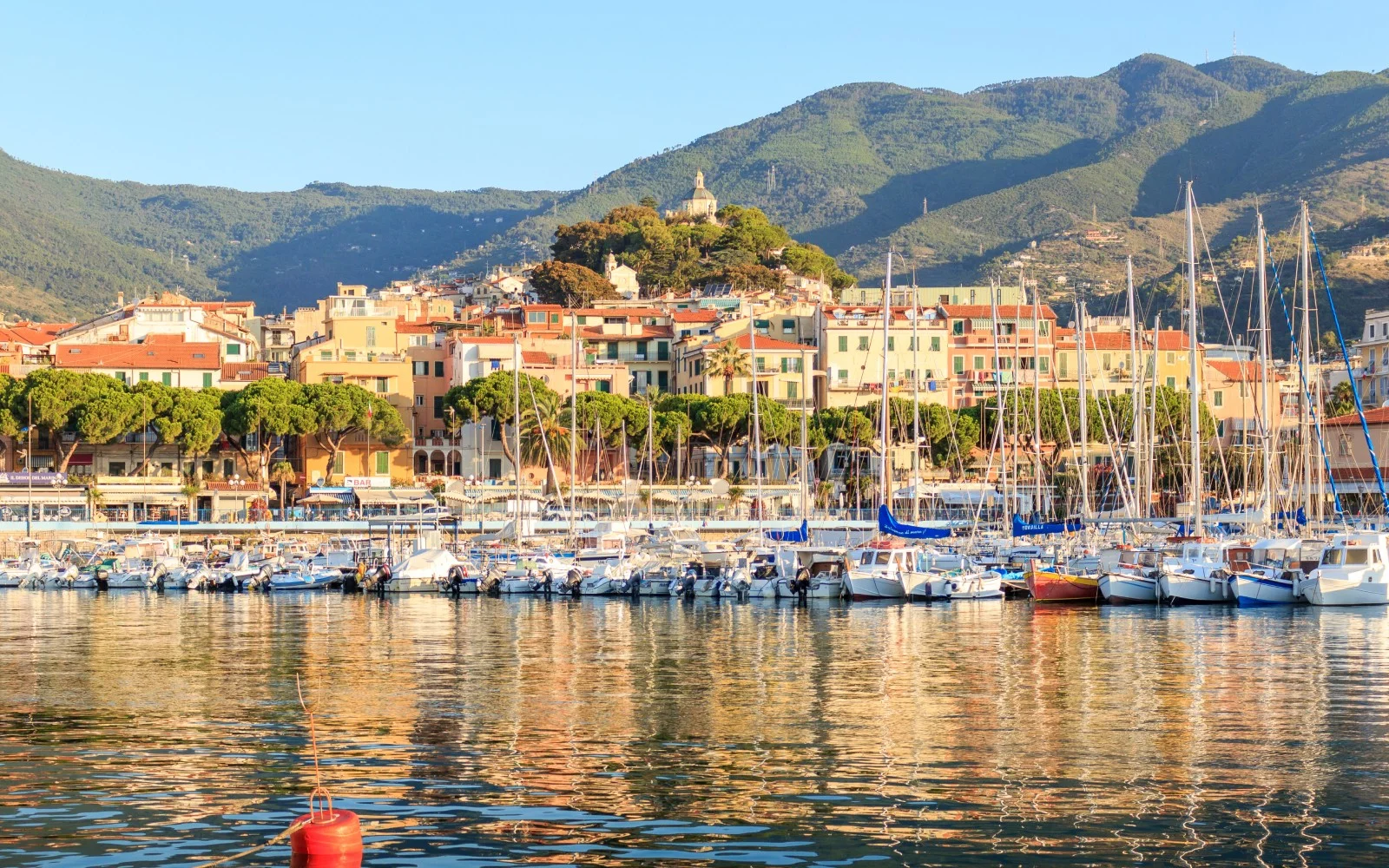
Quick answer: The western Ligurian coast ran out of buildable ground decades ago. What remains is land occupied by the greenhouses of a flower-growing industry that has contracted, and Liguria has regulated the planning treatment of greenhouses since 1976 precisely because they sit between agriculture and construction.
Drive the hills behind Sanremo and the landscape is not what the postcards show. Above the town, terrace after terrace is covered in glass and plastic, some of it working, much of it not. That is the Riviera dei Fiori doing what its name says, and it is also the only significant land reserve on a coast that has nowhere else to go.
Why land is the binding constraint here
The geography does most of the explaining. The province occupies a narrow strip between the Mediterranean and mountains that rise immediately behind it. The flat ground was built on long ago, the seafront is continuous development, and expansion inland means terraces, slopes and access problems.
That produces a market with a permanent supply constraint, and it explains a pattern that puzzles buyers arriving from elsewhere: prices that hold up in a region with modest population growth, because there is very little new product and very little prospect of any.
The exception, and the only one at scale, is agricultural land already in productive use. On this coast that means greenhouses.
The greenhouse as a planning object
Liguria recognised early that a greenhouse is an awkward category. It is an agricultural structure, but it is also a construction with volume, foundations and services, and treating it purely as either produces the wrong answer. Regional law 17 of 1976 established an urban planning discipline for greenhouses for that reason.
More recent regional legislation on the recovery of the existing building stock has also addressed disused greenhouses alongside rural building complexes and abandoned or degraded agricultural settlements, within a wider framework aimed at reducing land consumption and at addressing hydrogeological risk on unmanaged slopes.
| Question | Where the answer comes from |
|---|---|
| What the land is classified as | Certificato di destinazione urbanistica |
| What structures lawfully exist on it | Permit history at the comune |
| What may be done with them | Regional framework as applied by the municipal instrument |
| What the slope requires | Hydrogeological constraint mapping |
| What clearance involves | A specialist quote, not an estimate |
The honest general statement is this: a framework exists under which recovery and replacement operations on greenhouse land are possible in defined circumstances, and the answer for any specific parcel is a matter for the comune and a local technician. Anyone offering a general assurance that a greenhouse can become a villa is describing an ambition rather than a permission.
What clearance actually costs
Buyers routinely treat existing structures on a plot as a neutral, on the assumption that demolition is cheap. Greenhouses are not neutral.
A disused structure of this kind contains glass or rigid plastic sheeting, metal or timber framing, irrigation and heating installations, and concrete bases. Older ones may sit on soil with a long history of intensive horticulture. Removal is a waste management exercise with disposal costs attached, on a sloping site where access for machinery is frequently poor.
- Establish what the structures are made of before pricing removal
- Ask whether any material requires specialist handling and disposal
- Confirm access for plant and for removal vehicles, since terraces were built for people rather than for lorries
- Treat soil condition as a question to ask rather than an assumption to make
- Read the renovation and works cost guide for the general ranges, then add for slope and access
Is the industry actually going?
Partly, and a buyer should be careful with the assumption. Ligurian floriculture contracted from its twentieth-century peak under competitive pressure from lower-cost producers and under rising energy costs, which is why disused structures are visible across the hillsides. Substantial parts of the sector remain viable, and a working greenhouse is a business rather than a derelict site.
The practical consequence is that the seller’s position matters. A grower selling surplus land takes a different view of price and timing from a family selling an inheritance nobody wants to farm, and understanding which of those you are dealing with is worth more than any comparable.
What the terraces themselves are
The agricultural land behind the coast is not flat ground with structures on it. It is a constructed landscape of dry-stone terraces built over centuries to make a mountainside cultivable, and those terraces are themselves a maintenance liability that transfers with the land.
An unmaintained terrace wall fails, and when it does it takes soil with it and can threaten what is below. Regional policy on hydrogeological risk exists partly because abandoned agricultural terraces across Liguria have become a slope stability problem rather than merely an aesthetic one.
For a purchaser this means the land carries an obligation of attention whether or not anything is built on it. A buyer acquiring several hectares of abandoned terracing with a house on it has acquired the terracing too, and the cost of keeping it stable does not go away because the buyer’s interest is in the house.
- Walk the terraces and look at the condition of the retaining walls, not only at the buildings
- Ask whether any wall has failed and what was done about it
- Establish whether the parcel sits within a mapped hydrogeological constraint
- Price ongoing maintenance of the land as a recurring item
The conventional market, which is most of it
The greenhouse question concerns buyers looking at land. Most transactions in Sanremo are ordinary: apartments in the town, seafront stock, and villas on the lower slopes, all with the standard Italian questions attached and covered in the due diligence guide.
What distinguishes the town’s demand base is its composition:
- Second homes from the Piedmontese and Lombard hinterland, an established pattern going back generations
- A substantial retired population, drawn by the climate, which produces year-round occupancy rather than a summer-only town
- Cross-border proximity to France, which brings French buyers and visitors and gives the town a second national market
- A festival economy that concentrates national attention on the town for a period each year and fills its accommodation
- A casino and a historic resort infrastructure that gives the centre a commercial base beyond tourism
That mixture produces a coastal market with more winter life than most, which matters for anyone letting property rather than only using it.
What a development thesis here has to survive
Anyone considering greenhouse land as a development proposition is undertaking a project with more variables than a building purchase, and the honest list is longer than the optimistic one.
Planning. The framework is regional and it is applied through the municipal instrument, which means the answer is local and can move. A thesis that depends on a permission not yet granted is a thesis with a binary outcome.
Slope and hydrogeology. Terraced hillsides that have been intensively cultivated and then abandoned are exactly the ground that regional policy on hydrogeological risk is aimed at. Stabilisation and drainage are engineering costs and they arrive early.
Access. A terrace reached by a footpath and a monorail track is not a construction site. Building a route capable of taking materials is frequently the largest single cost in a hillside project here, and it happens before any value is created.
Services. Water, power and drainage on agricultural land are sized for agriculture, and upgrading them to residential standards involves third parties and time.
Time. Every one of the above is measured in seasons rather than weeks, and holding costs run throughout.
None of that makes such a project unattractive. It makes it a development, which is a different activity from buying a house, and it should be resourced and priced accordingly. Buyers who approach it as a cheap route to a sea-view villa are the ones who abandon it half finished, and a half-finished hillside project on this coast is close to unsellable.
What the season looks like
A coastal town with a resident retired population and a hinterland of second-home owners has a different occupancy pattern from a resort that empties in October. Sanremo works in winter, which is unusual on the Italian coast and is the most commercially relevant thing about it for a letting owner.
The reasons are climate, a large permanent population, and a calendar of events that draws national attention to the town for a period each year. That gives a letting owner three usable periods rather than one: the summer, the shoulder months when the climate is still comfortable and the crowds are gone, and the concentrated event window.
The practical implication is that a property here should be specified for year-round use rather than for a summer. Heating that works, insulation that is adequate and an interior that is comfortable in February are worth more here than an outdoor kitchen, because they extend the earning period into months when a purely seasonal town earns nothing.
- Model three periods rather than one and price them separately
- Specify for winter comfort, which most coastal stock in Italy does not
- Expect longer average stays from the retired and second-home markets than from tourists
- Confirm what the building costs to heat before assuming the shoulder season is profitable
The numbers behind the constraint
The scale of the supply problem is easiest to see in the geography. The province’s coastline runs for roughly 60 km, the mountains reach the sea along most of it, and the buildable strip in many comuni is a few hundred metres deep. Behind that strip the ground rises steeply, and it was terraced for cultivation over several centuries rather than left as open land.
Set against that, the greenhouse belt occupies a meaningful share of the workable slope within 5 km of the coast. Whatever fraction of it eventually comes out of agriculture is, in practical terms, the province’s entire land reserve for a generation.
That is why the planning framework governing these structures matters more here than an equivalent rule would elsewhere. In a region with open land behind the towns, greenhouse policy would be an agricultural footnote. On this coast it is the supply policy, and a buyer who understands that is reading the local market the way local developers read it rather than the way a portal presents it. It also explains why prices in the town have held up through cycles that softened markets with room to expand into open land behind them.
What this coast is and is not
It is a place where scarcity of land supports values and where a wealthy hinterland on two sides of a border provides demand. It is not a high-yield market, and it is not liquid in the way a city is: selling takes time and depends on finding a buyer with the same preference.
Buyers comparing Ligurian options should read the Liguria guide for the region, Savona and Santa Margherita Ligure for the central and eastern coast, Genoa for the urban alternative, and Portofino for what happens when a market becomes too small to price. The Liguria and Lake Como comparison frames the choice against Italy’s other second-home landscape.
The western end of the coast is the part most shaped by a single industry, and that industry’s contraction is the one thing that could change its supply position. Whether that becomes an opportunity depends entirely on what the planning framework permits, parcel by parcel, and that is a question with a documented answer rather than a matter for speculation.
Frequently Asked Questions
Because on this coast they occupy the only usable ground. The strip between the sea and the mountains is narrow, the built-up areas are full, and the terraced slopes behind them were given over to flower growing under glass and plastic. When that industry contracts, the land it used is the only meaningful supply left.
Yes. Liguria has regulated the urban planning treatment of greenhouses since regional law 17 of 1976, precisely because they are structures that sit between agriculture and construction. More recent regional legislation on the recovery of existing building stock also addresses disused greenhouses and degraded rural settlements.
No, and anyone who says otherwise is selling something. What exists is a regulated framework under which certain recovery and replacement operations are possible in defined circumstances, applied through the municipal planning instrument. The answer for a specific parcel comes from the comune and from a local technician, not from a general rule.
What the land is classified as, what the regional and municipal instruments currently permit on it, whether the existing structures are lawfully there, and what happens to the residual materials. Old greenhouses contain glass, plastics, metal frames and sometimes contaminated soil, and clearing them is a cost rather than a saving.
It has contracted substantially from its twentieth-century peak under competitive pressure and rising energy costs, which is why disused structures are visible across the hillsides. Parts of the sector remain viable, so a buyer should not assume every greenhouse is abandoned or that its owner regards it as surplus.
It does, and most transactions happen in it: apartments in the town, seafront stock and villas on the slopes, with the ordinary Italian questions attached. The greenhouse question matters to buyers looking at land or at development, which is a small but distinctive part of the local market.
A mixture of second homes, a substantial retired population, cross-border proximity to France and a festival economy that concentrates attention on the town for a period each year. That mix produces steadier winter occupancy than most Italian coastal towns achieve.
More reliably the second than the first. Prices are supported by scarcity of land and by demand from a wealthy hinterland on both sides of the border, but yields are modest and the market is not liquid in the way a city is. Buyers should be honest about which of the two they are pursuing.
Get an Italy property shortlist
Tell us your budget and region (Tuscany, Lake Como, Puglia, Milan, Sardinia). We reply within one business day with options matched to your goals.