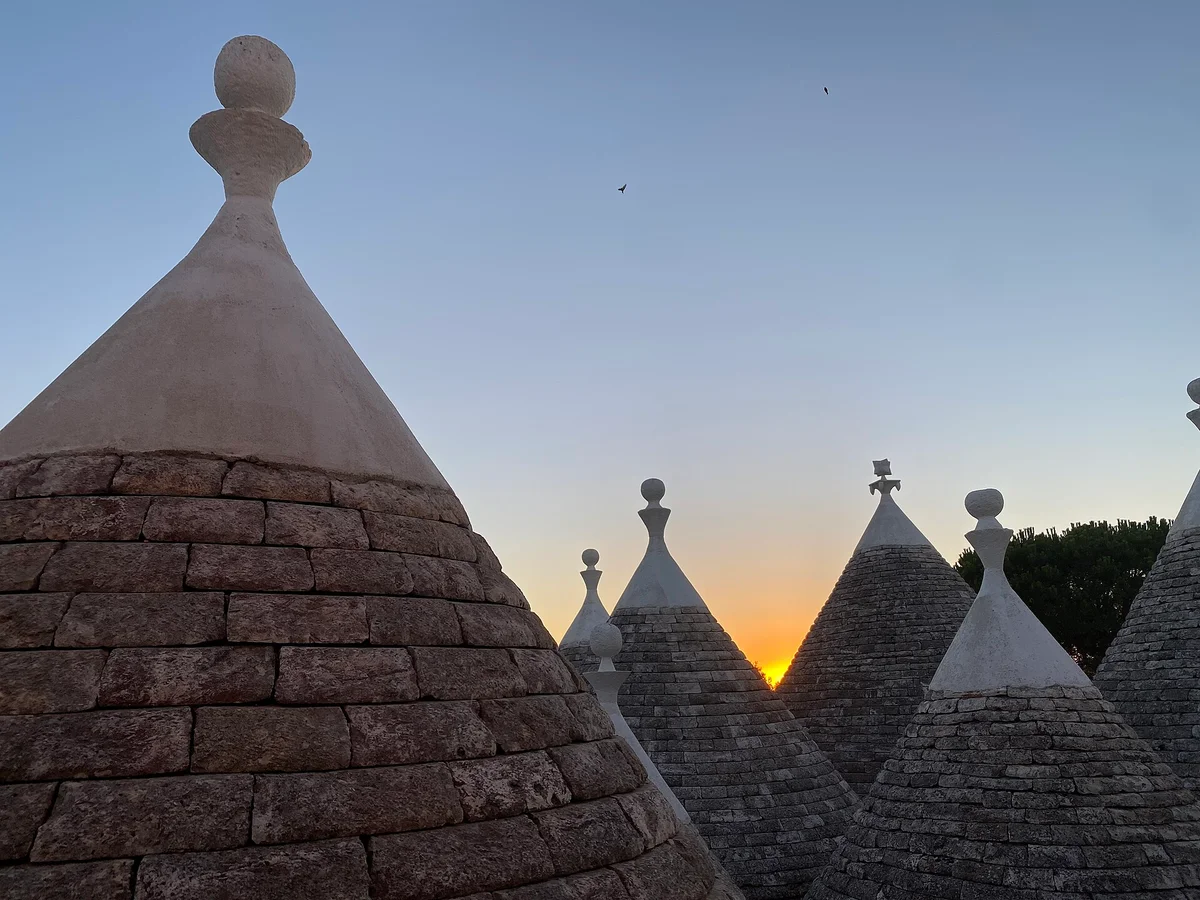
What Is Valle d’Itria Trulli Restoration Stock?
Trulli restoration stock is heritage cone complexes on contrada land: €120,000-350,000 to acquire and from €200,000 to restore, typically 60-80 sqm across two or three cones. Licensed short lets return 5-7% gross. Dutch and British buyers dominate, and Apulia Deluxe runs most of the coordinated heritage programmes.
Apulia Deluxe employs local maestri trullari for chiancarelle roofs and lime mortar work rather than generic contractors, reducing long-term maintenance failures common in poorly restored tourist rentals. Each site carries distinct Soprintendenza approval scope, agricultural land category, and pool feasibility that buyers must verify before compromesso on collapsed cone stock.
What Are the Key Facts for Valle d’Itria Trulli Stock?
Project stock needs a restoration budget from €200,000 on two-to-three-bedroom cone complexes of 60-80 sqm, at €800-1,500 per sqm. Every intervention runs through Soprintendenza coordination, pools are constrained by UNESCO landscape rules, and the timeline from purchase to first booking is 12-24 months.
| Factor | Detail |
|---|---|
| Renovation from | 200,000 EUR plus purchase |
| Trulli purchase (raw/partial) | 120,000 to 350,000 EUR |
| Cost per sqm restored | 800 to 1,500 EUR |
| Typical cone complex size | 60 to 80 sqm |
| Timeline | 12 to 24 months |
| Developer | Apulia Deluxe |
| Compare | Ostuni trulli modern villa |
What Should You Know About Location and Area?
The contrada land links Ostuni, Locorotondo, Cisternino and Martina Franca, with Brindisi airport 30-50 minutes away and Bari 45-75. There is no village walkability here at all: what a buyer gets instead is the UNESCO landscape itself, which is what British and Dutch guests book on €320,000-550,000 of total capital.
Restoration sites distribute across agricultural belts with distinct entry pricing and STR demand profiles. Ostuni corridor commands 120 to 200 EUR nightly peaks while Cisternino and Martina Franca offer lower acquisition basis with smaller STR markets in Puglia comparables.
| Comune | Restoration appeal | Nightly peak band |
|---|---|---|
| Ostuni | Highest STR rates, premium pricing | 150 to 200 EUR |
| Locorotondo | Strong tourism, moderate entry | 130 to 180 EUR |
| Cisternino | Authentic village, lower entry | 110 to 160 EUR |
| Martina Franca | Value entry, smaller STR market | 100 to 150 EUR |
- Brindisi airport at 30 to 50 minutes supports guest arrival on rural contrada stock without centro parking.
- Bari airport at 45 to 75 minutes serves owners flying from northern European renovation oversight schedules.
- Cross-read Valle d’Itria area guide OMI quartiere bands before comune allocation on identical capital.
Each comune offers different per sqm entry bands that buyers should cross-read against Puglia property investment guide before allocation on 320,000 to 550,000 EUR total invested capital targets reviewed with commercialista before first wire transfer.
What Should You Know About Design and Units?
The architecture is dry-stone cone with chiancarelle roofing, and it constrains everything. Collapsed or partial structures run €120,000-350,000 to buy; a standard restoration scope starts around €200,000. Bathrooms and windows have to be worked inside the existing cone volumes, and pool placement is subject to landscape visibility review.
Entry-tier restoration targets buyers accepting 12 to 24 month timelines and 15 to 20 percent cost contingency buffers in exchange for authentic heritage assets at 320,000 to 550,000 EUR total invested capital versus 800,000 EUR masseria flagships. Soprintendenza governs structural interventions unavailable in standard villa construction paths.
What Should You Know About Investment Case?
Licensed short lets on total capital under €450,000 return 5-7% gross, at €120-200 a night in peak season on a two-cone complex. Net settles at 3-5% after IMU and management. Resale on finished stock takes 12-18 months, which is quick for restored heritage property.
| Factor | Benchmark |
|---|---|
| STR gross (total capital under 450k) | 5 to 7 percent |
| Nightly peak (Ostuni corridor) | 120 to 200 EUR |
| Net yield after costs | 3 to 5 percent |
| Management | 20 to 25 percent of gross |
| Restoration contingency | 15 to 20 percent above quote |
| Resale liquidity | 12 to 18 months on restored stock |
| Compare turnkey | Ostuni Domus 470k |
Model six months post-habitability for licensing, photography, and manager onboarding before peak summer revenue. Capital appreciation on well-restored trulli in Ostuni corridor has outperformed generic countryside villas since 2018 due to supply constraints and UNESCO protection limiting new authentic stock.
Transaction stack on 400,000 EUR total invested capital runs 10 to 12 percent including purchase, restoration milestone payments, registration tax, and notary fees. STR launch adds 8,000 to 15,000 EUR for SCIA licensing and professional photography before first guest season on heritage cone stock.
Non-resident buyers rarely finance mid-restoration trulli through Italian banks without habitability and licensed revenue history. Staged milestone payments aligned with Soprintendenza inspection sign-offs protect buyers from paying for incomplete heritage phases on Apulia Deluxe delivery schedules.
Who Is This For?
Three buyers. Heritage collectors who accept 12-24 months of restoration before any income; British and Dutch short-let investors keeping total capital under €400,000; and lifestyle renovators who want hands-on involvement while a specialist manages the Soprintendenza side of it.
- Heritage collector: Authentic UNESCO dry-stone cones with chiancarelle roofs
- Value STR investor: Total capital under 400,000 EUR targeting 5 to 7 percent gross
- Lifestyle renovator: 18-month horizon with developer-coordinated heritage permits
- Puglia portfolio entry: Below 800,000 EUR masseria and trulli-villa flagships
Trulli restoration suits a buyer with restoration appetite and disappoints one without it, so the profiles matter more here than on new-build stock. It fits an owner who wants architecture that exists nowhere else in Europe, entering at €120,000-350,000 and budgeting €800-1,500 per sqm of works on top: a figure that frequently exceeds the purchase price itself. It fits a short-let operator taking a restored cone for 5-7% gross across a season concentrated between May and October, with German and British guests at 65-75% peak occupancy. And it fits a buyer choosing Locorotondo or Cisternino at 20-30% below Ostuni deliberately rather than by budget. It does not fit anyone needing income soon: the structural engineer, the cadastral regularisation and the Soprintendenza clearance all sit ahead of the first booking.
What Should You Know About Pros and Cons?
In favour: an entry tier well below the masseria flagships, and architecture that photographs better than anything else in Puglia, which matters more to short-let revenue than the finish level does. Against: restoration overrun risk, hard Soprintendenza limits on modification, rural utility trenching costs, and a dead winter.
| Factor | Advantage | Trade-off |
|---|---|---|
| Entry tier | Below 800,000 EUR masseria flagships | 12 to 24 month restoration timeline |
| Heritage | UNESCO authenticity lifts STR rates | Soprintendenza limits pool additions |
| Supply | Protection limits new authentic stock | Liquidity thinner than turnkey villas |
| Developer | Apulia Deluxe permit coordination | Requires active oversight on milestones |
| STR photography | Cone architecture commands premium listing imagery | Winter seasonality compresses revenue |
| Compare | 5 to 7 percent gross on under 450k capital | Cost overrun risk on collapsed cones |
Pros
- Entry tier below 800,000 EUR masseria and trulli-villa flagships
- Heritage authenticity supports premium STR photography and nightly rates
- UNESCO protection limits oversupply of authentic trulli stock
- Apulia Deluxe Soprintendenza coordination reduces permit friction
- Valle d’Itria tourism growth supports long-term demand since 2018
Cons
- Restoration timeline and cost overrun risk on heritage stone cones
- Soprintendenza limits modifications and pool additions on many sites
- Rural utility trenching and sewage compliance vary by contrada
- STR seasonality compresses winter revenue below peak assumptions
- Liquidity thinner than new-build turnkey villas on identical capital
- Requires active oversight even with developer coordination
What Should Foreign Buyers Verify Before Reserving?
Six checks before compromesso on €320,000-550,000 of total capital. A structural survey on any collapsed cone; Soprintendenza pre-approval for the intended scope, not a general assurance; a restoration budget with 15-20% contingency; the agricultural land category; pool feasibility under UNESCO landscape rules; and avvocato review.
| Red flag | What to verify |
|---|---|
| Collapsed cone | Structural survey before purchase commitment |
| Soprintendenza scope | Pre-approved bathroom and window intervention catalog |
| Pool feasibility | Landscape permit path during pre-purchase technical review |
| Milestone payments | Deposit releases tied to heritage inspection sign-offs |
| Land category | Agricultural restrictions on annex volumes |
| Developer claims | Independent verification of Apulia Deluxe track record |
- Codice fiscale and notary-led wire path before compromesso on restoration stock
- Structural survey on collapsed or abandoned cone complexes before deposit
- Cross-read heritage restricted property Italy before exterior plans
- Verify Soprintendenza pre-approval scope for planned bathroom and window work
- Confirm pool and external structure feasibility under UNESCO landscape rules
- Review Apulia Deluxe milestone payments and penalty clauses with independent avvocato
- Model STR licensing SCIA path via Italy holiday let licensing guide
- Follow the sequence in our guide for foreign buyers, adding whether the condono or conformità path is actually complete to the pre-caparra file.
Insider tip: Compare total invested capital against Ostuni new villa pool 470k turnkey alternative before accepting 18-month restoration timeline risk on collapsed cone stock.
How Should Restoration Capex Be Sized Here?
Restoration cost, not purchase price, is what decides a Valle d’Itria ticket. Foreign buyers at around €200,000 are typically buying raw or partially restored stone stock where works commonly run €800 to €1,500 per sqm, which usually exceeds whatever the purchase price appeared to save.
| Line | Typical band |
|---|---|
| Restoration | €800-€1,500 per sqm |
| Cadastral regularisation | €3,000-€8,000 |
| Static engineer review | €2,000-€5,000 |
| Licensing to let | CIN registration plus comune approval |
- Size the ticket from the works budget first, then check what is left for the purchase.
- An incomplete condono or conformità path constrains the works programme and the exit together.
- Budget IMU at 0.86% to 1.06% of cadastral value annually on a second home.
Frequently Asked Questions
It is an Apulia Deluxe heritage restoration program for authentic trulli cones across Valle d'Itria contrada land, with renovation budgets from about €200,000 plus purchase price. The product targets buyers wanting entry-tier trulli ownership with developer-coordinated Soprintendenza permits.
Apulia Deluxe markets restoration from about €200,000 for standard trulli renovation plus land and structure purchase, often €120,000-350,000 for raw or partial trulli. Full restoration runs €800-1,500 per square metre depending on condition and finish tier.
Trulli restoration requires Soprintendenza heritage approval for structural changes, landscape permits on agricultural land, and standard SCIA building compliance. Apulia Deluxe coordinates heritage inspections, chiancarelle roof sourcing, and lime mortar specifications as part of restoration delivery.
Yes. EU citizens buy freely, and non-EU buyers complete through the same Italian rogito where reciprocity applies, with a codice fiscale in place and independent legal review of the restoration contract. Restoration contracts need milestone schedules, cost overrun buffers, and heritage modification limits verified before compromesso.
Licensed restored trulli in Ostuni and Locorotondo corridors often achieve €120-200 nightly peak STR with 5-7% gross annual yields on total invested capital under €400,000. Premium photography and heritage authenticity lift occupancy versus generic countryside villas.
The Ostuni masseria pool targets €800k+ luxury pool hospitality. Valle d'Itria trulli restoration offers lower entry with renovation from €200k, suited to buyers accepting restoration timeline risk for heritage asset ownership.
What pairs with this page:
- Valle d’Itria area guide
- Apulia Deluxe developer profile
- Ostuni trulli modern villa project
- how heritage listing limits what you can change
- Puglia property investment guide
- everything between viewing and rogito
Trulli restoration capex is sized from a structural survey rather than a floor area, because the cone is the variable. Budget €800-1,500 per sqm as the working band, and treat that as covering four separate workstreams: stabilising the drystone vaults, which needs a structural engineer rather than a builder; damp management where the structure meets the ground; services installed without compromising the vault; and any external work, which is constrained where the site is visible from protected viewpoints. Add the cadastral position, since many cones predate formal permits and regularisation may be needed before a change of use permits letting. On €120,000-350,000 entry tickets the works frequently exceed the purchase price, which is why the engineer’s assessment belongs before the compromesso rather than after the deposit.
Get an Italy property shortlist
Tell us your budget and region (Tuscany, Lake Como, Puglia, Milan, Sardinia). We reply within one business day with options matched to your goals.